Band 5.5 IELTS Writing Task 1 Model Answer
Overall Band Score: 5.5 · IELTS Complete Catalyst · 2026-11-12
IELTS Writing Task 1 question
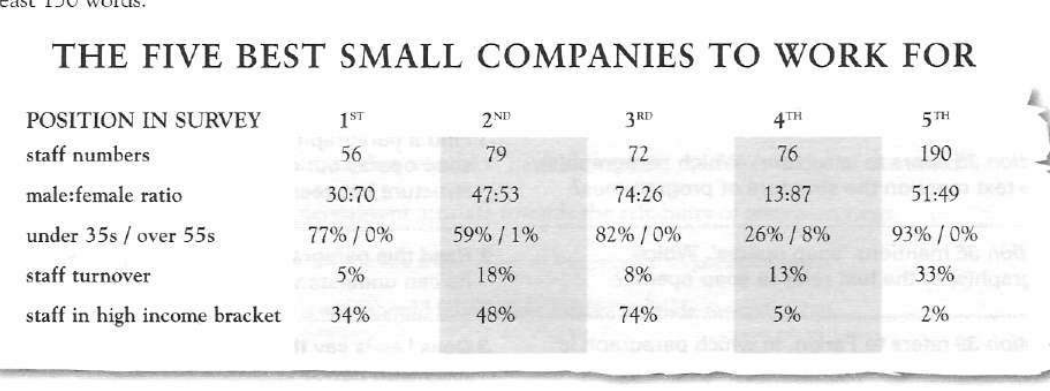
The table below gives information about the five small companies in Britain that came top in a survey of staff conducted by a national newspaper to find out which companies are the best to work for.
Summarise the information by selecting and reporting the main features, and make comparisons where relevant.
THE FIVE BEST SMALL COMPANIES TO WORK FOR
Student answer (Band 5.5)
The table shows the five best small companies to work for in Uk. This survey of staff is conducted by a national newspaper.Overall, five main traits has been disscused in the table. These five companies has been arranged in the table according to their position in survey from first to fifth postion.
The staff numbers in first ranked company is only 56 least from all other companies. While the company on second,third and fourt has slighty variable numbers as 79,72 and 76 accordingly. The company on fifth position has highest numbers of staff nearly 190.The male to female ratio has immense difference in fourth ranked company as 13:87 While the fifth comany has the least difference of ratio which is 51:49. While is rest of the two companies first, and second the ratio of female staff is more expressed as 70 and 53 recpectively. While in third the ratio of female is only 26 in contrast to it the male ratio is 74.
The workforce over 55 is nearly 0 in almost every company except fourth as compare to that the people above 35 is in large number.The staff turnover is highest in fifth at 33% and least in first at 5%.
Overall, third company has 74% of staff in high income bracket.while fifth company has only 2% of the staff in that bracket.
AI examiner evaluation
| Criterion | Band |
|---|---|
| Task Achievement / Task Response | 5.5 |
| Coherence and Cohesion | 5.5 |
| Lexical Resource | 5.5 |
| Grammatical Range and Accuracy | 5.0 |
| Overall | 5.5 |
Task Achievement / Task Response: Band 5.5
You identify the table’s subject and report several relevant comparisons, including staff numbers, gender balance, turnover and high-income employees. The figures for the first and fifth companies’ staff totals and turnover, and the third company’s 74% high-income share, are accurately selected. However, coverage is partial: the overview mainly says the companies are ranked, rather than summarising the strongest patterns, and the age row is misinterpreted. “People above 35” is not what the table reports; it gives the proportions under 35 and over 55. The claim that the fifth company has the “least difference” in gender ratio is also unclear, since its ratio is nearly balanced, not the smallest difference among all companies. A clearer overview and more precise reporting of the age data would strengthen the response.
Coherence and Cohesion: Band 5.5
The response has an identifiable opening, a body that compares several rows, and a concluding observation about high-income staff. This gives the reader some organisation, and comparisons such as the first company’s low turnover against the fifth’s high turnover are easy to locate. However, progression is uneven: the final “Overall” paragraph introduces a detail rather than synthesising the main features, while the opening overview largely repeats that the companies are ranked. Repeated “While” clauses and transitions sometimes make relationships unclear, as in “While is rest of the two companies.” Grouping related comparisons into clearer paragraphs and using linking phrases more selectively would make the information easier to follow.
Lexical Resource: Band 5.5
You use relevant vocabulary for describing the table, including “staff turnover,” “male to female ratio,” “high income bracket,” and “highest” and “least.” These choices allow the reader to understand the main subject and several comparisons. However, the range is limited and some expressions are inaccurate or awkward, such as “five main traits has been disscused,” “slightly variable numbers,” and “the ratio of female staff is more expressed.” Spelling errors, including “disscused,” “postion,” and “recpectively,” are noticeable and reduce precision. Aim for standard data-reporting collocations such as “the proportion of female employees” and “the figures were similar,” and check spelling and word forms carefully.
Grammatical Range and Accuracy: Band 5.0
You attempt both simple statements and longer comparative sentences, for example, “The staff turnover is highest in fifth at 33% and least in first at 5%.” However, control is inconsistent, and errors in agreement, articles and sentence construction occur frequently enough to make some sentences difficult to process. Examples include “five main traits has been disscused,” “These five companies has been arranged,” and “The staff numbers in first ranked company is only 56.” Some clauses are incomplete or poorly connected, as in “While is rest of the two companies first, and second.” Punctuation is also inconsistent, with missing spaces after full stops and unclear sentence boundaries. Practise accurate subject–verb agreement and build comparisons in complete, clearly punctuated sentences.
See this exact question answered at other band scores. The same prompt compared across bands.
Browse more IELTS Writing model answers or get your own writing scored by the same AI examiner.