Band 5.0 IELTS Writing Task 1 Model Answer
Overall Band Score: 5.0 · IELTS Complete Catalyst · 2026-11-13
IELTS Writing Task 1 question
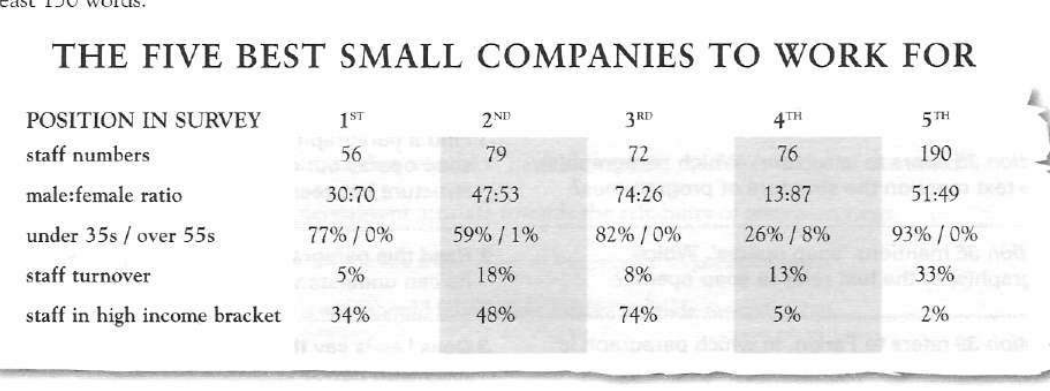
The table below gives information about the five small companies in Britain that came top in a survey of staff conducted by a national newspaper to find out which companies are the best to work for.
Summarise the information by selecting and reporting the main features, and make comparisons where relevant.
THE FIVE BEST SMALL COMPANIES TO WORK FOR
Student answer (Band 5.0)
the table for the five best small companies to work for , overall the fifth companie has the largest workforce 190 staff numberes and the largest stafff turnover , althought the first companies has the smallest worforce and staff turnover. while the first , the third and the fifth companies has the youngest workforce under 35 in contrast the second and the fourth has the lowerest employees under 35 , whereas the employees in high income brakeckt for the third companies has the highest percentage with 74% and the fifth companoes has the lowest percentage with 2% also the fourth is low percentage with 5%, the third and fifth repsented women with lowest number , in contrast represented the men with highset number , the staff turnover was the lowest in the first and the third while the firth has the highest staff turnover with 33% , for the employees over 55 the first , third ,and fifth with zero percentage
AI examiner evaluation
| Criterion | Band |
|---|---|
| Task Achievement / Task Response | 5.5 |
| Coherence and Cohesion | 4.5 |
| Lexical Resource | 5.0 |
| Grammatical Range and Accuracy | 5.0 |
| Overall | 5.0 |
Task Achievement / Task Response: Band 5.5
You identify several relevant comparisons, including the fifth-ranked company’s largest workforce (190) and turnover (33%), and the first-ranked company’s lowest turnover (5%). You also note that the third company has the highest share of high-income staff (74%) and the fifth the lowest (2%). However, some key details are inaccurate or unclear: the first company does not have the smallest workforce (the second has 79, compared with 56 for the first, so the first is smallest—this comparison is correct), but the claim that the first, third and fifth have the youngest workforces is imprecise: the fifth has the highest under-35 share at 93%, while the third has 82% and the first 77%. The gender comparison is also reversed or difficult to interpret: the third has the highest male share, while the fourth has the lowest. A clearer overview and more precise reporting would strengthen coverage.
Coherence and Cohesion: Band 4.5
The response includes a range of relevant data, and linking expressions such as “while,” “in contrast” and “whereas” show an attempt to compare companies. However, the information is presented as one long, largely unpunctuated sequence, so the reader has difficulty following the progression from workforce size to age, income, gender and turnover. Some links are repeated or do not clearly connect the ideas, and the final point about employees over 55 is added without a clear transition. Organise the response into a brief overview followed by grouped comparisons—for example, workforce and turnover, then age, gender and income. Use full stops to separate these groups and ensure each comparison has an explicit subject.
Lexical Resource: Band 5.0
You use some task-relevant vocabulary, including “workforce,” “staff turnover,” “percentage” and “high income,” which helps communicate the main categories. However, the range is limited and several word-choice, spelling and word-form errors make parts difficult to understand, such as “companie,” “stafff,” “brakeckt,” “companoes” and “repsented.” Phrases such as “youngest workforce” and “lowest employees under 35” are also imprecise for describing proportions. Aim for accurate collocations such as “the highest proportion of employees under 35” and “the lowest share of staff in the high-income bracket.” Proofreading spelling and using precise terms for percentages would make the comparisons clearer and more appropriate to an academic report.
Grammatical Range and Accuracy: Band 5.0
You attempt to combine comparisons in longer sentences, using structures such as “while,” “although” and “whereas.” However, these complex sentences are often faulty or incomplete, and the response has little reliable sentence-boundary punctuation. Agreement errors occur in phrases such as “the first companies has” and “the third companies has”; singular company subjects require “has,” while plural subjects require “have.” Articles and plural forms are also inconsistent, as in “the employees over 55” and “the first, third, and fifth with zero percentage.” Build a clearer mix of short, accurate sentences and controlled comparisons, checking subject–verb agreement and ensuring each sentence has a complete clause. Full stops and commas are essential to prevent the current run-on structure.
See this exact question answered at other band scores. The same prompt compared across bands.
Browse more IELTS Writing model answers or get your own writing scored by the same AI examiner.