Band 6.0 IELTS Writing Task 1 Model Answer
Overall Band Score: 6.0 · IELTS Complete Catalyst · 2026-11-13
IELTS Writing Task 1 question
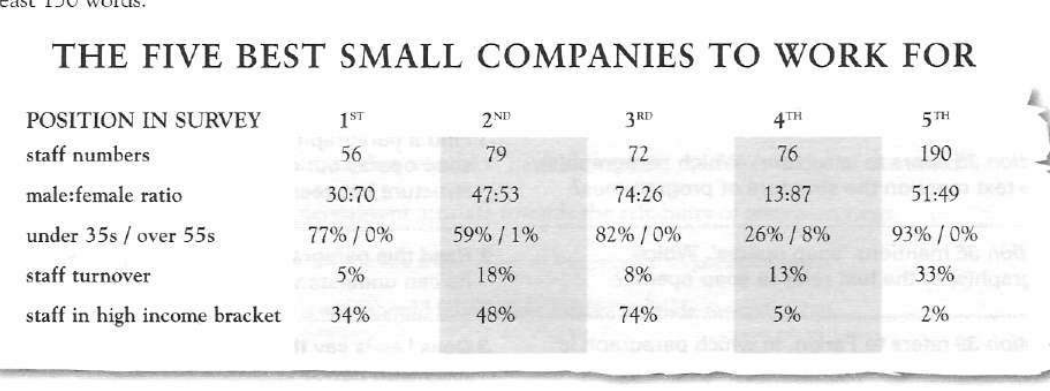
The table below gives information about the five small companies in Britain that came top in a survey of staff conducted by a national newspaper to find out which companies are the best to work for.
Summarise the information by selecting and reporting the main features, and make comparisons where relevant.
THE FIVE BEST SMALL COMPANIES TO WORK FOR
Student answer (Band 6.0)
The table illustrates the results of a survey conducted by a national newspaper in Britain about small companies which are best to work for. It lists the top 5 companies by their position.
It is noticeable that having less number of staffs and a low percentage of staff turnover play a significant role in overall staff satisfaction. On the other hand, having a lot of workers under the age of 35 has a negative impact.
A company with only 56 staffs stood first followed by companies with higher number of employees. The male to female ratio doesn't seem to have a great impact on company position. Males were 30%, 47%, 74%, 13% and 51% of the total employees for the top 5 companies respectively.
The age of the workers also has a little impact on the satisfaction of the staffs. The first three companies have 77%, 59% and 82% employees aged under 35. The staff turnover percentage has a meaningful impact. A company with the lowest (5%) staff turnover percentage was on top while another company with much higher figure (33%) was in the last position. About one-third of the staffs of the top company were on the high income bracket. Whereas the figure is only 2% for the company which standa on last.
AI examiner evaluation
| Criterion | Band |
|---|---|
| Task Achievement / Task Response | 5.5 |
| Coherence and Cohesion | 6.0 |
| Lexical Resource | 6.0 |
| Grammatical Range and Accuracy | 6.0 |
| Overall | 6.0 |
Task Achievement / Task Response: Band 5.5
You identify the table’s subject and report several relevant comparisons, including the first-ranked company’s 56 employees and 5% turnover, and the fifth-ranked company’s 190 employees and 33% turnover. However, the overview makes unsupported claims about what determines satisfaction: the table gives rankings and staff characteristics, but does not establish that smaller workforces or younger staff cause satisfaction. The claim that a high proportion of under-35s has a negative impact is also contradicted by the third-ranked company, where 82% are under 35. Some important information is omitted or only partly covered, such as the high-income figures for the second, third and fourth companies and the age profile of the fifth. A more data-led overview and more balanced selection of comparisons would make the response more complete and precise.
Coherence and Cohesion: Band 6.0
The response has a clear overall arrangement: an introduction, an overview, and paragraphs covering workforce size, gender, age, turnover and income. This makes the information reasonably easy to follow. Linking phrases such as “On the other hand,” “followed by,” and “while” help connect comparisons, although the contrast in the overview is not supported by the figures. Some transitions feel abrupt: the final paragraph moves from turnover to income without clearly signalling the change of feature, and “Whereas” begins a fragment rather than a complete sentence. Grouping related figures more deliberately—for example, age and gender together, then turnover and income—would improve progression and reduce the list-like effect. Overall, the organisation is coherent, though connections between some points are not always smooth.
Lexical Resource: Band 6.0
You use an adequate range of vocabulary for describing the table, including “position,” “percentage,” “ratio,” “followed by,” and “lowest.” These terms generally communicate the comparisons clearly. However, several word choices and collocations are inaccurate or unnatural, such as “less number of staffs,” “a lot of workers,” and “a meaningful impact.” “Staffs” is also not the usual plural form when referring to employees; use “staff” or “employees.” The phrase “stood on last” is unclear, and “standa” appears to be a spelling error. Aim for precise, neutral reporting language rather than claims about impact, which the table cannot demonstrate. More accurate collocations such as “a smaller workforce” and “ranked last” would make the description more natural and appropriate to Academic Task 1.
Grammatical Range and Accuracy: Band 6.0
You use a mix of simple and more complex sentence forms, including the comparison “A company with the lowest … was on top while another company … was in the last position.” Most sentences remain understandable, but some grammatical errors are noticeable. For example, “having less number” needs a different comparative construction, and “The age of the workers also has a little impact” is awkwardly formed. In the final paragraph, “Whereas the figure is only 2%…” is a dependent clause presented as a sentence; it should be joined to the preceding sentence or rewritten as a complete one. There are also issues with articles and number agreement in phrases such as “on the high income bracket.” Greater control of these patterns, while retaining varied sentence structures, would improve accuracy.
See this exact question answered at other band scores. The same prompt compared across bands.
Browse more IELTS Writing model answers or get your own writing scored by the same AI examiner.