Band 5.0 IELTS Writing Task 1 Model Answer
Overall Band Score: 5.0 · IELTS Complete Catalyst · 2026-11-16
IELTS Writing Task 1 question
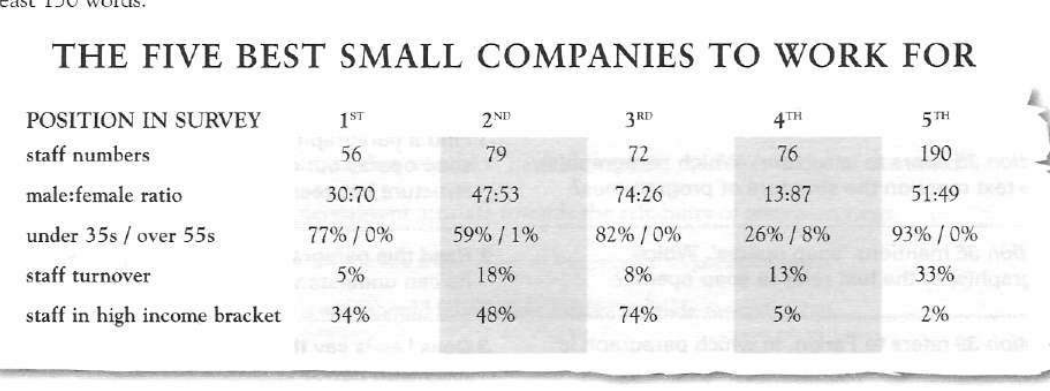
The table below gives information about the five small companies in Britain that came top in a survey of staff conducted by a national newspaper to find out which companies are the best to work for.
Summarise the information by selecting and reporting the main features, and make comparisons where relevant.
THE FIVE BEST SMALL COMPANIES TO WORK FOR
Student answer (Band 5.0)
The supplied table shows the top 5 surveys of staff conducted by a national newspaper to find out which companies are best for work.
As it is clearly recorded an company which represent first position has lowest number of staff like as the first position holder has only 56 staff number where as the fifth one has 190 members. In this record the lowest percentage is having staff in high income bracket which is in fifth position.
Secondly, the first position holder`s male and female ratio is 30:70 where as the other positions had more than it expect only 4th one which 1is 3:87. The individuals under 35s/over 55s have highest percentage in 5th position where as smallest one is having 4th position. The individuals who has turnover are more in 3rd position where as lowest has 1st position.
Subsequently,the staff in high income bracket in 5th position is lowest one at 2% and highest in 3rd position as 74% where as the first position is having 34% of it.
AI examiner evaluation
| Criterion | Band |
|---|---|
| Task Achievement / Task Response | 5.0 |
| Coherence and Cohesion | 4.5 |
| Lexical Resource | 5.0 |
| Grammatical Range and Accuracy | 5.0 |
| Overall | 5.0 |
Task Achievement / Task Response: Band 5.0
You identify several relevant comparisons, including the smallest and largest workforces (56 and 190), the lowest and highest high-income shares (2% and 74%), and the first-ranked company’s gender ratio. However, the response only partially summarises the table: it has no clear overview of the main patterns, and some comparisons are inaccurate or unclear. For example, turnover is highest in fifth place at 33%, not third place; third place has 8%. The statement that other positions had a higher male:female ratio than the first is also misleading, since the ratios vary and fourth place is 13:87. Include a concise overview and select accurate comparisons across the categories. (The length check notes that 13 words were copied from the prompt.)
Coherence and Cohesion: Band 4.5
The response is divided into paragraphs and uses sequencing expressions such as “Secondly” and “Subsequently,” so there is some attempt to organise the information. However, the progression is not consistently logical: the discussion moves between workforce size, income, gender, age and turnover, then returns to income. Linking phrases sometimes suggest a sequence without clarifying how the facts relate, and “where as” is repeated frequently. Some references, such as “the lowest percentage” and “the individuals who has turnover,” are difficult to follow. Group the information into clear comparisons—for example, workforce and demographics, then turnover and income—and use precise references to the ranked companies.
Lexical Resource: Band 5.0
You use some task-relevant vocabulary, including “staff turnover,” “high income bracket,” “percentage” and “position.” This gives the response a minimally adequate range for describing the table. However, several expressions are inaccurate or unnatural, which sometimes makes the intended comparison unclear. For instance, “top 5 surveys of staff” does not accurately describe the five companies, and “individuals who has turnover” is not an appropriate way to report a turnover rate. “Lowest percentage is having staff” is also awkward. Choose standard data-reporting phrases such as “ranked first,” “the proportion of employees,” and “staff turnover was lowest/highest.” Avoid repeating “position holder” when “company” is clearer.
Grammatical Range and Accuracy: Band 5.0
The response attempts longer sentences with comparisons, using structures such as “whereas” and “which,” but these are often faulty, and the range remains limited. Errors in articles, agreement and sentence construction occur throughout. For example, “an company” should be “a company,” “which represent first position” needs a correctly formed clause, and “the individuals who has turnover are more” has incorrect agreement and an unclear structure. The sentence about fourth place also contains a stray “1” and lacks a clear verb. These problems can make comparisons difficult to understand. Practise accurate simple comparison patterns first, then combine them into longer sentences while checking subject–verb agreement and articles.
See this exact question answered at other band scores. The same prompt compared across bands.
Browse more IELTS Writing model answers or get your own writing scored by the same AI examiner.