Band 5.5 IELTS Writing Task 1 Model Answer
Overall Band Score: 5.5 · IELTS Complete Catalyst · 2026-11-16
IELTS Writing Task 1 question
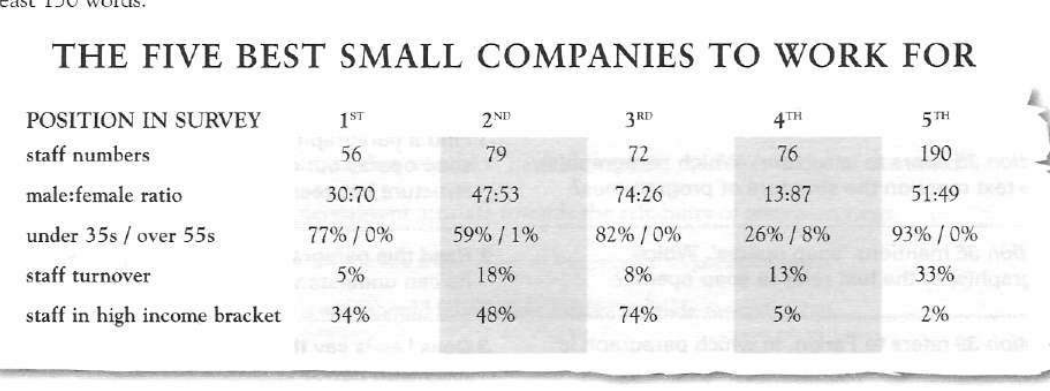
The table below gives information about the five small companies in Britain that came top in a survey of staff conducted by a national newspaper to find out which companies are the best to work for.
Summarise the information by selecting and reporting the main features, and make comparisons where relevant.
THE FIVE BEST SMALL COMPANIES TO WORK FOR
Student answer (Band 5.5)
The table describes the information about five small companies in Britain that came top in a survey to staff conducted by a national newspaper to find out which companies are the best to work for.
Overall, the survey consisted of 5 different positions, namely staff numbers, male:female ratio, under 35s / over 50s, staff turnover, and staff in high income bracket. All the companies had higher staff numbers under 35s and very few proportion are over 55s.
The 5th company had the highest number of staffs that was 190 with almost perfect ratio of male:female that was 51:49. The 2nd company had a closer even ratio of 47:53 but fewer staffs. The 1st company had the lowest number of staffs that was 56 with average proportion of male and female. The biggest disproportion of male:female was in the 4th company with 13:87.
The 5th company accounted for the highest proportion of staffs under 35s that was 93% and staff turnover that was 33%. Nevertheless, the 3rd, 5th and 1st company had no staffs over 55s. The 1st company had the lowest staff turnover percentage of 5% only. However the 5th company accounted for only 2% on the staff in high income bracket position, the lowest on the list. The 3rd company had the highest number of staff in high income bracket of 74%
AI examiner evaluation
| Criterion | Band |
|---|---|
| Task Achievement / Task Response | 5.5 |
| Coherence and Cohesion | 5.5 |
| Lexical Resource | 5.5 |
| Grammatical Range and Accuracy | 5.5 |
| Overall | 5.5 |
Task Achievement / Task Response: Band 5.5
You identify several relevant comparisons, including the largest workforce at the fifth-ranked company (190), the smallest at the first (56), and the highest high-income share at the third (74%). However, the overview is not accurate: the five “positions” are actually the companies’ rankings, while the listed categories are measures. The claim that all companies had more under-35s than older staff is not supported by the table, which gives age percentages but not a direct comparison with all other age groups. You also say the first company had an “average” gender proportion without clarifying that this is not a particularly balanced split. To strengthen the response, give a clear overview of the main contrasts and report the age and income figures more precisely.
Coherence and Cohesion: Band 5.5
The response has a recognisable structure: an introduction, an attempted overview, and two paragraphs comparing company figures. This helps the reader locate the main information. However, progression is weakened because the overview describes the table’s categories as “positions,” and the body moves between workforce size, gender, age, turnover and income without a clear grouping principle. Linking words such as “Nevertheless” and “However” are used, but the relationships they signal are not always logical; for example, the absence of older staff does not contrast clearly with the preceding figures about under-35s and turnover. Group related comparisons together and use references such as “the top-ranked firm” consistently to make the sequence easier to follow.
Lexical Resource: Band 5.5
You use relevant task vocabulary, including “staff turnover,” “male:female ratio,” “proportion,” and “high income bracket,” so the reader can understand the subject of most comparisons. However, several word choices and collocations are noticeably inaccurate or repetitive: “staffs” is used where “staff” or “employees” is needed, “average proportion” is vague, and “accounted for” is awkward when describing a percentage of employees. “Almost perfect ratio” is also an imprecise description of a 51:49 split. Aim for more exact reporting language and vary the repeated use of “company” and “staff.” These improvements would make the comparisons clearer and more natural without requiring unusually advanced vocabulary.
Grammatical Range and Accuracy: Band 5.5
You attempt a mixture of simple statements and longer sentences, and most of the figures remain understandable. However, errors occur frequently enough to make some sentences awkward. For example, “All the companies had higher staff numbers under 35s” lacks a clear grammatical relationship between the workforce and the age group, while “The 5th company had the highest number of staffs that was 190” has problems with number agreement and sentence construction. In “the 3rd, 5th and 1st company had,” the singular noun does not agree with the plural list. Review plural agreement, sentence structure, and the use of relative clauses; shorter, accurately formed comparisons would improve clarity.
See this exact question answered at other band scores. The same prompt compared across bands.
Browse more IELTS Writing model answers or get your own writing scored by the same AI examiner.