Band 5.0 IELTS Writing Task 1 Model Answer
Overall Band Score: 5.0 · IELTS Complete Catalyst · 2026-11-17
IELTS Writing Task 1 question
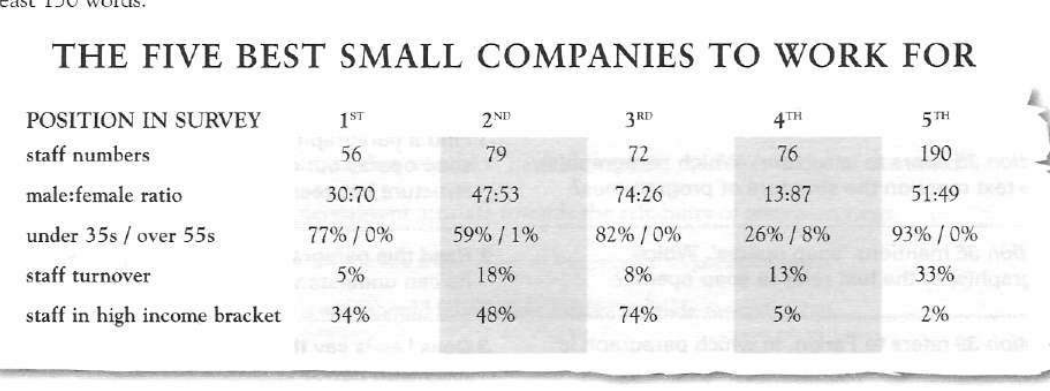
The table below gives information about the five small companies in Britain that came top in a survey of staff conducted by a national newspaper to find out which companies are the best to work for.
Summarise the information by selecting and reporting the main features, and make comparisons where relevant.
THE FIVE BEST SMALL COMPANIES TO WORK FOR
Student answer (Band 5.0)
The chart illustrates the information about the five small companies in britian that came top on a survey of staff conducted by a national newspapepr to find put the companies are the best to work. the chart showed five companies. these companies are showing the differnet number and difference by possition in survey to a work.
Overall, the chart showed the fove small companies to work for posstion in survey and the difference by five companies. the fiveth company staff member is proption in 190. the lowest third company is the 72. The chart showed under 35 / over 55 is the highest is fiveth company in the 93% / 0%. the lowest compant is fourth i n 26%/ 8%.
looking at the details, the chart showed the staff numbera is the first company is the highest in fiveth company is the nubmer of 190. the lowest company is first in the nubmer of 56. the male:female ratio proption is the third company in the 74:26. the lowest ratio is the fourth company in the 13:87.
In term of age, the chart showed the staff turnover is the highest fiveth company in the 33%. the lowest company is first in the 5%. the staff in high income bracket is the hight in third compani in the 74%. the lowest compa ny is fiveth in the 2%.
AI examiner evaluation
| Criterion | Band |
|---|---|
| Task Achievement / Task Response | 5.5 |
| Coherence and Cohesion | 5.0 |
| Lexical Resource | 4.5 |
| Grammatical Range and Accuracy | 4.5 |
| Overall | 5.0 |
Task Achievement / Task Response: Band 5.5
You identify several relevant extremes, including the fifth-ranked company’s largest workforce (190), the first-ranked company’s smallest workforce (56), the third company’s highest high-income share (74%), and the fifth company’s highest turnover (33%). These details show an attempt to select and compare information from the table. However, the overview is repetitive and does not clearly summarise the main pattern across the companies. Some comparisons are inaccurate or unclear: the fifth company has the highest proportion of under-35s (93%), but the lowest is the fourth company at 26%; describing the third company as “the lowest” at 72 staff is misleading, since the first has 56. Several important contrasts, such as the differing gender balances, are only partly reported. A clearer overview and more precise comparisons would strengthen the response.
Coherence and Cohesion: Band 5.0
The response has separate introductory, overview and detail paragraphs, and it groups some information by topic, such as workforce size and age. This gives the reader a basic structure. However, progression is limited because the introduction and overview repeat the same general point about the five companies, while the details are presented as a series of isolated highest/lowest statements. Linking phrases such as “looking at the details” and “In term of age” are used, but the latter introduces turnover and income rather than age, making the organisation confusing. Some references, including “the lowest company,” are also unclear. Organise the body into meaningful comparisons—for example, workforce and gender, then age, turnover and income—and use accurate transitions.
Lexical Resource: Band 4.5
You use some task-relevant terms, including “staff turnover,” “male:female ratio,” “high income bracket,” and “proportion,” so the topic is generally recognisable. However, vocabulary is limited and repeated, especially “the chart showed,” “company,” “highest,” and “lowest.” Frequent spelling errors such as “britian,” “posstion,” “differnet,” and “compani” reduce clarity, while phrases such as “came top on a survey” and “the staff numbera” are not natural or precise. Some word choices also obscure the intended comparison, as in “the lowest third company.” Build a more accurate range of reporting verbs and comparison language, and check spelling and collocations carefully.
Grammatical Range and Accuracy: Band 4.5
Most sentences follow a simple subject–verb pattern, and you attempt a few longer constructions, but these are often difficult to follow. For example, “the chart showed the staff numbera is the first company is the highest in fiveth company” combines clauses without a clear grammatical relationship. There are recurring problems with articles, agreement, and sentence structure, as in “the five small companies to work for position in survey” and “the staff turnover is the highest fiveth company.” Punctuation and capitalisation are also inconsistent, including the lowercase opening “the chart” and run-on phrasing. Practise writing short, complete comparison sentences first, then combine them with accurate clauses such as “whereas” or “while.”
See this exact question answered at other band scores. The same prompt compared across bands.
Browse more IELTS Writing model answers or get your own writing scored by the same AI examiner.