Band 5.5 IELTS Writing Task 1 Model Answer
Overall Band Score: 5.5 · IELTS Complete Catalyst · 2026-11-17
IELTS Writing Task 1 question
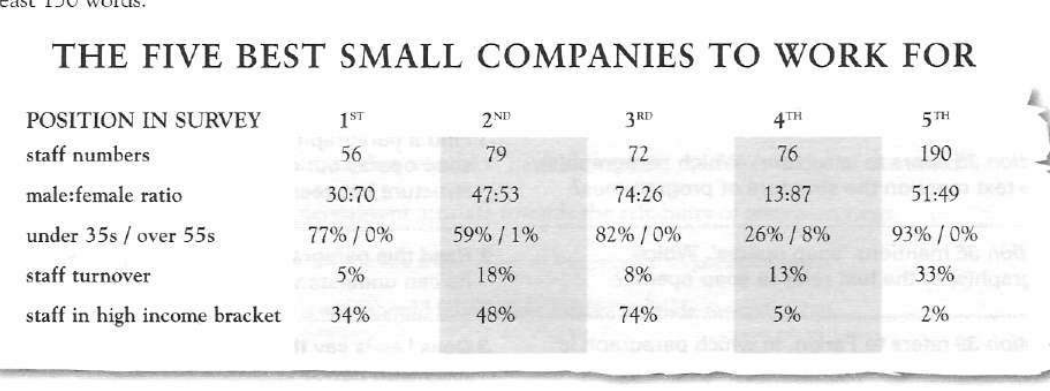
The table below gives information about the five small companies in Britain that came top in a survey of staff conducted by a national newspaper to find out which companies are the best to work for.
Summarise the information by selecting and reporting the main features, and make comparisons where relevant.
THE FIVE BEST SMALL COMPANIES TO WORK FOR
Student answer (Band 5.5)
The table reveals the information of a survey where five small companies came top.At a glance,it clear that there are five categories of informaton about the companies.
Overall,it is evident that most of the companies does not have any employee whose age is 55 or above.
Upon closer inspection,we can see that the company that came first have the least amount of staff compared to the company that came 5th which is the highest in this category.Another interesting fact is that, maximum companies have more female emplyees including the company that came first compared to others .Across the five companies the 2nd and the 4th company only has employees over 55 age.The staff turnover of the company that placed 5th is the highest among others.The company that came third have 74% of their employee whose income is in the high bracket compared to the company that came 5th,only 2%.
AI examiner evaluation
| Criterion | Band |
|---|---|
| Task Achievement / Task Response | 5.5 |
| Coherence and Cohesion | 5.5 |
| Lexical Resource | 5.5 |
| Grammatical Range and Accuracy | 5.5 |
| Overall | 5.5 |
Task Achievement / Task Response: Band 5.5
You identify several relevant features, including the smallest workforce in the first-ranked company, the largest in the fifth, the fifth company’s highest turnover, and the contrast in high-income staff between the third and fifth companies. However, the overview is vague: saying most companies have no staff aged 55 or above overlooks that the second has 1% and the fourth has 8%. The claim that the second and fourth companies “only” have employees over 55 is inaccurate; the figures refer to the proportions over 55, not an exclusive age group. The response also omits useful comparisons, such as the third company’s 74% male workforce and the fourth’s 87% female workforce. It is one word below the required minimum. Develop a clearer overview and report the age and gender data precisely.
Coherence and Cohesion: Band 5.5
The response has a basic progression from an introduction and overview to selected comparisons, and phrases such as “Overall” and “Upon closer inspection” help signal movement between points. However, the ideas are compressed into one long body paragraph, so the reader does not see a clear separation between the overview and supporting details. Several comparisons are placed together without a strong organising principle, and “Another interesting fact” is a general transition rather than a precise link. The sequence could be clearer by grouping workforce size and age first, then gender, turnover and income. Use separate paragraphs for the overview and details, and make links between comparisons more explicit.
Lexical Resource: Band 5.5
You use some task-relevant vocabulary, including “staff turnover,” “high income bracket,” and “compared to,” which allows the main subject to be understood. However, the range is limited and some expressions are imprecise or unnatural, such as “reveals the information of a survey,” “least amount of staff,” and “employees over 55 age.” There are also noticeable spelling errors, including “informaton” and “emplyees,” which reduce accuracy. Repeated use of “company that came” also makes the description less varied. Aim for concise, conventional report language and accurate forms such as “ranked first,” “workforce,” and “employees aged over 55.”
Grammatical Range and Accuracy: Band 5.5
You attempt both simple statements and longer sentences with clauses, for example the comparison beginning “The company that came third…”. However, errors in sentence structure, agreement and punctuation are frequent enough to make the writing less controlled. Examples include “it clear” instead of “it is clear,” “most of the companies does not” instead of “do not,” and “the company that came first have” instead of “has.” The sentence about the second and fourth companies also has an unclear grammatical relationship between “only” and “employees over 55 age.” Missing spaces after full stops and commas further affect readability. Practise accurate subject–verb agreement and build shorter, complete sentences before adding complex clauses.
See this exact question answered at other band scores. The same prompt compared across bands.
Browse more IELTS Writing model answers or get your own writing scored by the same AI examiner.