Band 5.0 IELTS Writing Task 1 Model Answer
Overall Band Score: 5.0 · IELTS Complete Catalyst · 2026-11-18
IELTS Writing Task 1 question
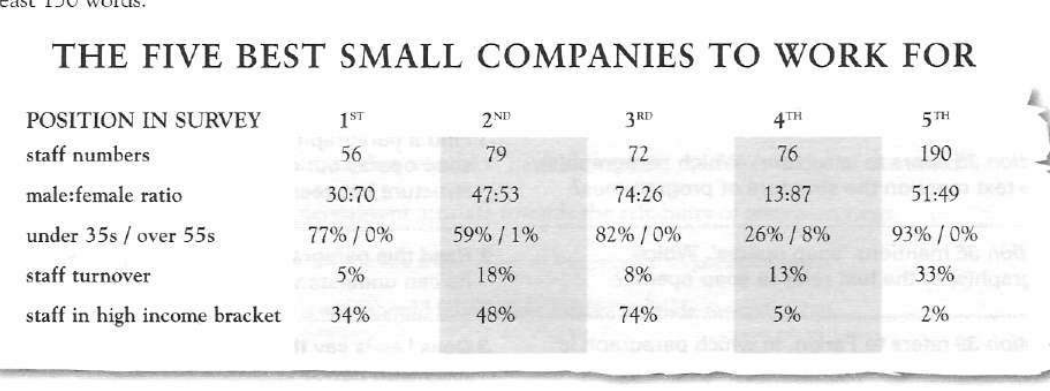
The table below gives information about the five small companies in Britain that came top in a survey of staff conducted by a national newspaper to find out which companies are the best to work for.
Summarise the information by selecting and reporting the main features, and make comparisons where relevant.
THE FIVE BEST SMALL COMPANIES TO WORK FOR
Student answer (Band 5.0)
The table gives a comparison about five best small companies to work in position of survey made by national newspaper in Britain.
Overall, it shows that the highest positions are the first runner up among others. The 2nd to 5th have differences in data figures, it has fluctuations every positions.
In detail, age under 35s and over 55s are the highest proportion at 93% in the 5th line, 82% in a third row and a third quarter at the first line. The greatest number of workers are in 5th, which is 190. In addition of the survey, most of the womens are in the best companies than men. The staff turnover have 33% which is a third in 5th, followed by 18% in 2nd, 13% in 4th and slightly difference in 1st and 3rd which is 5 to 8%. The data has different feedback that turns to have a fluctuation trend
AI examiner evaluation
| Criterion | Band |
|---|---|
| Task Achievement / Task Response | 4.5 |
| Coherence and Cohesion | 4.5 |
| Lexical Resource | 5.0 |
| Grammatical Range and Accuracy | 5.0 |
| Overall | 5.0 |
Task Achievement / Task Response: Band 4.5
You identify the table’s subject and report several relevant figures, including the largest workforce (190 in fifth place) and turnover rates. However, the overview is unclear and does not summarise the main patterns: “the highest positions are the first runner up” is difficult to interpret, and saying the figures fluctuate does not explain the key contrasts. Some details are inaccurate or confusing: 93% under 35 applies to fifth place, but the age figures are described as “a third quarter” and “a third row”; moreover, the claim that most companies have more women than men is not true for third place. Important comparisons, especially the high-income figures, are omitted. Select a few accurate contrasts and state the overall patterns clearly.
Coherence and Cohesion: Band 4.5
The response has an introduction, an attempted overview and a detail paragraph, so there is some basic organisation. However, the progression is difficult to follow because the overview does not establish a clear summary, and the detail paragraph moves between age, staff numbers, gender and turnover without a consistent grouping. Phrases such as “In addition of the survey” and “The data has different feedback” do not clearly connect ideas, while “followed by” is used to list turnover figures without explaining the comparison. Organise the body around related features—for example, workforce profile and then turnover/income—and use clear references to the survey positions so readers can follow each comparison.
Lexical Resource: Band 5.0
You use some relevant task vocabulary, including “proportion,” “staff turnover,” “workers” and “survey,” and the reader can generally identify the topic. However, the range is limited and several word choices or collocations are inaccurate or unclear, such as “comparison about,” “best small companies to work in position,” “first runner up,” and “different feedback.” Repetition of “data,” “figures” and “positions” also makes the description less precise. Use standard table-reporting language and choose terms that describe the information directly, such as “ranked,” “workforce,” “percentage” and “income bracket.” Check that each phrase accurately expresses the intended comparison.
Grammatical Range and Accuracy: Band 5.0
You attempt both simple and longer sentence forms, and some basic clauses communicate information, for example, “The greatest number of workers are in 5th, which is 190.” However, errors in sentence structure and agreement occur often enough to make several statements difficult to interpret. Examples include “The staff turnover have 33%,” where the subject and verb do not agree, and “The 2nd to 5th have differences in data figures,” which lacks a clear grammatical structure. The sentence beginning “In detail” also combines several figures without clear sentence boundaries or relationships. Practise forming complete comparison sentences with a clear subject and verb, and check articles, agreement and punctuation when joining clauses.
See this exact question answered at other band scores. The same prompt compared across bands.
Browse more IELTS Writing model answers or get your own writing scored by the same AI examiner.