Band 5.5 IELTS Writing Task 1 Model Answer
Overall Band Score: 5.5 · IELTS Complete Catalyst · 2026-11-19
IELTS Writing Task 1 question
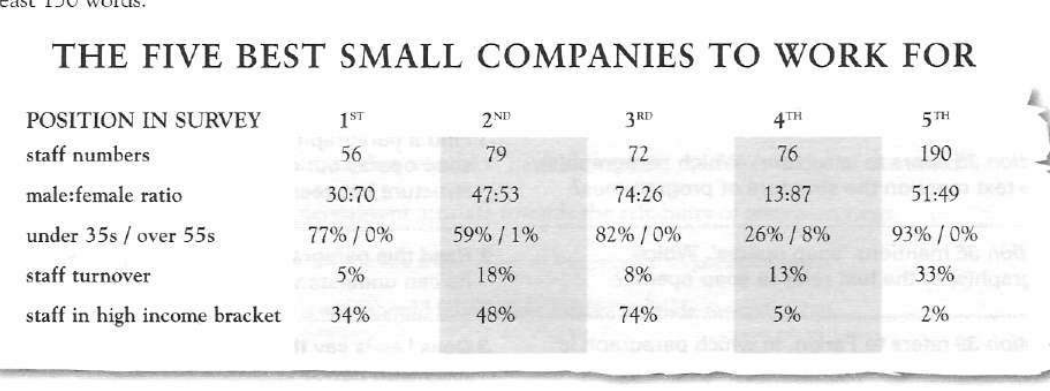
The table below gives information about the five small companies in Britain that came top in a survey of staff conducted by a national newspaper to find out which companies are the best to work for.
Summarise the information by selecting and reporting the main features, and make comparisons where relevant.
THE FIVE BEST SMALL COMPANIES TO WORK FOR
Student answer (Band 5.5)
The chart illustrates data about the five small companies based in UK that came top in a survey of staff conducted by a national newspaper to find out which companies are better to work.
Overall, 5th company have most number of workers and there 93% of staff is under 35s. However 3rd company secure first rank in terms of giving high salaries to there employes.
Firstly, 5th company have most number of staff followed by 2nd, 3rd and 4th, they almost have equal amount of staff 79,72 and 76 while 1st company have the mosy less number of staff. secondly, 2nd and 5th company is very balance in gender ratio while 3rd have more number of males and on the other hand 1 and 4th company hired more female workers.
Thirdly, 5th company have most number of people who are under 35s while 3rd company have 82% followed by 77% and 59% by 1 and 2nd. in constrast, 4th company is only who hired over 55s staff.
finally, 5th company have 33% of staff turnover, 2nd and 4th have 18,13% followed by less turnover of 1st and 3rd 5% to 8% respectively. 3rs company have hightest number of income bracket, mid tier are 1st and 2n 34% and 48% and 4 and 5th are with least income bracket of 5% and 2%
AI examiner evaluation
| Criterion | Band |
|---|---|
| Task Achievement / Task Response | 6.5 |
| Coherence and Cohesion | 6.0 |
| Lexical Resource | 5.0 |
| Grammatical Range and Accuracy | 5.0 |
| Overall | 5.5 |
Task Achievement / Task Response: Band 6.5
You cover the main categories in the table and give a clear overview: the fifth-ranked company has the largest workforce and the youngest profile, while the third has the highest share of high earners. Most figures are reported accurately, including the staff totals, gender patterns, turnover and income percentages. This strong coverage meets the task well and shows some selection of key comparisons. However, the overview could identify the contrast between the fifth company’s high turnover and low high-income share, and the third company’s high-income share more explicitly. The statement that the fifth company has the most staff under 35 is accurate, but the comparison of older staff is imprecise: the fourth company is the only one with a notable over-55 share, at 8%, while the second has 1%. More precise synthesis would strengthen the response.
Coherence and Cohesion: Band 6.0
The response has a recognisable structure, moving from an overview to comparisons of workforce size and gender, age, turnover and income. Sequencing words such as “Firstly,” “Thirdly” and “finally” help readers follow the categories, and the information is generally grouped logically. However, these transitions feel mechanical, and some sentences combine several comparisons without clear punctuation or a precise link between them. For example, the sentence beginning “Firstly, 5th company…” runs through staff numbers and rankings in one long sequence, while the final sentence shifts from income rankings to “mid tier” without a clear explanation. Use shorter, better-punctuated comparisons and vary linking methods so the progression feels smoother and references such as “they” are unambiguous.
Lexical Resource: Band 5.0
You use enough topic vocabulary to communicate the main comparisons, including “staff turnover,” “gender ratio,” “under 35s” and “income bracket.” Some choices are appropriate but repeated or imprecise, particularly “company have” constructions aside, the repeated use of “most” and “number of.” Several collocations and word forms are noticeably inaccurate: “better to work,” “giving high salaries,” “very balance in gender ratio,” and “hightest number of income bracket.” These choices sometimes make the intended meaning less natural or less clear. Aim for concise, standard report language such as “ranked highest,” “had the largest workforce,” and “the highest proportion of employees in the high-income bracket.” Check spelling and use precise terms for proportions and rankings.
Grammatical Range and Accuracy: Band 5.0
You attempt both simple and more extended sentences, and the overall meaning is usually recoverable. However, control of basic sentence patterns is inconsistent, with repeated subject–verb agreement and article errors: “5th company have,” “3rd company secure,” and “1st company have.” Plural and possessive forms also need attention, as in “there 93% of staff” and “2nd and 5th company is.” Some long sentences join several clauses with commas, making relationships between ideas difficult to follow; the sentence comparing staff numbers is one example. Use a consistent past tense for the survey findings, add articles where needed (“the fifth company”), and separate comparisons into complete sentences. More accurate control of these patterns would make your range easier to recognise.
See this exact question answered at other band scores. The same prompt compared across bands.
Browse more IELTS Writing model answers or get your own writing scored by the same AI examiner.