Band 5.0 IELTS Writing Task 1 Model Answer
Overall Band Score: 5.0 · IELTS Complete Catalyst · 2026-11-20
IELTS Writing Task 1 question
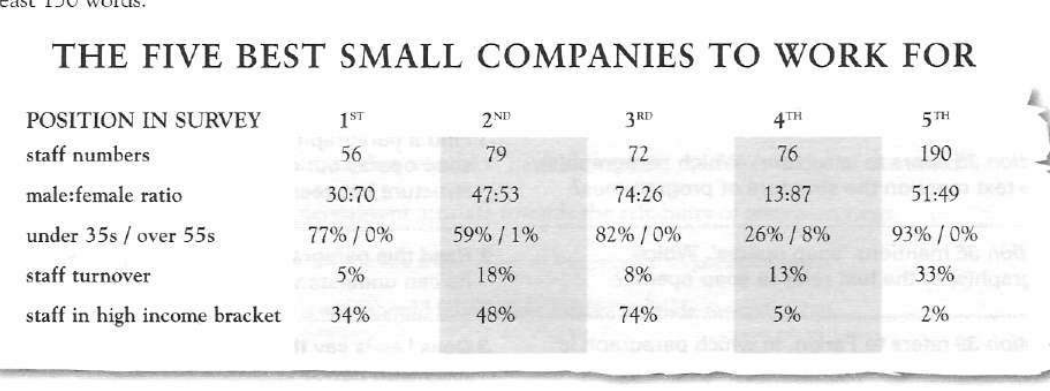
The table below gives information about the five small companies in Britain that came top in a survey of staff conducted by a national newspaper to find out which companies are the best to work for.
Summarise the information by selecting and reporting the main features, and make comparisons where relevant.
THE FIVE BEST SMALL COMPANIES TO WORK FOR
Student answer (Band 5.0)
The given chart illustrate proportion about the five different work for small companies in britain.That came top in a analysis of employees by a national newspaper to discover out which organization are the best to work for.
To uplift my notion five different position in survey Fristly, the staff numbers 56 in first time analysis.In second time posotion in survey staff numbers was 79.Along with that in third time staff numbers was 72.Position in survey fourth time it was 76.Following to that in fifth time it was 190.On the other analysis male:female ratio in first time 30:70.Position in survey second time male:female ratio was 47:53.In third time it was 74:26.Moreover in fourth time it was 13:87.Along with that in fifth time it was 51:49.
On the the third type of analysis position in survey on under 35s/ over 55s in frist time 77%/0%.Along with that in second time it was 59%/0%.Following to that in third time the ratio was 82%/0%.Moreover in fourth time it was 26%/8%.Lastly, fifth time the percentage was 93%/0%.
on the second last survey staff turnover in first time the ratio was 5%.Second time it was 18%.Along with that in third time it was 8%.fourth time it was 13%.Following to that in fifth time the ratio was 33%.Now coming on the last analysis in staff in high incime bracket first time the percentage was 34%.Second time it was 48%.Along with that in third time the ratio was 74%.Following to that in fourth time it was 5%.Lastly, the ratio in fifth time it was 2%.
Overall, the top-ranked companies generally have smaller workforces, lower staff turnover, and a much higher proportion of employees in high income bracket to comapire fifth ranked company.
AI examiner evaluation
| Criterion | Band |
|---|---|
| Task Achievement / Task Response | 5.0 |
| Coherence and Cohesion | 5.5 |
| Lexical Resource | 5.0 |
| Grammatical Range and Accuracy | 4.5 |
| Overall | 5.0 |
Task Achievement / Task Response: Band 5.0
You report figures from all five rows, including workforce size, gender balance, age groups, turnover and high-income staff, and most values match the table. The final overview also identifies a genuine contrast: the fifth-ranked company has the largest workforce and highest turnover, while its high-income share is low. However, the response is mainly a sequence of figures rather than a summary of the main features. The overview appears only at the end and overgeneralises that top-ranked companies have lower turnover: the second-ranked company’s turnover is 18%, higher than the fourth-ranked company’s 13%. Highlighting the first-ranked company’s lowest turnover and the third-ranked company’s highest high-income share would make the key comparisons clearer.
Coherence and Cohesion: Band 5.5
The response has an opening, several body sections and a concluding overview, so the reader can identify its broad structure. It also groups some related information, such as workforce and gender figures before age and employment statistics. However, progression is weakened by presenting nearly every value in rank order without explaining which comparisons matter. Connectors such as “Along with that,” “Following to that” and “Moreover” recur mechanically, and phrases like “first time analysis” make the sequence difficult to follow. The overview would work better near the beginning, followed by paragraphs organised around notable contrasts—for example, workforce and age profiles, then turnover and income—rather than listing every company in turn.
Lexical Resource: Band 5.0
You use relevant topic vocabulary, including “staff numbers,” “male:female ratio,” “staff turnover” and “high income bracket,” which helps communicate the table’s categories. However, the range is limited and several expressions are inaccurate or unnatural, sometimes making the meaning harder to follow. “To uplift my notion” does not introduce a clear summary, while “first time” and “second time” are unsuitable for describing survey rankings. There are also spelling errors such as “posotion,” “incime” and “comapire.” Use precise terms such as “ranked first,” “workforce,” and “proportion,” and vary reporting language with verbs like “accounted for” or “stood at.”
Grammatical Range and Accuracy: Band 4.5
Most of the response uses short, simple reporting patterns, and the figures are generally understandable despite grammatical problems. There is little accurate variety in sentence structure, and errors occur frequently in clauses, articles, agreement and punctuation. For example, “The given chart illustrate proportion” has subject–verb and article problems, while “That came top in a analysis” is an incomplete and incorrectly formed sentence. Many entries are fragments, such as “In third time it was 74:26,” and sentence boundaries are often missing after percentages. Practise complete sentences with a clear subject and verb, for example, “The first-ranked company employed 56 people, of whom 70% were women.” Check articles, verb agreement and full stops.
See this exact question answered at other band scores. The same prompt compared across bands.
Browse more IELTS Writing model answers or get your own writing scored by the same AI examiner.