Band 6.0 IELTS Writing Task 1 Model Answer
Overall Band Score: 6.0 · IELTS Complete Catalyst · 2026-11-21
IELTS Writing Task 1 question
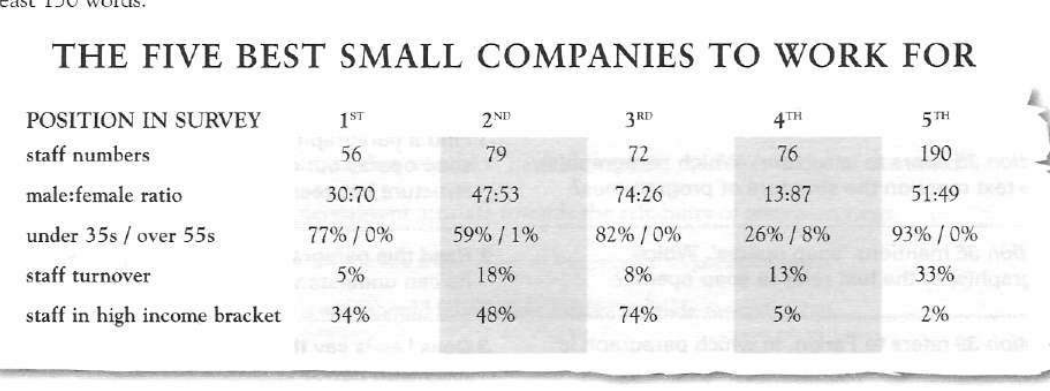
The table below gives information about the five small companies in Britain that came top in a survey of staff conducted by a national newspaper to find out which companies are the best to work for.
Summarise the information by selecting and reporting the main features, and make comparisons where relevant.
THE FIVE BEST SMALL COMPANIES TO WORK FOR
Student answer (Band 6.0)
The table compares the five small companies in Britain to work for, as ranked in a newspaper survey, in terms of staff numbers, gender balance, age, turnover and income.
Overall, four of the companies employed between 56 and 79 people, while the fifth was far larger. The top two ranked companies also tends to lose fewer staff, and young employees dominated at most companies.
The fifth placed company has by far the larger workforce, with 190 staff, compared with 56 at the top ranked company and 72 to 79 at the others, Gender balance varied widely. The first and fourth companies were mainly female where the third was mostly male. The second and fifth were close to equal.
Under 35s made up to 93% of the fifth company's staff and 82% of third's. The fourth was the exception with only 26% under 35% and 8% over 55. At the other four no more that one 1% of the staff was above 55. With turnover was the lowest at the first company(5%) and highest at the fifth(33%).
AI examiner evaluation
| Criterion | Band |
|---|---|
| Task Achievement / Task Response | 5.5 |
| Coherence and Cohesion | 6.0 |
| Lexical Resource | 6.5 |
| Grammatical Range and Accuracy | 5.5 |
| Overall | 6.0 |
Task Achievement / Task Response: Band 5.5
You identify the table’s subject and cover several relevant features, including workforce size, gender, age and turnover. The overview also notes that the fifth-ranked company is much larger and that younger staff predominate in most firms. However, some comparisons are inaccurate or incomplete: the first two companies do not both have low turnover (the second is 18%, compared with 5% for the first), and the overview omits the striking contrast in high-income staff, from 74% in third place to 2% in fifth. The statement that the fourth company has “only 26% under 35%” also misstates the age figure; it is 26% under 35, with 8% over 55. Select the most significant contrasts and report them precisely.
Coherence and Cohesion: Band 6.0
The response has a clear overall structure: an introduction, an overview, and two paragraphs presenting details. The information generally progresses from workforce size and gender to age and turnover, so the reader can follow the main comparisons. However, some links between ideas are awkward or unclear. For example, “The first and fourth companies were mainly female where the third was mostly male” uses “where” imprecisely, and the final paragraph begins “With turnover,” which does not connect grammatically to the preceding age information. The overview’s reference to the top two companies also creates a confusing transition because their turnover figures differ substantially. Use clearer comparison signals and ensure each paragraph moves logically between related data.
Lexical Resource: Band 6.5
You use a suitable range of task-related vocabulary, including “ranked,” “gender balance,” “dominated,” “workforce” and “staff turnover.” These choices make the response concise and generally clear, and “far larger” effectively highlights the fifth company’s size. Some phrasing is less precise or natural for describing table data: “companies in Britain to work for” is awkward, “lose fewer staff” is informal, and “made up to 93%” does not clearly express that the figure reached 93%. The phrase “the top ranked company” could also be expressed more precisely as “the company ranked first.” Greater control of collocations and more exact language for proportions would add the flexibility and precision needed for a stronger performance.
Grammatical Range and Accuracy: Band 5.5
You attempt a mix of simple and more complex sentences, and most of the information remains understandable. However, several grammatical errors affect accuracy. In the overview, “the top two ranked companies also tends” has a subject–verb agreement error; use “companies tend.” The sentence “The first and fourth companies were mainly female where the third was mostly male” needs a clearer grammatical link, such as “whereas.” There are also errors in “the fourth was the exception with only 26% under 35%,” “no more that one 1%,” and “With turnover was the lowest.” Punctuation is sometimes faulty, including the comma splice after “the others” and the missing space before “(5%).” Check agreement, sentence connections and punctuation when revising.
See this exact question answered at other band scores. The same prompt compared across bands.
Browse more IELTS Writing model answers or get your own writing scored by the same AI examiner.