Band 5.0 IELTS Writing Task 1 Model Answer
Overall Band Score: 5.0 · IELTS Complete Catalyst · 2026-11-22
IELTS Writing Task 1 question
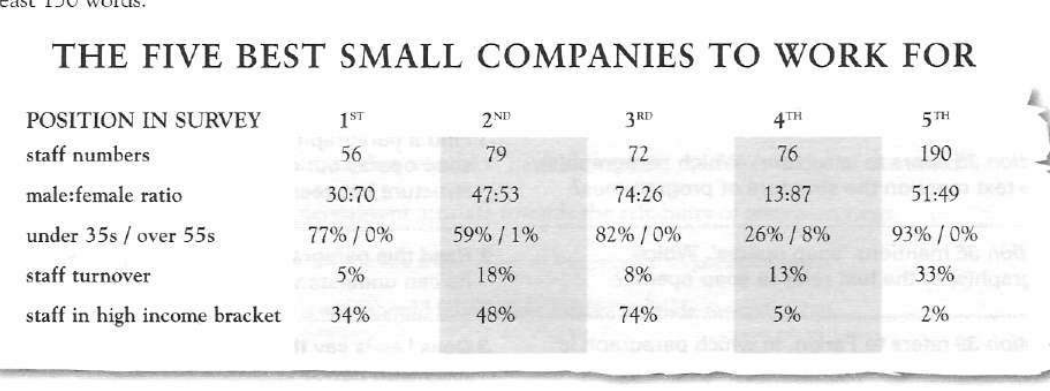
The table below gives information about the five small companies in Britain that came top in a survey of staff conducted by a national newspaper to find out which companies are the best to work for.
Summarise the information by selecting and reporting the main features, and make comparisons where relevant.
THE FIVE BEST SMALL COMPANIES TO WORK FOR
Student answer (Band 5.0)
The table gives information regarding the five small companies in Britian. It tells about a survey that was conducted by a national newspaper from staff. The survey find out which companies are best to work for. The infomation captured in this survey inludes staff numbers, male:female ratio , staff turnover. It also inlcudes number of people under 35s and ovr 50s, alon with this it also covered staff in high income bracket.
This survey tells us that the company which is ranked 1st has less staff numbers than other. Moreover, the ratio of female is more than male and noone is over 55s. The staff tunover ratio is pretty less and the survey also shows that the company who got first rank , 34 percent of saff are in high income bracket. This survey tells us that where staff numbers is less there is more chances of growth, people get decent amount of salary as comany can pay them decent amount because of less staff nubers.The compnaies who get ranked 2nd and 3rd, the survey shows that there are greater number of staff that are in high inome bracket but there staff turnover rate is also high.
At the end, the best company to work for is whose staff numbers and staff turnover is less
AI examiner evaluation
| Criterion | Band |
|---|---|
| Task Achievement / Task Response | 5.0 |
| Coherence and Cohesion | 5.5 |
| Lexical Resource | 5.0 |
| Grammatical Range and Accuracy | 5.0 |
| Overall | 5.0 |
Task Achievement / Task Response: Band 5.0
You identify the table’s subject and mention several relevant categories, including staff numbers, gender balance, turnover and high-income employees. You also make a few accurate observations about the first-ranked company, such as its 56 employees, female majority, zero over-55s and 5% turnover. However, the response only partially summarises the data: it gives little comparison across all five companies and omits important contrasts, such as the fifth-ranked company having the most staff and highest turnover, and the third-ranked company having the largest high-income share. The claim that fewer staff means greater growth or enables better salaries is not supported by the table. The final statement reduces the ranking to staff numbers and turnover, rather than presenting a clear overview of the main patterns. Focus on reporting comparisons the figures demonstrate, without inferring causes or outcomes.
Coherence and Cohesion: Band 5.5
The response has a basic sequence: an introduction to the table, a paragraph discussing some findings, and a concluding statement. Linking expressions such as “Moreover,” “At the end,” and “This survey tells us” show an attempt to connect ideas. However, progression is limited because the middle paragraph combines several observations with unsupported explanations, and the conclusion repeats a general claim rather than drawing together the main comparisons. Some references are unclear, particularly “the company who got first rank” and “the companies who get ranked 2nd and 3rd,” where the reader must infer which figures are being compared. Organise the report into a concise overview followed by grouped comparisons—for example, staff profile and turnover, then income—and use clear references to each ranking.
Lexical Resource: Band 5.0
You use some relevant task vocabulary, including “staff numbers,” “male:female ratio,” “staff turnover,” and “high income bracket,” so the topic is generally understandable. However, the range is limited and several phrases are imprecise or awkward, such as “the ratio of female is more than male,” “staff turnover ratio,” and “decent amount of salary.” There are also frequent spelling errors, including “Britian,” “infomation,” “inludes,” “comany,” and “nubers,” which reduce the accuracy and polish of the report. Some wording is repetitive, especially repeated references to “This survey tells us.” Use precise terms such as “female employees,” “turnover rate,” and “proportion,” and check spelling carefully. Avoid conversational or speculative expressions when describing numerical data.
Grammatical Range and Accuracy: Band 5.0
You attempt both simple and longer sentences, including a sentence beginning “Moreover” and a clause introduced by “because.” However, the range is limited, and errors occur frequently enough to make some sentences difficult to follow. For example, “The survey find out” has incorrect verb agreement and tense, while “where staff numbers is less there is more chances” contains agreement problems and an unclear clause structure. In “the companies who get ranked 2nd and 3rd … there staff turnover rate,” the sentence construction and possessive reference are faulty. Articles and plurals are also inconsistent, as in “the company which is ranked 1st has less staff numbers than other.” Practise accurate comparisons and subject–verb agreement, and divide long sentences into clearer units with correct punctuation.
See this exact question answered at other band scores. The same prompt compared across bands.
Browse more IELTS Writing model answers or get your own writing scored by the same AI examiner.