Band 5.5 IELTS Writing Task 1 Model Answer
Overall Band Score: 5.5 · IELTS Complete Catalyst · 2026-11-23
IELTS Writing Task 1 question
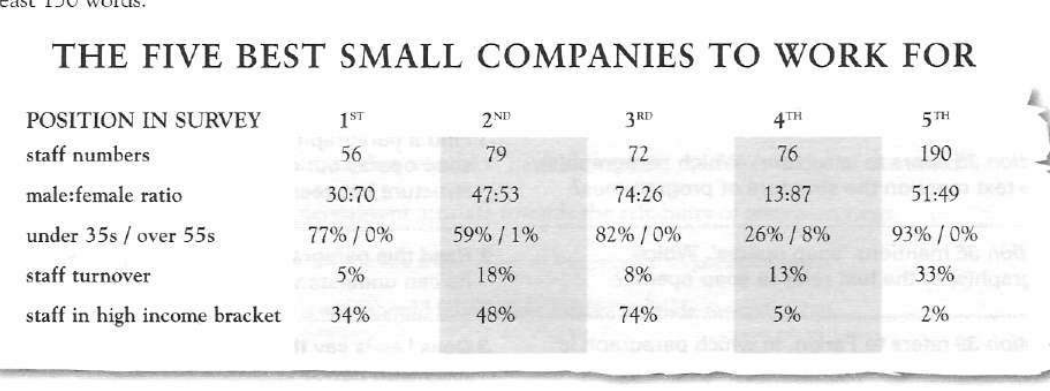
The table below gives information about the five small companies in Britain that came top in a survey of staff conducted by a national newspaper to find out which companies are the best to work for.
Summarise the information by selecting and reporting the main features, and make comparisons where relevant.
THE FIVE BEST SMALL COMPANIES TO WORK FOR
Student answer (Band 5.5)
The table illustrates the details about the survey conducted by a national newspaper to find out the top 5 small companies of Britain that are mostly preferred to work for. Overall it is clear that the company with fewer employees who are below 35 years and that too more females could be more better place to work.
The best small company has only 56 employees with 70% females who are under 35. The low employee turnover of 5% denotes that less number of staff is leaving and the retention ratio is more. In addition to that only 34% of the staff lies in the high income bracket, which even makes it clear that the employees with lower salaries are also willing to work.
Also in other companies as the number of employees increase rank decreases except for 2nd rannk as it has 79 employees. The male to female ratio is also well diversified, in addition we can notice that mostly the top 5 companies have staff under 35 and only in 2nd and 4th rank has staff over 35 as 1% and 8% respectively. On the other hand the staff in high income bracket does not reveal any trend as such because even the staff with 74% in high incomes slab is on 3rd rank, with 34% in high salary bracket is on 1st rank where as with 5% and 2% is on 4th and 5th rank.
AI examiner evaluation
| Criterion | Band |
|---|---|
| Task Achievement / Task Response | 5.5 |
| Coherence and Cohesion | 5.5 |
| Lexical Resource | 6.0 |
| Grammatical Range and Accuracy | 5.5 |
| Overall | 5.5 |
Task Achievement / Task Response: Band 5.5
You identify the top-ranked company and report several relevant figures, including its 56 employees, 70% female workforce, 5% turnover and 34% in the high-income bracket. You also make useful comparisons across the rankings. However, the overview is unclear and partly unsupported: the claim that the best company has fewer under-35s is not borne out by the table, since the fifth-ranked company has the highest proportion at 93%, compared with 77% for the winner. You also misread the age data: the table gives over-55s, not over-35s. The response would be stronger with a concise, accurate overview of the main contrasts, such as the winner’s low turnover and the fifth-ranked company’s high turnover.
Coherence and Cohesion: Band 5.5
The response has a recognisable structure: an introduction and overview are followed by details about the winner and then comparisons among the other companies. Linking phrases such as “In addition to that” and “On the other hand” help signal relationships between points. However, progression is not consistently clear. The opening overview combines several ideas without establishing a reliable main comparison, and the final paragraph moves between staff numbers, gender, age and income in a way that can feel list-like. Some connections are also awkward, particularly “Also in other companies as the number of employees increase rank decreases.” Grouping related data into clearer comparisons—for example, workforce profile first and turnover/income second—would make the organisation easier to follow.
Lexical Resource: Band 6.0
You use an adequate range of vocabulary for describing the table, including “employee turnover,” “retention ratio,” “male to female ratio” and “high income bracket.” These terms generally make the subject clear, and you attempt to vary your wording with phrases such as “does not reveal any trend.” Some choices are imprecise or unnatural, however: “mostly preferred to work for,” “more better place,” and “high incomes slab” do not express the intended meaning naturally. There are also spelling and word-form slips, such as “rannk.” Aim for standard collocations and concise data-reporting language; this will make your comparisons sound more precise without requiring more elaborate vocabulary.
Grammatical Range and Accuracy: Band 5.5
You attempt both simple and more complex sentence forms, including clauses introduced by “which” and “because,” and the main meaning is usually understandable. However, some errors in sentence structure and agreement reduce accuracy. For example, “the company with fewer employees who are below 35 years and that too more females could be more better place” is difficult to follow and contains faulty comparison and article use. In “only in 2nd and 4th rank has staff over 35,” the subject–verb structure is incomplete, while “as the number of employees increase rank decreases” needs clearer clause structure and agreement. Use shorter, controlled sentences when reporting figures, and check articles, verb agreement and comparative forms.
See this exact question answered at other band scores. The same prompt compared across bands.
Browse more IELTS Writing model answers or get your own writing scored by the same AI examiner.