Band 5.5 IELTS Writing Task 1 Model Answer
Overall Band Score: 5.5 · IELTS Complete Catalyst · 2026-11-25
IELTS Writing Task 1 question
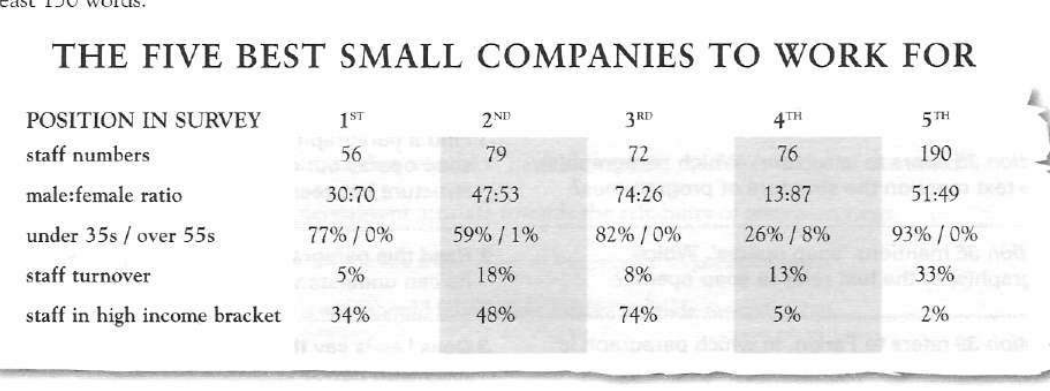
The table below gives information about the five small companies in Britain that came top in a survey of staff conducted by a national newspaper to find out which companies are the best to work for.
Summarise the information by selecting and reporting the main features, and make comparisons where relevant.
THE FIVE BEST SMALL COMPANIES TO WORK FOR
Student answer (Band 5.5)
The table illustrates information on the top five small companies to work for in Britian that came into light in a survey conducted by national newsaper. It is shown which companies are best to work for.
The layout of the table is shown in a way that the position of each company is shown in a horizontal order. More so, in vertical order the number of staff, male to female ratio, age under 35 and over 55, staff turnover and staff in high income bracket is presented respectively.
Clearly, the 2nd, 3rd and 4th company has nearly the same number of staff available whereas the 5th company holds the highest number of staff which is 190 and the 1st company is averaging the lowest number of staff. Seemingly, almost all the companies are averaging more and more people who are under 35. In staff turnover comapny 2 has been by far the worst with 18% as compared to company 1 that holds the best record of staff turnover at 5%. Company 3 is also averaging the staff with highest income bracket.
Therefore, analysing the whole table thoroughly, it can be concluding that company 3 is the best to work for closely followed by company 2 except for their staff turnover. The worst company to work for is probably company 5.
AI examiner evaluation
| Criterion | Band |
|---|---|
| Task Achievement / Task Response | 5.0 |
| Coherence and Cohesion | 6.0 |
| Lexical Resource | 5.5 |
| Grammatical Range and Accuracy | 5.5 |
| Overall | 5.5 |
Task Achievement / Task Response: Band 5.0
You identify several relevant features, including the largest workforce at company 5 (190), the lowest turnover at company 1 (5%), and company 3’s leading share of high earners (74%). However, the overview is incomplete and some comparisons are inaccurate or unclear. Company 2 does not have the highest turnover: company 5 does, at 33%. Also, company 1, not company 3, has the fewest staff, while company 3 has the highest proportion of under-35s (82%), not simply a general pattern across “almost all” companies. The conclusion that company 3 is best to work for is not supported by the table, which reports survey rankings rather than an overall judgement based on these figures. Select and compare the main patterns more precisely, without adding a personal ranking.
Coherence and Cohesion: Band 6.0
The response has a clear overall shape: an introduction, a description of the table, a paragraph of comparisons, and a concluding statement. This makes the information reasonably easy to follow. Linking expressions such as “Clearly,” “Seemingly,” and “Therefore” signal the movement between points, although some are used mechanically or introduce claims that do not follow from the data. The second paragraph mainly explains the table’s layout rather than developing comparisons, and the final conclusion repeats an unsupported judgement instead of summarising the key patterns. Improve progression by moving from a concise overview to grouped comparisons—for example, workforce and age first, then turnover and income—and use references such as “the top-ranked company” consistently so the companies remain clear.
Lexical Resource: Band 5.5
You use a reasonable range of task-related vocabulary, including “staff turnover,” “male to female ratio,” and “high income bracket,” so the reader can generally understand the categories being discussed. However, several word choices and collocations are unnatural or imprecise, such as “came into light,” “holds the highest number of staff,” and “averaging more and more people.” “Worst” and “best” are also too evaluative when describing turnover unless you specify that a lower rate is being treated as preferable. There are noticeable spelling errors in “Britian,” “newsaper,” and “comapny,” which reduce accuracy. Aim for standard data-reporting language and precise verbs such as “recorded,” “accounted for,” and “had,” while checking spelling carefully.
Grammatical Range and Accuracy: Band 5.5
You attempt a mix of simple statements and longer sentences, and most of the main comparisons remain understandable. Some grammatical errors are evident, particularly with subject–verb agreement and sentence construction. For example, “the 2nd, 3rd and 4th company has” should use a plural subject and verb, while “it can be concluding” needs a passive form such as “it can be concluded.” The phrase “age under 35 and over 55 … is presented” also has an awkward structure and agreement with a list of categories. Articles and prepositions are sometimes missing or misplaced, as in “conducted by national newsaper.” Practise accurate plural forms and agreement, and build longer sentences around clear subjects and verbs; this will make your comparisons more controlled.
See this exact question answered at other band scores. The same prompt compared across bands.
Browse more IELTS Writing model answers or get your own writing scored by the same AI examiner.