Band 6.0 IELTS Writing Task 1 Model Answer
Overall Band Score: 6.0 · Cambridge IELTS 17 · 2026-11-06
IELTS Writing Task 1 question
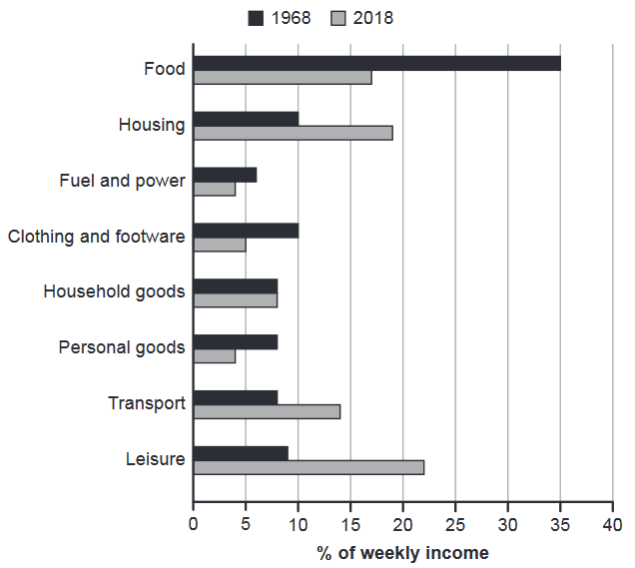
The chart below gives information about how families in one country spent their weekly income in 1968 and in 2018.
Summarise the information by selecting and reporting the main features, and make comparisons where relevant.
1968 and 2018: average weekly spending by families
Student answer (Band 6.0)
the bar chart illustrates about how the income is spent weekly by families in one country in two different years ([redacted phone]).
overall, food represented the largest category of expenditure in 1968, on the other hand leisure became the biggest spendding category in2018. also, spending on housing,transport and leisure increased,while expenditure on most other categories declined.
three sectors experienced decreasing in expenditure :food,clothing and footware,and personal goods.
in1968,food was the most thing that families spent their money on by aproximetly 35% of their weekly income.
however, a sizebale drop occured, in 2018 it represents around 17%of their income
clothing and footware, persinal goods, fuel and power followed the same trajectory , albeit at a less steep rate and they acxounts for (10%-9%-6%) in 1968 and going down to (5%-4%-4%) in the same ordre.
in contrast,leisure, housing shows a large increase in the families expenditure and take the lead, in 1968 it represtens around 9%-10% and it had become the most populaire stuff to buy in 2018 by 22%-19% in the same ordre. another sector illustrate an noticebale increase (transport from 8% to 14%) the household goods share the same results in the two years.
AI examiner evaluation
| Criterion | Band |
|---|---|
| Task Achievement / Task Response | 6.5 |
| Coherence and Cohesion | 6.0 |
| Lexical Resource | 5.5 |
| Grammatical Range and Accuracy | 5.0 |
| Overall | 6.0 |
Task Achievement / Task Response: Band 6.5
You identify the main shift accurately: food was the largest category in 1968, while leisure led in 2018, and you note that housing and transport also increased. Most figures are reported consistently with the chart, including food (about 35% to 17%), transport (8% to 14%), and household goods remaining unchanged. This gives the response a relevant overview and useful comparisons. However, the overview could be more precise about the full pattern: leisure rose from 9% to 22%, while fuel and power also declined, a change mentioned later but not included in the summary. Some details are unclear, particularly the grouped figures and the claim that leisure and housing “take the lead.” A more complete, clearly prioritised overview would strengthen the response further.
Coherence and Cohesion: Band 6.0
The response has a recognisable overall structure: an introduction, an overview, and paragraphs describing decreases and increases. Comparisons such as “in contrast” help signal changes, and the categories are generally grouped by trend. However, progression is sometimes difficult to follow because several figures are compressed into one sentence, as in “(10%-9%-6%)” and “(5%-4%-4%),” without clearly matching each value to its category. The sentence beginning “in contrast, leisure, housing” also combines ideas awkwardly, and punctuation and spacing make boundaries between points less clear. Use separate, logically ordered sentences and explicit category references so the reader can follow each comparison without having to infer the links.
Lexical Resource: Band 5.5
You use a reasonable range of task-related language, including “expenditure,” “trajectory,” “represented,” and “increase,” and you attempt to vary how changes are described. However, inaccurate word forms, spelling, and collocations are noticeable and sometimes make the meaning less clear. Examples include “spendding,” “sizebale,” “acxounts,” and “most populaire stuff to buy”; the last phrase is also too informal for an academic report. “The same trajectory” is not quite suitable for categories that simply show similar declines. Aim for accurate, neutral terms such as “share,” “proportion,” “rose,” and “fell,” and check spelling carefully. More precise vocabulary would make the comparisons clearer and more appropriately academic.
Grammatical Range and Accuracy: Band 5.0
You attempt both simple and more complex sentence forms, including contrast clauses with “however” and “albeit,” and the overall meaning can usually be understood. However, grammatical control is inconsistent. For example, “three sectors experienced decreasing in expenditure” uses an incorrect structure, while “they acxounts” has a subject–verb agreement problem. The sentence “in contrast, leisure, housing shows a large increase” also has unclear sentence structure and agreement, and several clauses are joined without clear punctuation. Capitalisation at sentence beginnings and commas after introductory phrases are also inconsistent. Practise forming comparisons with accurate patterns, such as “spending on X decreased” and “X rose from … to …,” and proofread each sentence for a clear subject and verb.
See this exact question answered at other band scores. The same prompt compared across bands.
Browse more IELTS Writing model answers or get your own writing scored by the same AI examiner.