Band 5.5 IELTS Writing Task 1 Model Answer
Overall Band Score: 5.5 · Cambridge IELTS 17 · 2026-11-07
IELTS Writing Task 1 question
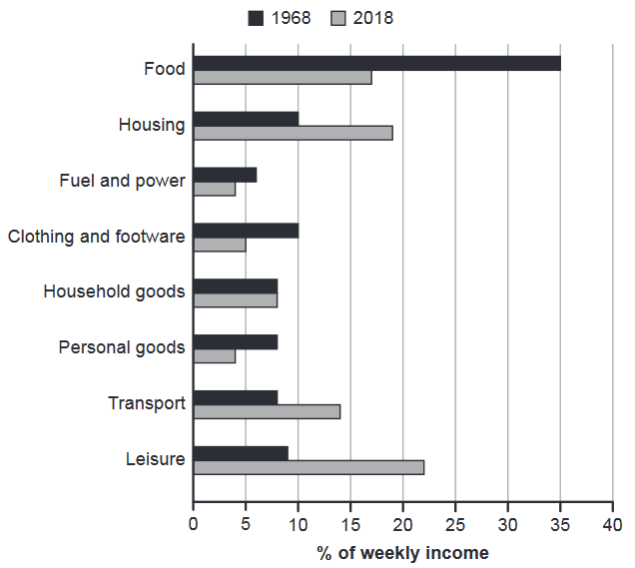
The chart below gives information about how families in one country spent their weekly income in 1968 and in 2018.
Summarise the information by selecting and reporting the main features, and make comparisons where relevant.
1968 and 2018: average weekly spending by families
Student answer (Band 5.5)
The chart compares between average weekly spending by families in 1968 and 2018 according to different categories like food, housing, fuel and power, Clothing and footware and others.
Overall, weekly income was spent in diiferent way in 1968 from 2018 . In additions, Families did not spent on some thimgs very mush in 1968 and they increased their spent on them in 2018.
In 1968, Weekly income was spent mostly on food at 35%. Housing and clothing and footware were 10% separetely of weekly income. But the fuel and power was only approxomately at 6% and that was the lowest.
Household goods and personal goods were the same for around 7%
Transport and leisure were cliser to each other at approximately 8%.
In 2018, the spemt weekly income was roughly different. Leisure was the highest thing that families spent their weekly income on as they spent around 22%. Housing and food made up above 15% of weekly income for each other.
Nevertheless, transport made up less than 15% and they spent the same percentage of weekly income on householdg
AI examiner evaluation
| Criterion | Band |
|---|---|
| Task Achievement / Task Response | 5.5 |
| Coherence and Cohesion | 5.5 |
| Lexical Resource | 5.0 |
| Grammatical Range and Accuracy | 5.0 |
| Overall | 5.5 |
Task Achievement / Task Response: Band 5.5
You identify the main contrast between the years: food was the largest category in 1968, while leisure was highest in 2018, and you include several relevant figures. However, the overview is vague and does not clearly summarise the overall shifts. The claim that families “increased their spent” on some items is unclear, and the 2018 account is incomplete: it omits the falls in fuel and power, clothing, and personal goods, as well as the rise in transport. Some figures are also imprecise: household and personal goods were about 8% each in 1968, not 7%, and household goods were 8% in 2018. A clearer overview and more accurate, balanced comparisons would strengthen the response.
Coherence and Cohesion: Band 5.5
The response has a recognisable structure, with an introduction, an overview, and separate paragraphs for each year. This helps the reader follow the broad comparison. However, progression is weakened by the unclear overview and by the unfinished final sentence, which ends at “householdg” without completing the comparison. Some linking expressions do not show the intended relationship: “Nevertheless” introduces a further category rather than a contrast, while “In additions” is awkwardly used. Grouping the main increases and decreases in a clearer sequence, and using connectors only where their meaning fits, would make the report more cohesive and complete.
Lexical Resource: Band 5.0
You use relevant chart vocabulary, including “weekly income,” “categories,” “made up,” and “approximately,” and the reader can generally identify the spending areas being discussed. However, the range is limited and several word choices or collocations are inaccurate, such as “spent mostly on food,” “the highest thing,” and “spent the same percentage ... on householdg.” There are also noticeable spelling errors, including “diiferent,” “separetely,” “approxomately,” and “cliser,” which reduce clarity and control. Aim for precise terms such as “accounted for,” “share,” and “category,” and check spelling carefully. Avoid repeating “spent” when a more exact reporting verb is available.
Grammatical Range and Accuracy: Band 5.0
You attempt some longer sentence forms, for example, “Leisure was the highest thing ... as they spent around 22%,” and most of the basic meaning remains understandable. However, the range is limited, and errors occur frequently in sentence construction and verb forms. Examples include “families did not spent,” “they increased their spent,” and “Housing and food made up above 15% ... for each other.” The final sentence is also incomplete, so its grammatical relationship cannot be understood. Articles, agreement, and punctuation are not consistently controlled, as seen in “the fuel and power” and the spacing before the full stop in the overview. Practise accurate simple comparisons first, then build longer sentences around them.
See this exact question answered at other band scores. The same prompt compared across bands.
Browse more IELTS Writing model answers or get your own writing scored by the same AI examiner.