Band 6.5 IELTS Writing Task 1 Model Answer
Overall Band Score: 6.5 · Cambridge IELTS 17 · 2026-11-09
IELTS Writing Task 1 question
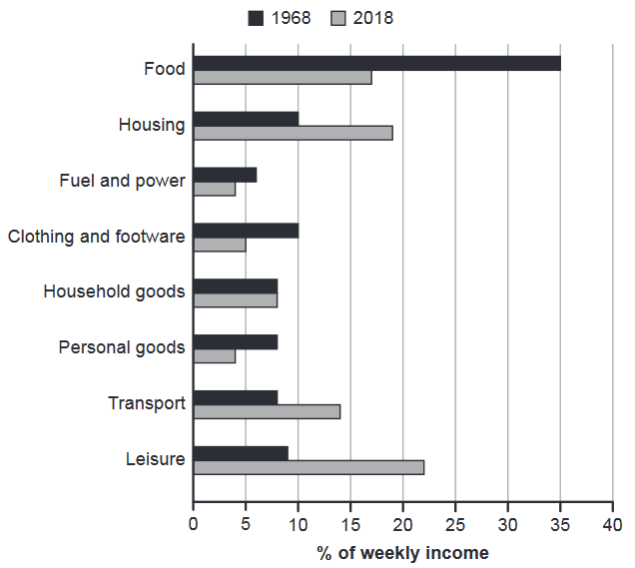
The chart below gives information about how families in one country spent their weekly income in 1968 and in 2018.
Summarise the information by selecting and reporting the main features, and make comparisons where relevant.
1968 and 2018: average weekly spending by families
Student answer (Band 6.5)
The bar chart illustrates the proportion of weekly income allocated to eight different expenditure categories in a single country between 1968 and 2018.
Overall, the expenditure was significantly highest in food in 1968, but the noticeable decline found over the 50 years. For housing, People spent almost double in 2018, Spending on leisure and transport also increased. Meanwhile, family expenditure on household goods remain unchanged.
In 1968, Families income mostly accounted for food and the percentage is 35, whereas, for housing and clothing and footwear they allocated 10% of their weekly earnings. Spending on fuel and power above 5%, while for household goods around 8%, personal goods about 7% and transport 8% approximately .
In 2018, the nature of the expenditure has been changed a lot. In leisure, families are spending highest and that is almost 24%, as well as in housing and transport around 18% and 13% of their expenditure have been made respectively. Clothing and footwear, personal goods and fuel and power, all experienced the downfall, dropping to roughly 10%,3% and 3% respectively. Only household goods allocation was remain unchanged and the percentage was around 8%.
AI examiner evaluation
| Criterion | Band |
|---|---|
| Task Achievement / Task Response | 7.0 |
| Coherence and Cohesion | 7.0 |
| Lexical Resource | 6.0 |
| Grammatical Range and Accuracy | 5.5 |
| Overall | 6.5 |
Task Achievement / Task Response: Band 7.0
You identify the main pattern clearly: food takes the largest share in 1968, while leisure and housing become more prominent by 2018, and household-goods spending stays stable. The response also reports several relevant figures, including food at 35% and household goods at about 8%. Most comparisons match the chart, but some 2018 values are overstated: housing is about 19%, not 18% only approximately (a small difference), and leisure is about 22%, rather than almost 24%; clothing is about 5%, not 10%. The overview could also state more precisely that food fell sharply and that transport rose. More accurate selection and reporting of the figures would make the account more fully supported.
Coherence and Cohesion: Band 7.0
The response has a clear four-part structure: an introduction, an overview, and separate descriptions of the two years. This gives the reader a logical route through the information, and contrasts such as “Meanwhile” help signal changes. The progression is generally easy to follow, although some links between details are awkward or unclear. For example, “For housing, People spent almost double in 2018, Spending on leisure and transport also increased” joins several comparisons without clean sentence boundaries. The two year-by-year paragraphs are understandable, but grouping the largest increases and decreases would make the comparisons more direct. Use linking expressions selectively and ensure each sentence presents one clearly connected point.
Lexical Resource: Band 6.0
You use a reasonable range of task-related vocabulary, including “allocated,” “expenditure,” “decline,” and “remained unchanged,” so the main trends are communicated. There are also attempts at more formal phrasing, such as “the nature of the expenditure,” though this is not a natural way to describe the chart. Some word choices and collocations are inaccurate: “Families income mostly accounted for food” should describe the share spent on food, and “the downfall” is less suitable than “a fall” or “a decline.” “The percentage is 35” would be clearer as “the figure was 35%.” Spelling varies in “footware”; use “footwear.” Greater precision and more natural collocations would strengthen the vocabulary.
Grammatical Range and Accuracy: Band 5.5
You attempt both simple and more complex sentences, including a contrast with “whereas” and a sentence beginning “Meanwhile.” However, some grammatical errors recur and occasionally make relationships between ideas less clear. For example, “the noticeable decline found over the 50 years” lacks a finite verb; write “it declined noticeably over the 50 years.” In “family expenditure on household goods remain unchanged,” the verb should be “remained” to match the past-time comparison. The construction “Only household goods allocation was remain unchanged” is also incorrect; use “Only the allocation for household goods remained unchanged.” Capitalisation after commas and sentence boundaries needs attention. More consistent tense control and complete sentence structures would improve accuracy.
See this exact question answered at other band scores. The same prompt compared across bands.
Browse more IELTS Writing model answers or get your own writing scored by the same AI examiner.