Band 5.5 IELTS Writing Task 1 Model Answer
Overall Band Score: 5.5 · Cambridge IELTS 17 · 2026-11-10
IELTS Writing Task 1 question
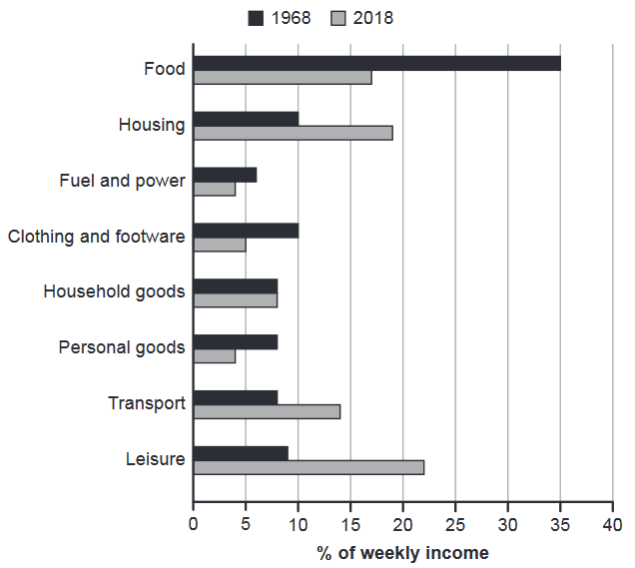
The chart below gives information about how families in one country spent their weekly income in 1968 and in 2018.
Summarise the information by selecting and reporting the main features, and make comparisons where relevant.
1968 and 2018: average weekly spending by families
Student answer (Band 5.5)
The provided bar graph illsutrates the proportion of weekly household expenditure across various categories in a specific nation during the years 1968 and 2018.
From the overview, it is evident that the highest proportion of food in 1968. While, fuel and power and personal goods had the lowest percentile among all groups.
It can be seen clearly, the percentage of fuel and power was only just above 5% in 1968 and in second year it reached at 4%. Near about 8% of household goods remained same in both years. The next followed food was 35% in first year and 16% in 2018.
Moving further, in 1968 the housing was 10% of expenditure whereas it incresed about 8% and reached at 18% in 2018. However, clothing and footware were 5% ( 10%) more than in intiall year as compared to 2018. The second greatest proportion was taken by leisure in 2018 that was around 22% and in 1968 it was just below 10%
AI examiner evaluation
| Criterion | Band |
|---|---|
| Task Achievement / Task Response | 5.5 |
| Coherence and Cohesion | 5.5 |
| Lexical Resource | 5.5 |
| Grammatical Range and Accuracy | 5.0 |
| Overall | 5.5 |
Task Achievement / Task Response: Band 5.5
You identify several relevant comparisons, including food falling from 35% to about 16–17%, housing rising from 10% to around 18–19%, and leisure reaching roughly 22% in 2018. However, the overview is incomplete and partly inaccurate: food was the largest category in 1968, but fuel and power and personal goods were not the lowest then; both were 8%, while fuel and power was lowest in 2018. The response also omits the important rise in transport from 8% to 14%, and the clothing comparison is unclear and incorrectly phrased. To make the report more complete, give a clear overview of the main shifts and report the categories accurately, including which figures stayed stable.
Coherence and Cohesion: Band 5.5
The response has a basic paragraph structure, moving from an introduction and overview to details, and phrases such as “Moving further” signal a change of focus. However, the progression between categories is not consistently clear: food and household goods are grouped together, then housing and clothing, without a clear organising principle. Some linking expressions are awkward or misleading, particularly “The next followed food” and “However” before the clothing comparison. The overview also does not clearly prepare the reader for the detailed comparisons. Group the categories by their main trends—for example, decreases, increases and little change—and use straightforward links such as “By contrast” or “Meanwhile” to make relationships easier to follow.
Lexical Resource: Band 5.5
You use relevant task vocabulary, including “proportion,” “expenditure,” “categories” and “remained same,” so the meaning is generally recoverable. However, several word choices and collocations are inaccurate or unnatural, such as “lowest percentile,” “reached at,” “The next followed food,” and “the second greatest proportion was taken by leisure.” Spelling errors, including “illsutrates,” “incresed,” “footware” and “intiall,” also reduce accuracy. Aim for precise, conventional chart language: say that a figure “accounted for” a share, “rose to” a value, or “was the second-largest category.” Check spelling carefully and avoid using “percentile” when you mean “percentage.”
Grammatical Range and Accuracy: Band 5.0
There are attempts to use both simple and more complex sentences, including comparisons with “whereas” and “as compared to.” However, grammatical errors are frequent and sometimes make relationships difficult to interpret. The overview fragment “it is evident that the highest proportion of food in 1968” needs a verb, such as “food accounted for the highest proportion.” “While, fuel and power…” is also an incomplete clause, and “the percentage … was only just above 5% … and in second year it reached at 4%” has faulty sentence construction and tense phrasing. The clothing sentence is especially hard to understand because its comparison is not grammatically formed. Practise complete clauses, accurate past-tense verbs and clear comparative structures.
See this exact question answered at other band scores. The same prompt compared across bands.
Browse more IELTS Writing model answers or get your own writing scored by the same AI examiner.