Band 5.0 IELTS Writing Task 1 Model Answer
Overall Band Score: 5.0 · Cambridge IELTS 17 · 2026-11-10
IELTS Writing Task 1 question
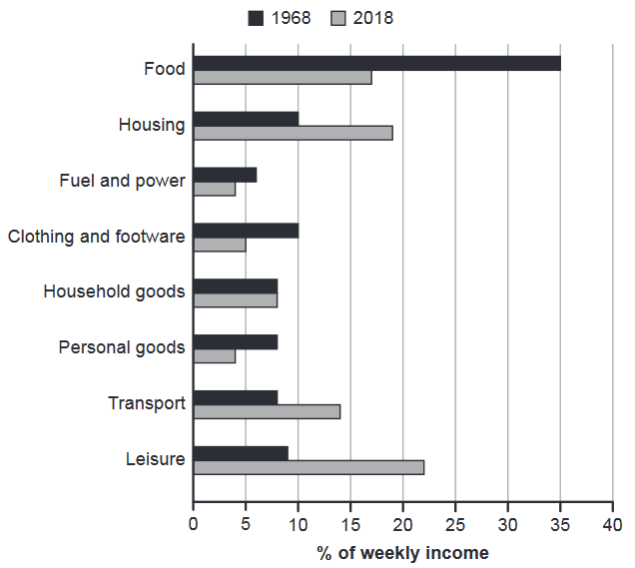
The chart below gives information about how families in one country spent their weekly income in 1968 and in 2018.
Summarise the information by selecting and reporting the main features, and make comparisons where relevant.
1968 and 2018: average weekly spending by families
Student answer (Band 5.0)
The chart illustrates the infromation how family spent their percentage of weekly income in 1968 and 2018.
In 1968, people used to spent more of their income on food than any other things. They used 35% of their weekly income on food. They used 10% of their weekly income on housing and clothing and footware in 1968. In past, people used most of their money for food, housing and clothing. But in 2018, the picture is bit different. People in 2018 used approximately 22% of their income on leisure. Thus shows how modern people care more about leisure than other thing. In 2018, families spent less for food than they spent for housing.
In 1968, families spent less for everything in contrast of 2018 but in only one thing families still spend almost same amount of their weekly income. That is household goods which is approximately 8%.
Overall in almost everything families in 2018 spent more than they used to spent in 1968.
AI examiner evaluation
| Criterion | Band |
|---|---|
| Task Achievement / Task Response | 5.0 |
| Coherence and Cohesion | 5.5 |
| Lexical Resource | 5.0 |
| Grammatical Range and Accuracy | 5.0 |
| Overall | 5.0 |
Task Achievement / Task Response: Band 5.0
You identify several relevant features, including food as the largest category in 1968 (35%), leisure as the largest in 2018 (about 22%), and household goods remaining around 8%. However, the account is only partial and the overview is inaccurate: “families in 2018 spent more” in almost everything reverses the overall pattern. In fact, spending fell in food, fuel and power, clothing and footwear, and personal goods; housing, transport and leisure rose, while household goods stayed similar. The comparison of food and housing in 2018 is useful, but other major changes are omitted or not quantified. Focus the overview on the contrasting shifts, then select and accurately compare the most significant categories.
Coherence and Cohesion: Band 5.5
The response has a basic sequence, moving from 1968 to 2018 and ending with an overall statement, and the time markers help readers follow the comparison. However, the progression is not consistently clear because the overview comes last and makes a broad, misleading claim. Several ideas are repeated, such as the emphasis on food and the statement that 2018 is “different,” while the categories are not grouped systematically by increases, decreases or stable figures. Linking phrases such as “But” and “Thus” are used, but some connections are unclear—for example, “Thus shows” does not form a complete link to the preceding point. A clear overview followed by organised comparison paragraphs would improve cohesion.
Lexical Resource: Band 5.0
You use enough topic vocabulary to communicate the general subject, including “weekly income,” “housing,” “leisure” and “household goods.” However, the range is limited and several phrases are repetitive or imprecise, such as “used more of their income,” “other things” and “the picture is bit different.” There are also noticeable spelling and word-choice problems, including “infromation” and “footware,” which reduce accuracy. Some expressions are not natural for describing chart data, particularly “care more about leisure,” which interprets the figures rather than neutrally reporting them. Use precise reporting language such as “accounted for,” “rose to,” “fell to” and “remained stable,” and check category names and spelling.
Grammatical Range and Accuracy: Band 5.0
The response relies mainly on short, simple sentences, with limited evidence of varied or controlled complex structures. Frequent errors affect accuracy, including “families spent less for everything,” “in contrast of 2018,” and “used to spent.” The opening phrase, “illustrates the information how family spent,” is also structurally faulty, and “Thus shows” lacks a clear grammatical subject. These errors do not make the whole response impossible to understand, but they sometimes interrupt the reader’s understanding and weaken the comparisons. Practise accurate past-tense reporting and sentence patterns such as “spending on X rose from … to …,” while checking articles, prepositions and subject–verb forms.
See this exact question answered at other band scores. The same prompt compared across bands.
Browse more IELTS Writing model answers or get your own writing scored by the same AI examiner.