Band 5.5 IELTS Writing Task 1 Model Answer
Overall Band Score: 5.5 · Cambridge IELTS 17 · 2026-11-11
IELTS Writing Task 1 question
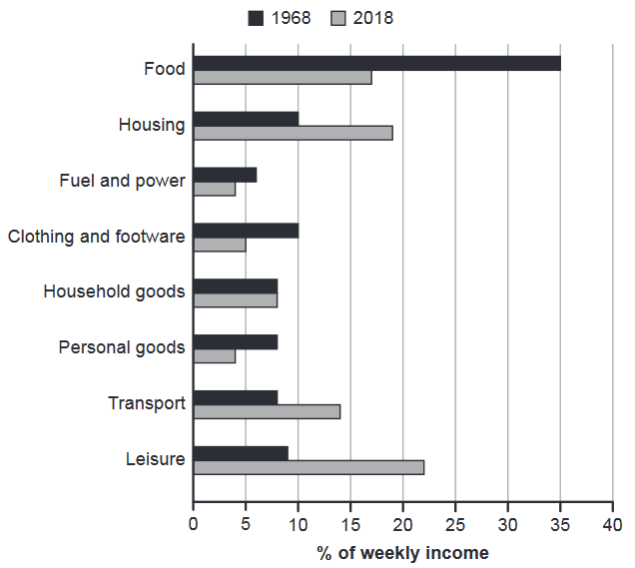
The chart below gives information about how families in one country spent their weekly income in 1968 and in 2018.
Summarise the information by selecting and reporting the main features, and make comparisons where relevant.
1968 and 2018: average weekly spending by families
Student answer (Band 5.5)
The bar chat illustrate families spending of weekly income in the country between 1996 and 2018.
Overall, food was a highest spending area which replaced by leisure. Moreover, housing, transportation and leisure were increased drasticaly while household goods remains stable.
In 1968, food was a most spending area of income with 35 percent which drasticaly decrease to 17 percent. while spending on leisure was increased significantly from approx 9 percent to 22 percent. Moreover, household good remains stable at approximately 8 percent.
In 2018, spending on housing also rose significantly from 10 percent to approximetly 22 percent. while fuel and power and personal good stack was decreased slightly, 2 and 5 percent respectively. Also transportation stack on spending was increased approximetly 5 percent. However, clothing and footware contribution also decreased slightly with 5 percent from 10 percent in 1968 to 5 percent in 2018. In 2018, fuel and power and personal good became least spending factors.
AI examiner evaluation
| Criterion | Band |
|---|---|
| Task Achievement / Task Response | 6.0 |
| Coherence and Cohesion | 5.5 |
| Lexical Resource | 5.5 |
| Grammatical Range and Accuracy | 5.0 |
| Overall | 5.5 |
Task Achievement / Task Response: Band 6.0
You identify several important patterns, including the sharp fall in food spending (35% to 17%), the rise in leisure (about 9% to 22%), and the stability of household goods at 8%. The overview also recognises that spending shifted towards housing, transport and leisure. However, some details are inaccurate or unclear: the chart compares 1968 and 2018, not 1996 and 2018; housing reaches about 19%, not 22%; and fuel and power falls from 6% to 4%, while personal goods falls from 8% to 4%, rather than by 2 and 5 percentage points. The overview’s claim that food was replaced by leisure is also imprecise, since leisure becomes the largest category in 2018. More accurate reporting of these comparisons would strengthen coverage.
Coherence and Cohesion: Band 5.5
The response has a recognisable structure: an introduction, an overview, and two paragraphs of details. This gives the reader a basic route through the comparison, and linking words such as “Moreover” and “However” show attempts to connect information. However, progression within the detail paragraphs is uneven: the final paragraph moves between housing, fuel, personal goods, transport and clothing without a clear grouping or consistent comparison pattern. Several sentences begin with “while” after a full stop, which weakens the connection between ideas, and “In 2018” is repeated. Grouping the categories that rose together and those that fell or stayed stable, then comparing both years consistently, would make the organisation clearer and cohesion less mechanical.
Lexical Resource: Band 5.5
You use relevant chart vocabulary, including “spending,” “income,” “increased,” “decreased,” and “approximately,” so the main comparisons are generally understandable. There is also some attempt to vary phrasing with “rose significantly” and “remains stable.” However, several word choices and collocations are inaccurate or awkward, such as “a highest spending area,” “spending factors,” and “transportation stack on spending.” Spelling errors, including “drasticaly,” “approximetly,” and “footware,” also reduce control. Aim for precise, natural expressions such as “accounted for,” “share of weekly income,” and “category,” and check spelling carefully. This would make the vocabulary more reliable and appropriate for describing statistical data.
Grammatical Range and Accuracy: Band 5.0
You attempt both simple statements and more complex comparisons, for example, “while spending on leisure was increased significantly…” and “However, clothing and footware contribution also decreased…”. The intended meaning is usually recoverable, but errors in sentence structure and verb forms are noticeable. “The bar chat illustrate” has subject–verb disagreement, while “which replaced by leisure” is missing a suitable verb construction. The passive form “was increased” is also inappropriate for describing a change, and several sentences begin with a lowercase “while” after a full stop. Articles and plurals are inconsistent in phrases such as “a most spending area” and “household good.” Use direct forms such as “spending on leisure increased,” and check sentence boundaries, agreement and articles.
See this exact question answered at other band scores. The same prompt compared across bands.
Browse more IELTS Writing model answers or get your own writing scored by the same AI examiner.