Band 5.5 IELTS Writing Task 1 Model Answer
Overall Band Score: 5.5 · Cambridge IELTS 17 · 2026-11-12
IELTS Writing Task 1 question
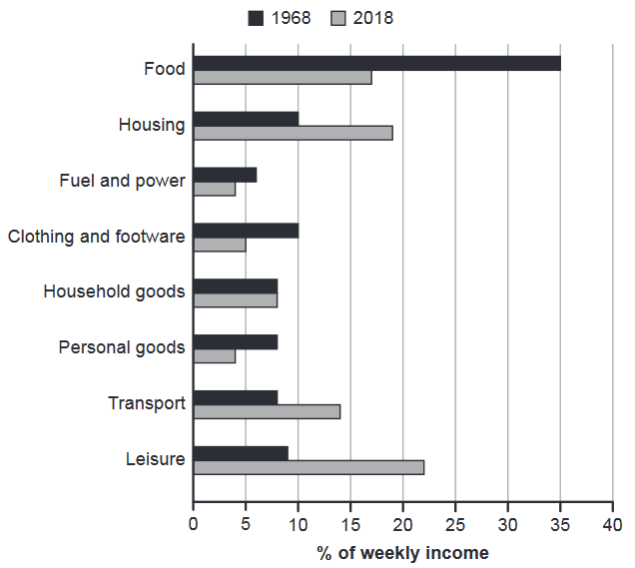
The chart below gives information about how families in one country spent their weekly income in 1968 and in 2018.
Summarise the information by selecting and reporting the main features, and make comparisons where relevant.
1968 and 2018: average weekly spending by families
Student answer (Band 5.5)
The chart presents information about how families spent their weekly salary in two years, 1968 and 2018. The figures are given as percent.
Overall, families spent their weekly income on food was highest in 1968 while in 2018 this figure dramatically reduced. However, in 2018 spending income on leisure was high moreover, people spent less money on fuel and power.
Initially, in 1968 spending weekly income on food was 35% in 2018 it decreased to around 15%. Meanwhile, the weekly income spent on housing was 10% in 1968 and increased minially to almost 20% in 2018. In 1968, weekly income spent on all activities were around 5 to 10% respectively.
Moreover, in 2018 the leisure dramatically surge to around 22%.
AI examiner evaluation
| Criterion | Band |
|---|---|
| Task Achievement / Task Response | 5.5 |
| Coherence and Cohesion | 5.5 |
| Lexical Resource | 5.5 |
| Grammatical Range and Accuracy | 5.5 |
| Overall | 5.5 |
Task Achievement / Task Response: Band 5.5
You identify the main contrast: food accounted for the largest share in 1968, while leisure was prominent in 2018, and you report the approximate food and housing figures. However, the overview is unclear in places, and the comparison is only partly developed. The chart shows food falling from 35% to about 17%, not around 15%; leisure rises to 22%, while housing rises from 10% to 19%. The statement that families spent less on fuel and power is relevant, but you do not give its figures or compare other important categories such as transport. The response also falls 30 words short of the required minimum, limiting the detail you can provide. Select and compare several key changes more fully.
Coherence and Cohesion: Band 5.5
The response has a basic overall structure: an introduction, an overview, and details about food and housing, followed by a point about leisure. This gives the reader some sense of the chart’s main features. However, progression is limited because the final paragraph adds only one brief comparison, and the categories are not organised into a clear pattern of increases and decreases. Some linking is awkward or mechanical: “However” and “Moreover” do not clearly connect the ideas that follow, while “Initially” is not especially suitable for introducing a year’s data. Group the main changes into a more purposeful sequence and use straightforward links such as “By contrast” or “Meanwhile” only where the relationship is clear.
Lexical Resource: Band 5.5
You use enough topic vocabulary to communicate the general subject, including “weekly income,” “food,” “housing,” “leisure,” and “fuel and power.” There are also attempts at more descriptive language, such as “dramatically reduced” and “dramatically surge.” However, several word choices and collocations are inaccurate or unnatural: “weekly salary” is less suitable than “weekly income” for this chart, “spending income on leisure” is unclear, and “the leisure dramatically surge” has an incorrect form and collocation. “Minially” is misspelled, and “all activities” is too vague for the chart’s spending categories. Use precise terms such as “the proportion spent on” and name each category directly.
Grammatical Range and Accuracy: Band 5.5
You attempt both simple and more complex sentences, and the main topic is generally understandable. However, sentence structures are often incomplete or incorrectly joined. For example, “Overall, families spent their weekly income on food was highest” combines two structures without a grammatical link; “In 1968 spending weekly income on food was 35% in 2018 it decreased” also needs clearer sentence boundaries. There are errors in verb form and agreement in “the leisure dramatically surge,” as well as missing grammatical words in phrases such as “spending weekly income on food.” Punctuation between clauses is also inconsistent. Practise building accurate comparison sentences, for example, “Food accounted for 35% in 1968, before falling to 17% in 2018,” and check each sentence for a clear subject and verb.
See this exact question answered at other band scores. The same prompt compared across bands.
Browse more IELTS Writing model answers or get your own writing scored by the same AI examiner.