Band 5.5 IELTS Writing Task 1 Model Answer
Overall Band Score: 5.5 · Cambridge IELTS 17 · 2026-11-14
IELTS Writing Task 1 question
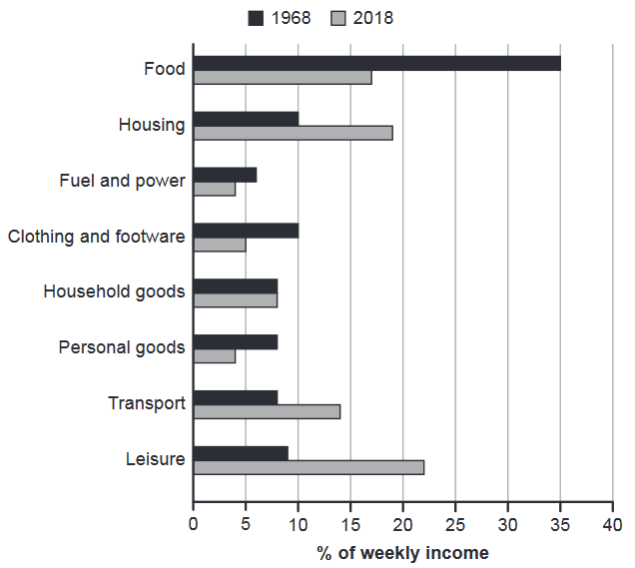
The chart below gives information about how families in one country spent their weekly income in 1968 and in 2018.
Summarise the information by selecting and reporting the main features, and make comparisons where relevant.
1968 and 2018: average weekly spending by families
Student answer (Band 5.5)
The chart illustrates the information about the families in one country who spent income in one week in between 1968 to 2018.
Overall, Food are greater then the other its percantage is 35% in 1968. While, Fuel and power are lowest then others its percantage is roughly 6% to 7%. Furthermore, Leisure present roughly 22% in 2018 which are heigher than other while, Personal goods are lower than other its shows around 4% in 2018.
In 1968, families spent their weekly income where Food are hiegher than other,while Housing and Clothing and footware are remain stable at 10%. Moreover other three transport, personal goods and household googs stay constant at around 9%. Fuel and power shows 6% and last one Lsieure are presented 9%.
In 2018, Leisure are greater then the other at 22% while, housing and food are flactuate at around 16% to 17% moreover, Fuel and power and also personal goods are stay constant at 4%while Clothing anf footware are at 5% in 2018.
AI examiner evaluation
| Criterion | Band |
|---|---|
| Task Achievement / Task Response | 5.5 |
| Coherence and Cohesion | 5.5 |
| Lexical Resource | 5.0 |
| Grammatical Range and Accuracy | 5.0 |
| Overall | 5.5 |
Task Achievement / Task Response: Band 5.5
You identify several important features, including the high food share in 1968 and the prominence of leisure in 2018, and you attempt to compare the two years. However, the overview is not fully accurate: food was the largest category in 1968, but leisure—not food—was largest in 2018. The statement that fuel and power was the lowest category overall is also too broad; it was the lowest in 2018, while personal goods and transport were lower in 1968. Some figures are misreported: 2018 housing was about 19%, not 16–17%, and transport rose to 14%, a key change that is omitted. Select the main contrasts accurately and support them with clearer comparisons.
Coherence and Cohesion: Band 5.5
The response has a recognisable structure: an introduction, an overview, and separate paragraphs for each year. This gives the reader some organisation. However, progression within the paragraphs is uneven, and several ideas are joined in long strings with commas and repeated connectors such as “while,” “moreover,” and “furthermore.” For example, the overview moves from food to fuel and then leisure without clearly distinguishing the main changes between years. Some references, such as “the other” and “other three,” are also unclear. Grouping the largest categories and the notable increases or decreases, then using shorter, clearly linked sentences, would make the comparisons easier to follow.
Lexical Resource: Band 5.0
You use relevant chart vocabulary, including “weekly income,” “percentage,” “spent,” and category names, so the topic is generally understandable. However, the range of reporting language is limited, and repeated phrases such as “greater than the other” and “stay constant” do not express the data precisely. Several word-choice and spelling errors are noticeable, including “percantage,” “heigher,” “flactuate,” and “googs.” “Stable” and “constant” are also inaccurate for categories that changed between years. Build a small set of accurate comparison verbs and phrases, such as “accounted for,” “rose to,” “fell to,” and “remained unchanged,” and check spelling before submitting.
Grammatical Range and Accuracy: Band 5.0
You attempt some longer sentences and use time references to distinguish 1968 from 2018, but sentence structures are limited and errors occur frequently. Subject–verb agreement is often incorrect, as in “Food are greater” and “Leisure are greater”; singular category names generally require “was.” Verb forms are also faulty in phrases such as “are remain stable” and “are stay constant.” Commas and conjunctions sometimes join several clauses without clear sentence boundaries, making the relationships harder to understand. Practise accurate simple comparison sentences first, then combine them with controlled clauses using “whereas” or “while.”
See this exact question answered at other band scores. The same prompt compared across bands.
Browse more IELTS Writing model answers or get your own writing scored by the same AI examiner.