Band 5.5 IELTS Writing Task 1 Model Answer
Overall Band Score: 5.5 · Cambridge IELTS 17 · 2026-11-15
IELTS Writing Task 1 question
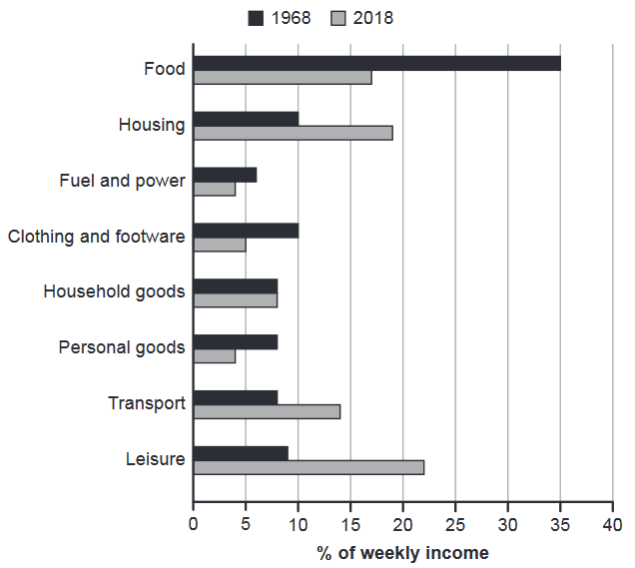
The chart below gives information about how families in one country spent their weekly income in 1968 and in 2018.
Summarise the information by selecting and reporting the main features, and make comparisons where relevant.
1968 and 2018: average weekly spending by families
Student answer (Band 5.5)
The bar graph below illustrates the spendings of their family in every week in the years 1968 and 2018. The percentage of the income spends for food, housing, fuel and power, clothing and footware, househod goods, personal goods, transport and leisure.
Overall, it is evident that highest percentage of salary in 1968 spent on food, whereas in 2018 was on leisure. The least amout spended in 1968 was fuel and power, while in 2018 was personal goods.
Firstly, we would consider the food, 35% of income spended in 1968, whereas in 2018 declined to below 20%. Leisure featured more than 10% in 1968 and while in 2018 its increased to more than 20%. Respectively housing marks as 10% in 1968 and in 2018 was
AI examiner evaluation
| Criterion | Band |
|---|---|
| Task Achievement / Task Response | 5.0 |
| Coherence and Cohesion | 5.5 |
| Lexical Resource | 5.5 |
| Grammatical Range and Accuracy | 5.0 |
| Overall | 5.5 |
Task Achievement / Task Response: Band 5.0
You identify the chart’s main contrast: food takes the largest share in 1968, while leisure is highest in 2018, and you note the lowest categories in each year. The figures for food and housing in 1968 are accurate, and the food decline and leisure rise are relevant comparisons. However, the response is incomplete: it stops while describing housing, so the 2018 housing figure and most other categories are not reported. The overview is useful but the body covers only a small selection of the data, leaving the task partially addressed. The response also contains 124 words, below the required 150. To improve, complete the comparison and include a few key figures for categories such as transport, clothing, and fuel and power.
Coherence and Cohesion: Band 5.5
The response has a recognisable structure, with an introduction, an overview, and a body paragraph beginning with “Firstly.” This helps the reader identify the purpose of each section. The overview also groups the highest and lowest spending categories, giving the report a basic organising idea. However, the body does not develop into a complete comparison and ends abruptly at “in 2018 was,” so progression is limited. Linking is also sometimes awkward: “and while” joins ideas incorrectly, and “Respectively” does not clearly show which figures are being compared. Organise the body into clear comparisons across the two years, use straightforward links such as “by contrast” or “whereas,” and ensure the final sentence is complete.
Lexical Resource: Band 5.5
You use relevant chart vocabulary, including “percentage,” “income,” “declined,” and “featured,” and the reader can generally understand the categories being discussed. There is some attempt to vary wording rather than repeat “spending” throughout. However, several word choices and forms are inaccurate or unnatural, such as “spendings,” “the income spends,” and “amout spended.” There are also spelling errors in “househod” and “footware.” These noticeable problems limit precision and sometimes make the phrasing difficult to follow. Use standard collocations for describing charts, such as “accounted for” or “made up,” and check the spelling of category labels. More accurate vocabulary would make the comparisons clearer without requiring more elaborate wording.
Grammatical Range and Accuracy: Band 5.0
You attempt to use comparison clauses, for example “35% of income … in 1968, whereas in 2018 declined to below 20%,” and the overview uses a contrast between the two years. However, the range of sentence structures is limited, and errors occur frequently in basic sentence construction. Several clauses lack a clear subject or a correctly formed verb, as in “the highest percentage of salary in 1968 spent on food” and “in 2018 was on leisure.” The final housing sentence is unfinished, while “and while” creates a faulty connection between clauses. Practise complete subject–verb structures, for example, “Food accounted for 35% in 1968, but its share fell to 17% in 2018.” Check each sentence for a main verb and a complete ending.
See this exact question answered at other band scores. The same prompt compared across bands.
Browse more IELTS Writing model answers or get your own writing scored by the same AI examiner.