Band 6.5 IELTS Writing Task 1 Model Answer
Overall Band Score: 6.5 · Cambridge IELTS 17 · 2026-11-15
IELTS Writing Task 1 question
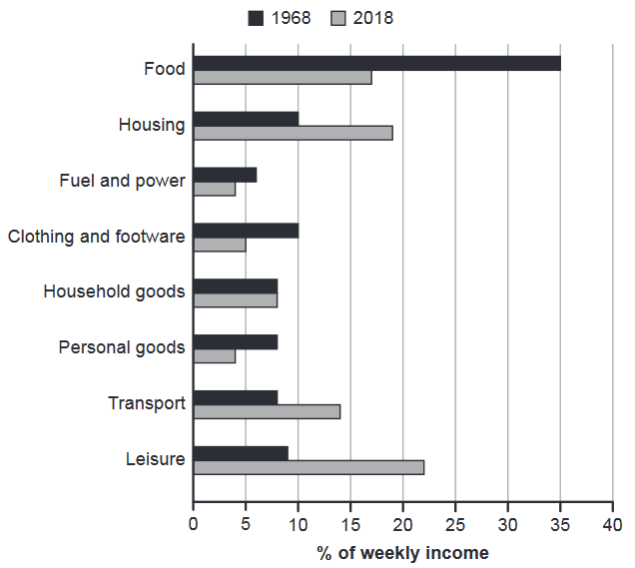
The chart below gives information about how families in one country spent their weekly income in 1968 and in 2018.
Summarise the information by selecting and reporting the main features, and make comparisons where relevant.
1968 and 2018: average weekly spending by families
Student answer (Band 6.5)
The chart illustrates the comparative details about the consumption of weekly income by families in 1968 and 2018.
Overall, families used the biggest part of their income on food in 1968 and on leisure in 2018. Whereas fuel & power recorded as the least expense in both years. Food expanse showed a dramatic decrease with thew passage of time, while expanses on housing and leisure increased.
Food expanses consumed the highest amount from income (35%) but experienced a sharp decline to around 17% in 2018. Meanwhile, expanses on personal good (8% vs 4%), clothing and footwear (10% vs 5%) and fuel & power (6% vs 4%) also showed a decline over the period of time.
On the other hand, expenditure on leisure rose from just under 10% to 23% followed by housing expanses that rose from 10% to 19% between 1968 and 2018. Whereas household goods accounted for around 8% in both years.
AI examiner evaluation
| Criterion | Band |
|---|---|
| Task Achievement / Task Response | 7.0 |
| Coherence and Cohesion | 7.0 |
| Lexical Resource | 6.0 |
| Grammatical Range and Accuracy | 6.5 |
| Overall | 6.5 |
Task Achievement / Task Response: Band 7.0
You identify the main overall shifts clearly: food was the largest category in 1968, leisure became the largest in 2018, and spending on food fell while housing and leisure rose. The response also supports these points with relevant figures and covers several declining categories, as well as the stable household-goods figure. This gives a clear account of the chart’s key features. However, the overview says fuel and power was the least expense in both years, which is not accurate for 2018: personal goods and fuel and power are both about 4%. Transport, which rose substantially from 8% to 14%, is also omitted from the detailed comparisons. More precise coverage of these features would make the report more complete and better supported.
Coherence and Cohesion: Band 7.0
The information is organised in a clear progression: an introduction, an overview, then details about decreases and increases. The contrast between “Meanwhile” and “On the other hand” helps distinguish the two groups of trends, and the comparisons are generally easy to follow. Paragraphing is appropriate for a short chart report. Some linking is less effective, however. The final sentence begins with “Whereas” but is not joined to a main clause, leaving it as a fragment; “Whereas” is also used in the overview in a way that makes the contrast slightly awkward. Grouping the figures more systematically—for example, all rising categories together and all falling or stable categories together—would strengthen the progression and reduce the sense of a list.
Lexical Resource: Band 6.0
You use a reasonable range of task-related vocabulary, including “comparative details,” “sharp decline,” “rose,” and “accounted for,” and the reader can understand the trends you describe. There are, however, repeated word-choice and spelling problems that limit precision. “Expanse” is repeatedly used where “expenditure” or “spending” is intended, and “consumption of weekly income” is not a natural collocation for describing a budget. “Personal good” should be plural in this context, while “footware” is misspelled in the response’s category label. Some repetition of “expanses” also makes the report less fluent. More accurate collocations and a wider choice of reporting verbs would improve clarity and control.
Grammatical Range and Accuracy: Band 6.5
You attempt a mix of simple and more complex structures, including the contrast in “Food … experienced a sharp decline … Meanwhile…” and the comparison “rose from … to …”. Most of the intended meaning remains clear, but some grammatical errors persist. In “fuel & power recorded as the least expense,” the verb pattern is incomplete; write “fuel and power was the smallest expense.” The final “Whereas household goods…” clause is a fragment and should be joined to the preceding sentence or rewritten as a complete sentence. “Food … consumed the highest amount from income” also has an awkward grammatical construction. These examples show that complex linking is attempted, but more consistent control of clause structure and sentence completeness is needed.
See this exact question answered at other band scores. The same prompt compared across bands.
Browse more IELTS Writing model answers or get your own writing scored by the same AI examiner.