Band 5.5 IELTS Writing Task 1 Model Answer
Overall Band Score: 5.5 · Cambridge IELTS 17 · 2026-11-15
IELTS Writing Task 1 question
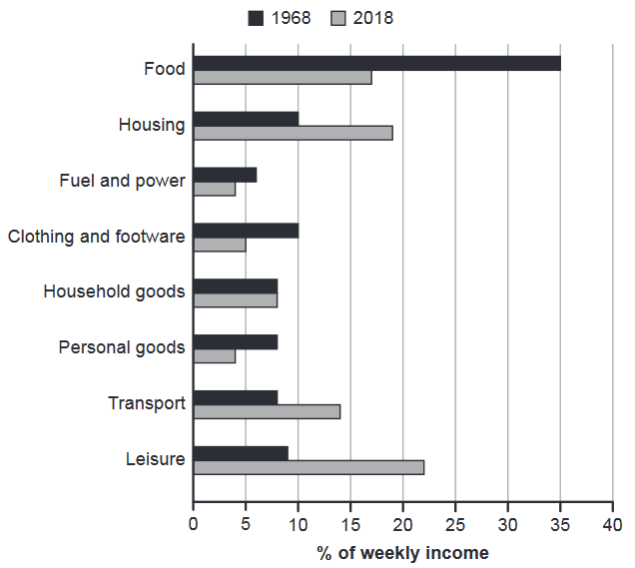
The chart below gives information about how families in one country spent their weekly income in 1968 and in 2018.
Summarise the information by selecting and reporting the main features, and make comparisons where relevant.
1968 and 2018: average weekly spending by families
Student answer (Band 5.5)
The bar chart compares the expenditure of weekly income in eight different categories among the families in a country in 1968 and 2018.
Overall, the highest percentage of income was used in buying foods, while the lowest amount of money was spent on fuel and power.Over time, considerable amount of money was spent in leisure activities which surpassed both housing and food in 2018.
As can be seen, the amount of money spent on food decreased significantly from 35% in 1968 to about 17% in 2018. Similarly, in the year 1968 higher amount of money was spent on fuel and power, clothing and footware, and personal goods which decreased drastically by 2018. During this period, families spent lowest amount of money in fule and power which was about 7% and 4% respectively.Meanwhile, between 1968 and 2018, the money spent on buying household goods remained unchange at about 7%.
In addition, in 1968, the money spent on housing was 10%, at about 8% and 9% for transport and leisure respectively. By 2018, the money spent on these three categories increased significant
AI examiner evaluation
| Criterion | Band |
|---|---|
| Task Achievement / Task Response | 5.5 |
| Coherence and Cohesion | 5.5 |
| Lexical Resource | 6.0 |
| Grammatical Range and Accuracy | 5.5 |
| Overall | 5.5 |
Task Achievement / Task Response: Band 5.5
You identify the main fall in food spending, from 35% to 17%, and note the rise in leisure, which becomes the largest category in 2018. These are relevant headline features. However, the overview is not fully accurate: fuel and power was the lowest category in 2018, but in 1968 it was not the lowest; several categories were lower. The response also ends before completing the comparison of housing, transport and leisure, and does not report their 2018 figures. Some details are imprecise, such as household goods remaining at about 7% rather than 8%. To make the summary more complete, give a clear overview of the major shifts and finish the comparisons for the categories introduced.
Coherence and Cohesion: Band 5.5
The response has a recognisable structure, with an introduction, an overview and paragraphs describing changes, and linking phrases such as “Similarly,” “Meanwhile” and “In addition” help signal relationships. However, progression is weakened by grouping several categories together without giving their individual figures, then introducing housing, transport and leisure in the final paragraph without completing the comparison. The overview’s claim about the lowest category also conflicts with the later detail. Some transitions feel mechanical, and the final sentence is incomplete, leaving the reader without a clear ending. Organise the body around the main decreases and increases, and ensure each paragraph develops its comparison fully.
Lexical Resource: Band 6.0
You use a suitable range of chart vocabulary, including “percentage,” “decreased significantly,” “surpassed” and “remained.” These choices communicate the broad trends and show some flexibility. However, several expressions are imprecise or awkward for describing data: “expenditure of weekly income,” “amount of money was spent in leisure activities,” and “higher amount of money” could be expressed more naturally. There are also spelling and word-form errors, including “footware,” “fule” and “unchange.” Use concise collocations such as “share of weekly income,” “spending on leisure,” and “remained unchanged,” and check category names carefully. More precise vocabulary would make the comparisons clearer.
Grammatical Range and Accuracy: Band 5.5
The response includes both simple statements and more complex comparisons, for example, “the amount of money spent on food decreased significantly from 35% in 1968 to about 17% in 2018.” Most of the intended meaning is understandable, but some grammatical errors and punctuation problems remain. In “considerable amount of money,” an article is needed, and “which decreased drastically” has an unclear reference because it follows several categories. The sentence beginning “During this period” also has an awkward construction, while “By 2018, the money spent on these three categories increased significant” is incomplete and uses an incorrect adverb form. Review articles, clear pronoun reference, adverb forms and sentence completion to improve accuracy.
See this exact question answered at other band scores. The same prompt compared across bands.
Browse more IELTS Writing model answers or get your own writing scored by the same AI examiner.