Band 6.0 IELTS Writing Task 1 Model Answer
Overall Band Score: 6.0 · Cambridge IELTS 17 · 2026-11-15
IELTS Writing Task 1 question
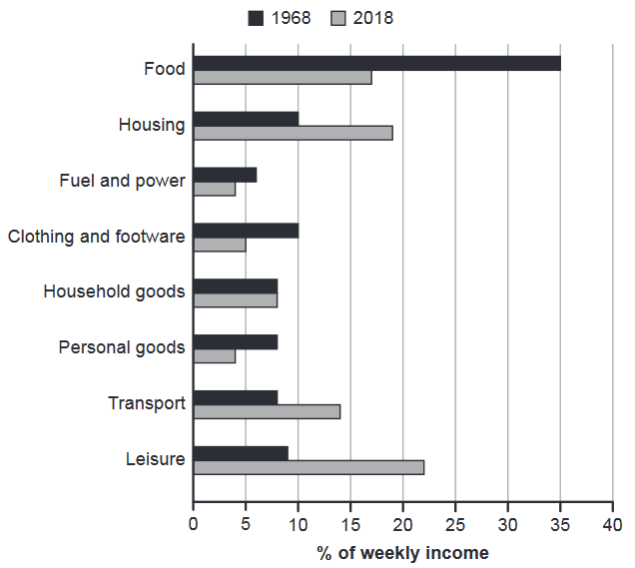
The chart below gives information about how families in one country spent their weekly income in 1968 and in 2018.
Summarise the information by selecting and reporting the main features, and make comparisons where relevant.
1968 and 2018: average weekly spending by families
Student answer (Band 6.0)
The bar chart illustrates average weekly spending by families , and compares the percentages between 1968 and 2018.
Overall, the largest proportion in 1968 was food ,followed by housing and clothing and footwear and smallest proportion was fuel and power,while in 2018 the highest percentage was leisure after that we had housing and the lowest percentage personal goods.
Regarding the largest proportion was food accounted for 35% , followed by housing and clothing and footwear made up 10% they had similar percentages, while personal goods, transport and household goods around 7% , leisure close to 10% after that we had the smallest proportion fuel and power contributed around 6%.
In 2018, the largest percentage leisure increased to around 23% , second ranked housing rose to 19%, followed by food dropped to around 17%, transport jumped to 14%, household goods accounted for 8%, clothing fell slightly to 5% and the smallest proportion fuel and power and personal goods they decreased to around 3 %
AI examiner evaluation
| Criterion | Band |
|---|---|
| Task Achievement / Task Response | 6.0 |
| Coherence and Cohesion | 6.0 |
| Lexical Resource | 6.0 |
| Grammatical Range and Accuracy | 5.0 |
| Overall | 6.0 |
Task Achievement / Task Response: Band 6.0
You identify the main contrast clearly: food was the largest category in 1968, while leisure led in 2018, and you report several relevant figures. The overview also notes housing’s importance and the low shares for fuel and power or personal goods. Most figures are close to the chart, but the 1968 grouping of personal goods, transport and household goods as “around 7%” is imprecise: each is about 8%. In 2018, fuel and power and personal goods are about 4%, rather than around 3%. The response covers both years, but some comparisons are listed rather than explained; for example, it could highlight the marked fall in food spending and rise in leisure and housing more directly.
Coherence and Cohesion: Band 6.0
The response has a recognisable structure: an introduction, an overview, and separate descriptions of the two years. This makes the main information reasonably easy to follow. However, progression within paragraphs is sometimes weakened by list-like reporting and mechanical links such as “followed by,” “after that,” and “while.” The overview’s long sentence combines several rankings, and the 1968 detail sentence moves through categories without a clear grouping principle. Use shorter, more controlled sentences and organise details around meaningful contrasts—for instance, categories that rose, fell, or stayed stable. Clearer punctuation and more precise referencing would also make the relationships between figures easier to follow.
Lexical Resource: Band 6.0
You use an adequate range of task-relevant vocabulary, including “proportion,” “accounted for,” “increased,” “dropped,” and “jumped,” and the meaning is generally clear. There is some variation in how you describe changes, although “largest proportion” and “percentage” recur frequently. A few choices are imprecise or awkward: “second ranked housing” is not a natural way to describe the category’s position, and “they had similar percentages” has an unclear reference. Check spelling and standard forms, particularly “footwear” rather than “footware.” To improve, use precise terms such as “share” or “expenditure,” and choose verbs that accurately distinguish a rise, fall, or stable figure.
Grammatical Range and Accuracy: Band 5.0
You attempt both simple statements and more complex comparisons, including clauses linked with “while” and “followed by.” The overall meaning can usually be understood, but some sentence structures are not controlled, and punctuation errors make several sentences difficult to read smoothly. For example, “Regarding the largest proportion was food accounted for 35%” combines an introductory phrase with a clause that does not form a complete grammatical structure. In “the smallest proportion fuel and power and personal goods they decreased,” the categories and verb are not joined correctly. Use a clear subject and verb in each clause, and separate complete ideas with full stops or semicolons. Commas should also be placed consistently around clauses.
See this exact question answered at other band scores. The same prompt compared across bands.
Browse more IELTS Writing model answers or get your own writing scored by the same AI examiner.