Band 5.0 IELTS Writing Task 1 Model Answer
Overall Band Score: 5.0 · Cambridge IELTS 17 · 2026-11-16
IELTS Writing Task 1 question
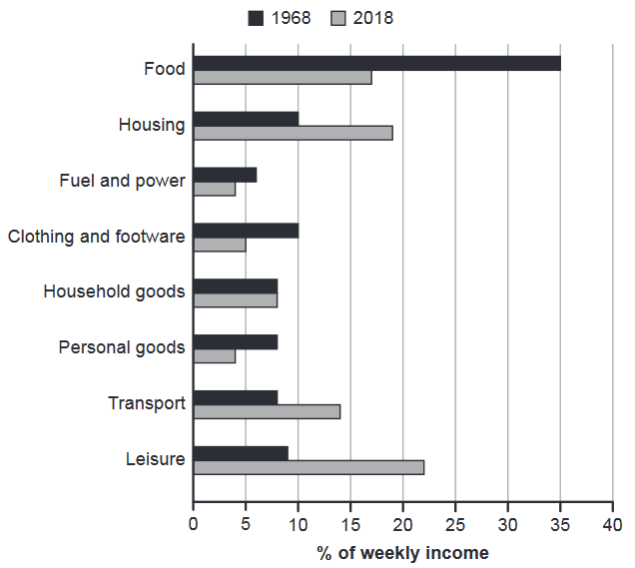
The chart below gives information about how families in one country spent their weekly income in 1968 and in 2018.
Summarise the information by selecting and reporting the main features, and make comparisons where relevant.
1968 and 2018: average weekly spending by families
Student answer (Band 5.0)
The given bar illustrates the amount of weekly income spent for six different purpose by families in a particular country from 1968 to 2018.
Overall, it can be seen that the earliar times the families spent highest sources of income on foods and least on fuel and power whereas the new decade families spent maximum on leisure activity and housing and lowest on personal goods.
To begin with, in 1968 35% of income spent on foods and in 2018 the familes
AI examiner evaluation
| Criterion | Band |
|---|---|
| Task Achievement / Task Response | 4.0 |
| Coherence and Cohesion | 5.0 |
| Lexical Resource | 5.5 |
| Grammatical Range and Accuracy | 5.0 |
| Overall | 5.0 |
Task Achievement / Task Response: Band 4.0
The response identifies two relevant overall patterns: food was the largest spending category in 1968, while leisure and housing were prominent in 2018. It also correctly gives the 1968 food figure as 35%. However, the report is only a partial response: it stops mid-sentence at “in 2018 the familes” and provides no completed comparison or account of most categories. The chart has eight purposes, not six, and the claim that fuel and power was the lowest category in 1968 is inaccurate; it was the lowest at 6%, but the response does not report this figure. The required minimum of 150 words is not met. Complete the report with the main changes and supporting figures, including the rise in leisure and housing and the fall in food spending.
Coherence and Cohesion: Band 5.0
There is a basic attempt to organise the response: an introduction is followed by an overview and the start of a detail paragraph. “Overall” and “To begin with” signal these stages, so the reader can recognise the intended structure. However, there is no clear progression beyond the opening detail, and the final sentence is unfinished, leaving the comparison incomplete. The overview also combines several categories without developing them into a coherent account of the chart. To improve, use a complete paragraph for the main comparisons and group related changes—for example, categories that increased versus those that decreased. Ensure each sentence is finished and that linking phrases connect complete ideas rather than merely announcing a section.
Lexical Resource: Band 5.5
The response uses some relevant chart vocabulary, including “weekly income,” “spent,” “highest,” and “lowest,” and the meaning is generally understandable. However, the range is limited and several choices are inaccurate or awkward: “six different purpose” misstates the number of categories and has an incorrect plural form, while “highest sources of income on foods” does not clearly express spending. There are also spelling errors such as “earliar” and “familes,” and “foods” is less suitable than “food” for this category. Aim for precise reporting language such as “share of weekly expenditure,” “accounted for,” and “category,” and check spelling and collocations. More varied, accurate vocabulary would make the comparisons clearer.
Grammatical Range and Accuracy: Band 5.0
The response attempts a few sentence forms, including an overview with “whereas” and a time comparison beginning “in 1968 … and in 2018 …”. However, the range is limited, and errors occur in basic sentence construction. In “35% of income spent on foods,” the verb “was” is missing; “the families spent highest sources of income” also has an unclear grammatical structure. The final sentence is incomplete, ending with “the familes,” so it cannot communicate the intended comparison. There are problems with plural agreement in “six different purpose” and article use in “the earliar times.” Practise complete subject–verb sentences and check that each comparison has a verb and a finished clause.
See this exact question answered at other band scores. The same prompt compared across bands.
Browse more IELTS Writing model answers or get your own writing scored by the same AI examiner.