Band 5.5 IELTS Writing Task 1 Model Answer
Overall Band Score: 5.5 · Cambridge IELTS 17 · 2026-11-16
IELTS Writing Task 1 question
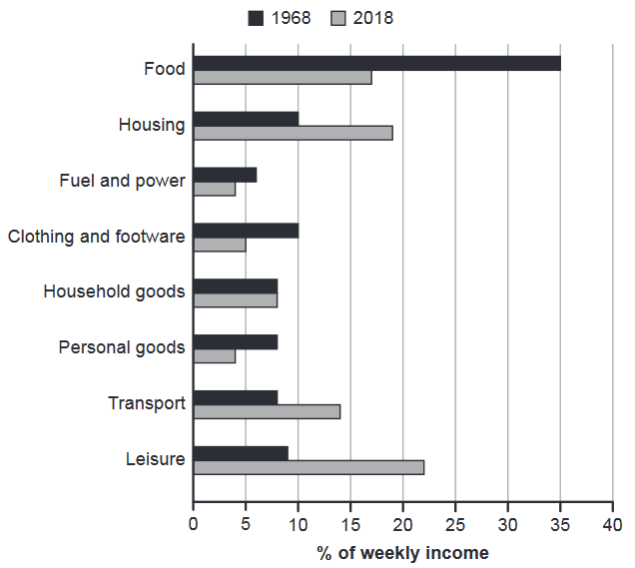
The chart below gives information about how families in one country spent their weekly income in 1968 and in 2018.
Summarise the information by selecting and reporting the main features, and make comparisons where relevant.
1968 and 2018: average weekly spending by families
Student answer (Band 5.5)
The chart below illustrates information about how families in one country spent their weekly income in 1968 and in 2018.
Overall, this report shows the comparison between how families used their weekly salary in one country in different two years. To begin with, the highest amount of income spent on food was about 35% in 1968 however it declined and reached was accord to 17% in 2018 and the lowest number of income was spending on fuel and power in 1968 was about 7%but it also decreased during period and reached was related to 4%.
Moreover, the maximum number of income was spending on leisure to about 22% in 2018 but it was decrease in the beginning was accord to 8% in 1968.
In addition, 10% of weekly income spent on housing in 1968 however, it rise up and was about 18% in 2018. Furthermore, 8% of spent from the total incom on household goods in both years as well as, 7% weekly income was spending on transport in 1968 and it grow up with time period was about 14% in 2
AI examiner evaluation
| Criterion | Band |
|---|---|
| Task Achievement / Task Response | 6.0 |
| Coherence and Cohesion | 5.0 |
| Lexical Resource | 5.0 |
| Grammatical Range and Accuracy | 5.0 |
| Overall | 5.5 |
Task Achievement / Task Response: Band 6.0
You identify several important comparisons, including food falling from about 35% to 17%, leisure rising to 22% from roughly 9%, and housing increasing from 10% to around 19%. These figures support a relevant account of the chart, and you also note that household-goods spending stayed at 8%. However, the overview is not clearly separated from the details, and some comparisons are incomplete or inaccurate: leisure in 1968 was about 9%, not 8%, and transport was about 8%, rather than 7%. The response also ends while reporting the 2018 transport figure, leaving that comparison unfinished and omitting other categories such as clothing and personal goods. Select the main rises and falls, then report them accurately and complete each comparison.
Coherence and Cohesion: Band 5.0
The response has a recognisable sequence: an introduction, an overall statement, and several comparisons introduced by phrases such as “Moreover” and “In addition.” This gives the reader some sense of how the information is being grouped. However, progression is not consistently clear because the overview repeats the introduction rather than summarising the main trends, and the body moves between categories without a clear organising principle. Linking phrases are also used mechanically, while punctuation around them is often confusing. The final sentence breaks off during the transport comparison, which weakens the sense of completion. Grouping the largest changes together and then covering the remaining categories in a separate paragraph would make the report easier to follow.
Lexical Resource: Band 5.0
You use relevant chart vocabulary, including “declined,” “decreased,” “rise up,” and “spent,” so the reader can generally understand whether figures went up or down. However, the range is limited and several phrases are unnatural or imprecise, such as “maximum number of income,” “was accord to,” and “reached was related to.” “Weekly salary” is also less suitable than “weekly income” for describing the chart. Spelling and word-form slips, including “incom,” further reduce accuracy. Aim for concise, conventional expressions for proportions and change, such as “accounted for,” “rose to,” and “fell to.” This would improve precision without requiring more elaborate vocabulary.
Grammatical Range and Accuracy: Band 5.0
You attempt to combine comparisons in longer sentences, for example, “10% of weekly income spent on housing in 1968 however, it rise up…” This shows an effort to use more than simple sentence patterns, but control is inconsistent. Missing or incorrect verb forms occur in “income spent” and “it rise up,” while constructions such as “reached was accord to” make relationships between clauses difficult to follow. Several sentences also run together without appropriate punctuation, particularly around “however” and “as well as.” Use a clear subject and verb in each clause, maintain past-tense forms when describing the years, and separate contrasting clauses with suitable punctuation. These changes would make your comparisons more reliably clear.
See this exact question answered at other band scores. The same prompt compared across bands.
Browse more IELTS Writing model answers or get your own writing scored by the same AI examiner.