Band 5.5 IELTS Writing Task 1 Model Answer
Overall Band Score: 5.5 · Cambridge IELTS 17 · 2026-11-16
IELTS Writing Task 1 question
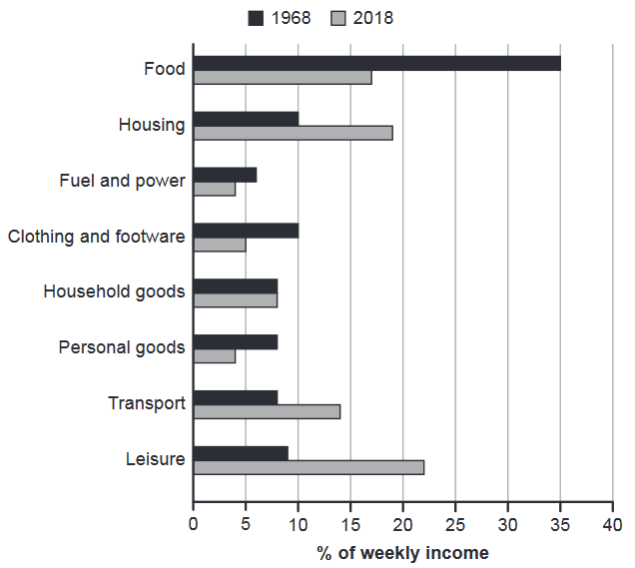
The chart below gives information about how families in one country spent their weekly income in 1968 and in 2018.
Summarise the information by selecting and reporting the main features, and make comparisons where relevant.
1968 and 2018: average weekly spending by families
Student answer (Band 5.5)
The chart illustrates the information about the families in one country use their weekly income in 1968 or 2018.
Overall, The families allocate the large share of income spend on Food over a week and the most least thing people invest their income is Fuel and power.
The families spend their largest proportion of income on Food in 1968 but in 2018 people reduce to invest on Food and know invest in Leisure. In 1968 leisure is only 8% spending field and 2018 leisure in 20% plus spending field. Most of the families is less spend their income on personal good presently in 2018 just only 4% and in 1968 is 7%.
Transport can increase the rate of spending income in 1968 only 8% people invest but now move to 14%. Household goods are comparetively same in 1968 or 2018. Clothing and footware decreased 5% in 2018. Morever Housing is well spending income field the amount is increased 9% in 2018. Fuel and power is most less investing field in 1968 or 2018.
AI examiner evaluation
| Criterion | Band |
|---|---|
| Task Achievement / Task Response | 6.0 |
| Coherence and Cohesion | 6.0 |
| Lexical Resource | 5.0 |
| Grammatical Range and Accuracy | 5.0 |
| Overall | 5.5 |
Task Achievement / Task Response: Band 6.0
You identify several important comparisons, including the sharp fall in food spending, the rise in leisure and transport, and the similar household-goods figures. The overview also attempts to identify the largest and smallest categories. However, it is not fully accurate: fuel and power is not the smallest category in 1968, since clothing and footwear is higher but personal goods and transport are both 8%, while fuel is 6%; in 2018, personal goods and fuel are tied at 4%. Some figures are also imprecise: leisure is about 9% in 1968 and 22% in 2018, and housing rises from 10% to 19%, rather than by 9% as a stated amount. Select the key extremes and report comparisons more precisely.
Coherence and Cohesion: Band 6.0
The response has a recognisable structure: an introduction, an overview, and paragraphs describing changes across categories. This gives the reader a coherent overall route through the information. Some links between ideas are unclear, however. For example, “reduce to invest on Food and know invest in Leisure” makes the intended contrast difficult to follow, and the overview’s claim about the “most least” category is not clearly connected to the later details. The final paragraph lists several categories in sequence without grouping the increases and decreases. Use clearer comparison signals such as “whereas” and “by contrast,” and organise details into meaningful groups so the progression is easier to follow.
Lexical Resource: Band 5.0
You use relevant topic vocabulary, including “proportion,” “spending,” “increased,” and “decreased,” and the reader can generally identify the categories being compared. However, the range and control of collocations are limited, with repeated or unnatural phrases such as “invest their income,” “spending field,” and “most least thing.” These choices sometimes make the meaning less clear, even when the intended comparison can be inferred. There are also spelling errors in “foottage” (written as “footware”) and “Morever.” Aim for precise chart language and natural combinations, such as “accounted for,” “share of weekly income,” and “rose/fell to.”
Grammatical Range and Accuracy: Band 5.0
You attempt both simple statements and longer comparisons, and the main message is usually understandable. However, sentence structures and grammatical control are uneven. For example, “The chart illustrates the information about the families … use their weekly income” lacks a correctly formed clause, while “Most of the families is less spend” has problems with agreement and verb form. The sentence beginning “The families spend their largest proportion…” also shifts awkwardly between present and past. Use a consistent past tense for the two years and check subject–verb agreement, articles, and verb patterns. Shorter, complete sentences would help you express the comparisons accurately while you build more reliable complex structures.
See this exact question answered at other band scores. The same prompt compared across bands.
Browse more IELTS Writing model answers or get your own writing scored by the same AI examiner.