Band 5.5 IELTS Writing Task 1 Model Answer
Overall Band Score: 5.5 · Cambridge IELTS 17 · 2026-11-17
IELTS Writing Task 1 question
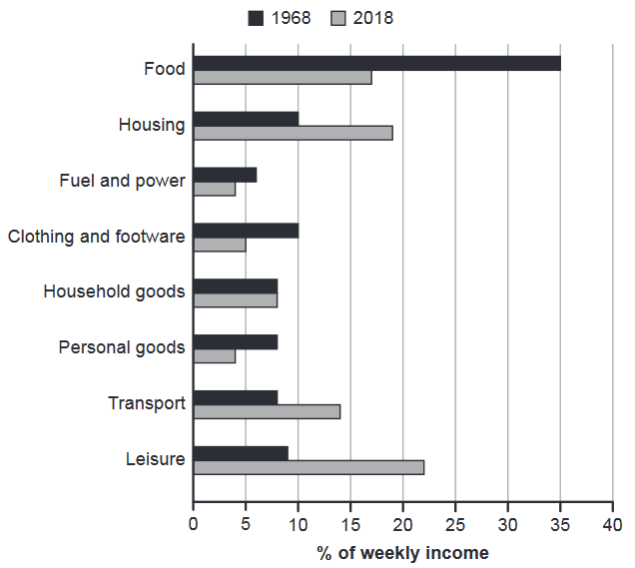
The chart below gives information about how families in one country spent their weekly income in 1968 and in 2018.
Summarise the information by selecting and reporting the main features, and make comparisons where relevant.
1968 and 2018: average weekly spending by families
Student answer (Band 5.5)
The chart illustrates information regarding how families in a country spent their weekly income in 1968 and in 2018.
Overall, spending pattern was changed by families over the time period, their weekly income spending habits were constant but a significant shift was addressed in their priorities about selection of goods or services between 1968 and 2018. Whereas, few remained unchangeable.
Firstly, in 1968 food was on the top of the list and they spent 35% of their weekly earnings on it. Furthermore, housing, clothing and footwear was on the top 2nd priority in past and that's how they consumed15% of their weekly income on these items. At the end, remaining facilities took under 10% of their total weekly income.
Secondly, in 2018 leisure and housing was on top of the list and they spent about 18%-22% on these facilities. The transport and food took place at 2nd priority of public, whereas household goods remained constant. Moreover, remaining necessities took only 5% or less of their weekly spendings.
AI examiner evaluation
| Criterion | Band |
|---|---|
| Task Achievement / Task Response | 6.0 |
| Coherence and Cohesion | 5.5 |
| Lexical Resource | 5.5 |
| Grammatical Range and Accuracy | 5.0 |
| Overall | 5.5 |
Task Achievement / Task Response: Band 6.0
You identify the main change clearly: food was the largest category in 1968, while leisure and housing were the leading categories in 2018. You also report several relevant figures, including food at 35% and the later leading categories at roughly 18–22%. However, some comparisons are inaccurate or unclear. In 1968, housing and clothing were each 10%, not jointly 15%; in 2018, transport was 14% and food 17%, so they were not both the second priority. The claim that remaining categories took 5% or less is also too broad: household goods were 8%. The overview mentions a shift but does not specify the major rises and falls. Select and compare the key changes more precisely, including leisure’s rise and food’s decline.
Coherence and Cohesion: Band 5.5
The response has a recognisable structure: an introduction, an overview, and separate paragraphs for 1968 and 2018. This gives the reader a basic route through the information. However, progression is weakened by mechanical sequencing such as “Firstly” and “Secondly,” and some links do not express the relationships accurately. “Whereas, few remained unchangeable” is an incomplete, awkwardly connected idea, while “At the end” does not clearly signal a meaningful comparison. The overview also repeats the idea of changing spending habits without organising the main contrasts. Group the largest increases and decreases, then use clear comparisons between years; this would make the progression more coherent and reduce reliance on formulaic transitions.
Lexical Resource: Band 5.5
You use relevant task vocabulary, including “weekly income,” “priorities,” “transport,” and “household goods,” and the reader can generally understand the categories being discussed. However, several word choices and collocations are unnatural or imprecise, which limits clarity: “a significant shift was addressed” does not naturally describe a change in spending, and “facilities” is not an appropriate substitute for spending categories such as food or housing. “On the top 2nd priority” and “took place at 2nd priority” are also awkward. Use precise chart language such as “accounted for,” “share,” “category,” “rose,” and “fell.” Check spelling and forms as well, for example “footwear” rather than “footware,” and avoid repeating “top of the list” where “largest share” is more exact.
Grammatical Range and Accuracy: Band 5.0
You attempt both simple statements and longer sentences, and the main message is usually understandable. However, control of sentence structure and agreement is inconsistent. For example, “spending pattern was changed” has an awkward passive construction, while “housing, clothing and footwear was” uses a singular verb with a plural subject. The sentence beginning “Whereas” is a fragment, and “their weekly income spending habits were constant but a significant shift…” joins ideas in a confusing way. Articles and prepositions also need attention in phrases such as “on the top 2nd priority.” Use complete, direct sentences and check subject–verb agreement, verb forms, and punctuation when combining clauses. More accurate control of these patterns would make the comparisons easier to follow.
See this exact question answered at other band scores. The same prompt compared across bands.
Browse more IELTS Writing model answers or get your own writing scored by the same AI examiner.