Band 6.0 IELTS Writing Task 1 Model Answer
Overall Band Score: 6.0 · Cambridge IELTS 17 · 2026-11-17
IELTS Writing Task 1 question
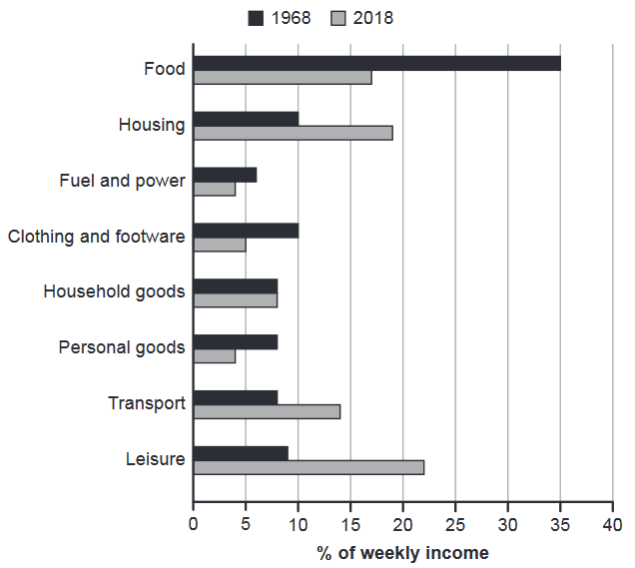
The chart below gives information about how families in one country spent their weekly income in 1968 and in 2018.
Summarise the information by selecting and reporting the main features, and make comparisons where relevant.
1968 and 2018: average weekly spending by families
Student answer (Band 6.0)
The graph below illustrates the details about the nation household managing their weekly salary in 1968 and 2018.
Overall, the amount spent on food was double in 1968 than in 2018, whereas the least amount was used for fuel and power, and Personal goods. By 2018, the maximum cash is used for Leisure.
In 1968, food, fuel and power, clothing and footware, and personal goods were more expensive than in 2018. Food consumes around 35% of the income, whereas other categories remain between 5% to 10%. Household goods was at the same rate below 10% in both years.
In 2018, most of the amount was utilized for Leisure, which is double than in 1968. Food, housing, and transport are expensive, it take 14% - 18% of total income, while fuel and power, clothing and footware, household goods, and Personal goods use 4% to 8% and are the least spending categories.
AI examiner evaluation
| Criterion | Band |
|---|---|
| Task Achievement / Task Response | 6.5 |
| Coherence and Cohesion | 6.5 |
| Lexical Resource | 6.0 |
| Grammatical Range and Accuracy | 5.5 |
| Overall | 6.0 |
Task Achievement / Task Response: Band 6.5
You identify the main contrast between the years: food takes a much larger share in 1968, while leisure is the largest category in 2018. You also report several relevant figures and note that household goods stayed unchanged. These features support a clear overview. However, some comparisons are inaccurate or too broad: food at 35% is not double 17% (it is a little over twice), and leisure at 22% is not double 9%. The claim that food, housing and transport in 2018 each take 14–18% also misses housing at about 19% and food at 17%. To strengthen the response, report the leading categories more precisely and distinguish the smallest shares in each year; fuel and power is lowest in both years, rather than being tied with personal goods overall.
Coherence and Cohesion: Band 6.5
The response has a clear four-paragraph structure, moving from an introduction and overview to separate descriptions of 1968 and 2018. This gives the information a coherent overall arrangement, and linking expressions such as “Overall,” “whereas” and “In 2018” help signal comparisons. Some connections are less clear, however. The sentence “Food, housing, and transport are expensive, it take 14% - 18%” joins two clauses awkwardly, and the shift from “most of the amount” to a list of other categories could be more smoothly organised. Grouping the largest and smallest categories within each year, then comparing them directly, would create clearer progression. Use reference words carefully so that each comparison clearly identifies the year and category.
Lexical Resource: Band 6.0
You use an adequate range of task-related vocabulary, including “income,” “categories,” “utilized” and “amount spent,” and the reader can generally understand the comparisons. There are, however, several imprecise or unnatural choices that limit flexibility. “Nation household managing their weekly salary” does not naturally describe the chart, while “more expensive” suggests prices rather than proportions of income. “Maximum cash is used” and “least spending categories” are also awkward in this context. Spelling errors in “footware” and inconsistent capitalisation of “Personal goods” reduce accuracy. Prefer precise terms such as “share of weekly income,” “accounted for” and “expenditure,” and check the spelling of category labels.
Grammatical Range and Accuracy: Band 5.5
You attempt both simple and more complex sentence forms, including a contrast with “whereas” and a relative clause in “which is double than in 1968.” The main ideas remain understandable, but some grammatical errors recur. For example, “the amount spent on food was double in 1968 than in 2018” uses an incorrect comparison pattern; write “was more than twice as high as.” In “Food, housing, and transport are expensive, it take…,” the clauses are incorrectly joined and “it take” does not agree with the plural subject. “Household goods was” also has a subject–verb agreement error. Practise accurate comparative structures and check agreement and sentence boundaries. More consistently controlled complex sentences would improve accuracy.
See this exact question answered at other band scores. The same prompt compared across bands.
Browse more IELTS Writing model answers or get your own writing scored by the same AI examiner.