Band 5.5 IELTS Writing Task 1 Model Answer
Overall Band Score: 5.5 · Cambridge IELTS 17 · 2026-11-18
IELTS Writing Task 1 question
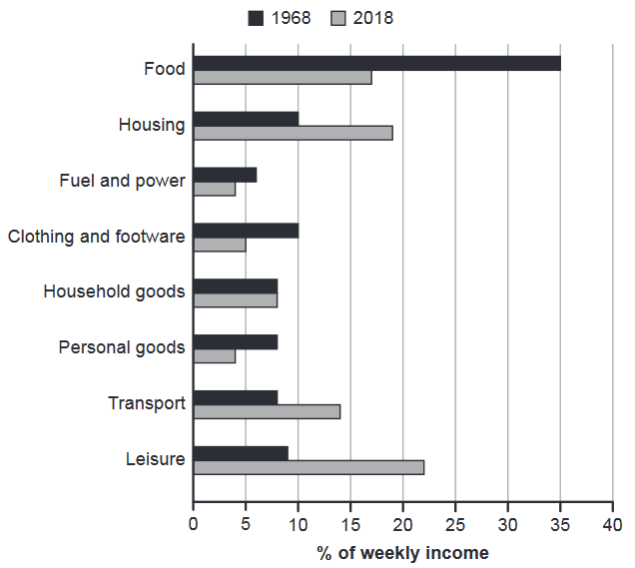
The chart below gives information about how families in one country spent their weekly income in 1968 and in 2018.
Summarise the information by selecting and reporting the main features, and make comparisons where relevant.
1968 and 2018: average weekly spending by families
Student answer (Band 5.5)
The illustration shows the serving of their weekly income in 1968 and in 2018, in one country. Overall, people spent a great amount of their income on food in 1968 which was lowered in 2018.
It is quite evident from the graph that in 1968, people spent almost 35% of their income on food while in 2018 people only spent almost 15% of their income on food items. In 1968, 10% of the people use their income on housing which increased to almost 20% in 2018. The expenditure on fuel and power were almost same in 1968 and 2018.
Furthurmore, in 1968, clothing and footware costs 10% of the total weekly income which lowered to only 5% in 2018. Household as well as personal goods costs almost same with percentage of 8% in 1968. Some people also spent their income on leisure which was almost 10% in 1968 and increased to above 20% in 2018.
AI examiner evaluation
| Criterion | Band |
|---|---|
| Task Achievement / Task Response | 5.5 |
| Coherence and Cohesion | 6.0 |
| Lexical Resource | 5.5 |
| Grammatical Range and Accuracy | 5.5 |
| Overall | 5.5 |
Task Achievement / Task Response: Band 5.5
You identify the main contrast in food spending and report several relevant categories, including housing, clothing and leisure. The figures for food, housing, clothing and leisure are broadly accurate, although food in 2018 is closer to 17% than “almost 15%.” The overview is limited to the fall in food spending; it should also highlight that leisure became the largest category in 2018 and that housing and transport rose. Transport is omitted, and the statement that household and personal goods were “almost same” is unclear because only household goods stayed level, while personal goods fell. The response is 147 words, three short of the 150-word minimum; the eight words copied from the prompt are excluded. Develop the overview and cover the key changes more fully.
Coherence and Cohesion: Band 6.0
The response has a generally understandable order: an introduction and overview are followed by details for the two years, with “Furthermore” introducing another comparison. This gives the reader a basic progression through the chart. However, the body is not clearly divided into paragraphs, and the comparisons are presented somewhat mechanically, often as separate category-by-category statements. The final sentence combines leisure with the earlier discussion of household and personal goods, making the grouping less clear. Use distinct overview and detail paragraphs, and organise the details around the largest increases and decreases. More precise links between comparisons would also help; for example, contrast the rise in leisure and housing with the fall in food and clothing.
Lexical Resource: Band 5.5
You use a relevant range of chart vocabulary, including “weekly income,” “expenditure,” “increased,” and “lowered,” and the meaning is generally clear. However, several choices are inaccurate or unnatural: “the serving of their weekly income” does not describe spending, and “people use their income on housing” is an awkward way to report a proportion. “Food items” is less precise than simply “food,” while “costs” is not the best noun for the share of income spent. There are also spelling errors in “Furthurmore” and “footware.” Aim for accurate collocations such as “accounted for,” “spent on,” and “the proportion allocated to,” and check spelling before submitting.
Grammatical Range and Accuracy: Band 5.5
You communicate the main comparisons using a mixture of simple statements and some subordinate clauses, such as “while in 2018 people only spent…” and “which increased to almost 20%.” Most sentences remain understandable, but some grammatical errors recur. In “10% of the people use their income,” the past-tense report requires “used,” and the subject should be the spending share rather than the people. Agreement is also inconsistent in “The expenditure … were” and “clothing and footware costs.” The phrase “Household as well as personal goods costs almost same” lacks a clear grammatical structure and an article before “the same.” Use consistent past tense, check subject–verb agreement, and practise forming comparisons with accurate noun phrases.
See this exact question answered at other band scores. The same prompt compared across bands.
Browse more IELTS Writing model answers or get your own writing scored by the same AI examiner.