Band 6.0 IELTS Writing Task 1 Model Answer
Overall Band Score: 6.0 · Cambridge IELTS 17 · 2026-11-19
IELTS Writing Task 1 question
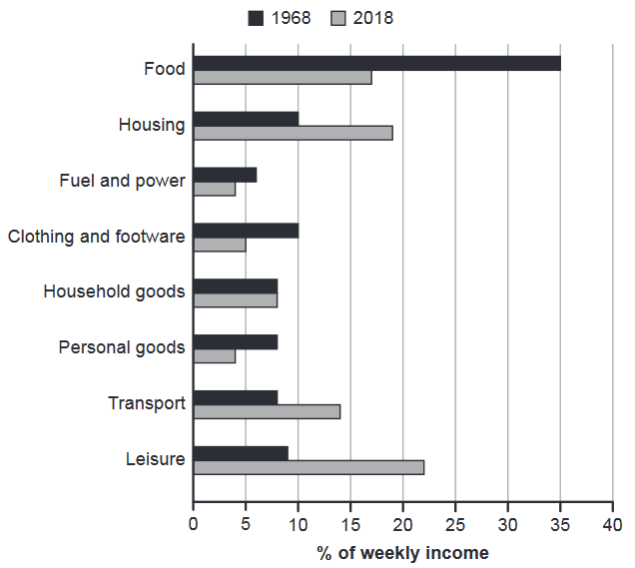
The chart below gives information about how families in one country spent their weekly income in 1968 and in 2018.
Summarise the information by selecting and reporting the main features, and make comparisons where relevant.
1968 and 2018: average weekly spending by families
Student answer (Band 6.0)
The chart illustrates the, spending of families in a country. It was a comparison between two years, 1968 and 2018. It was about what they have spend on their grocery, housing, fuels,cloathing, personal goods, transfort and leisure.
Overall, families spent the largest portion of their weekly income on food in 1968, whereas leisure become the biggest expenditure in 2018.It is alo clear that spending on housing, transport and leisure increased, while the proportion allocated to food, fuelpower, clothings,persnol goods, decreased. Meanwhile expenditure on household goods remained stable.
While in the year 1968 food spendings were on 35% but it decreased in 2018 and came at 17%. Also cloathing and footware were at 10% in 1968 but it came down approximately 5%.More in1968 personal goods were at 7% and in 2018 it was 3.5%. While household goods remain constant at 8% relatively.
Further, housing increased from approximately 10% to 18%. Also transport rose from 7% to 18%. Leisure increased considerably from 9% to 22%.
AI examiner evaluation
| Criterion | Band |
|---|---|
| Task Achievement / Task Response | 6.5 |
| Coherence and Cohesion | 6.0 |
| Lexical Resource | 5.5 |
| Grammatical Range and Accuracy | 5.5 |
| Overall | 6.0 |
Task Achievement / Task Response: Band 6.5
You provide a clear overview of the main shift: food was the largest category in 1968, while leisure led in 2018, and you identify several increases and decreases. Most reported figures are close to the chart, including food, clothing, household goods, housing and leisure. However, some details are inaccurate: transport rose from 8% to 14%, not from 7% to 18%, and personal goods were 8% and 4%, rather than 7% and 3.5%. Fuel and power also fell from 6% to 4%, but this category receives no figures in the body. The response covers the task and selects relevant features, but more precise reporting and fuller support for the overview would strengthen it further.
Coherence and Cohesion: Band 6.0
The response has a coherent overall arrangement: an introduction, an overview, and two paragraphs comparing categories. This makes the main message easy to follow. You also use linking expressions such as “Overall,” “While,” “Further,” and “Meanwhile.” At times, however, these links feel mechanical or do not connect ideas smoothly; for example, “More in1968” is unclear, and the repeated use of “Also” gives the final paragraphs a list-like quality. Some punctuation and spacing around sentence boundaries also interrupt the flow. Grouping the categories more deliberately—for example, decreases together and increases together—and using clearer transitions would make progression more natural.
Lexical Resource: Band 5.5
You use relevant task vocabulary, including “portion,” “expenditure,” “allocated,” “increased,” and “remained stable,” which helps describe the chart. There is some variety in how you report change, particularly in “decreased,” “rose,” and “increased considerably.” However, spelling errors and imprecise or awkward choices are noticeable, including “cloathing,” “transfort,” “persnol,” and “fuelpower.” Phrases such as “what they have spend on their grocery” and “food spendings were on 35%” are not natural collocations for this task. Aim for accurate category names and standard chart language, such as “spending on food accounted for” or “the proportion spent on transport.”
Grammatical Range and Accuracy: Band 5.5
You attempt a mix of simple and more complex forms, including a contrast with “whereas” and a subordinate clause beginning “While.” The overall meaning is generally understandable, but some grammatical errors and punctuation problems remain. For example, “It was about what they have spend” has an incorrect verb form and tense, while “leisure become the biggest expenditure” needs past-tense agreement. The opening sentence also has an unnecessary comma after “the,” and several sentences run together without a space after the full stop. Some constructions, such as “food spendings were on 35%,” are grammatically awkward. Check tense consistency when describing past data and proofread sentence boundaries and verb forms.
See this exact question answered at other band scores. The same prompt compared across bands.
Browse more IELTS Writing model answers or get your own writing scored by the same AI examiner.