Band 5.0 IELTS Writing Task 1 Model Answer
Overall Band Score: 5.0 · Cambridge IELTS 17 · 2026-11-19
IELTS Writing Task 1 question
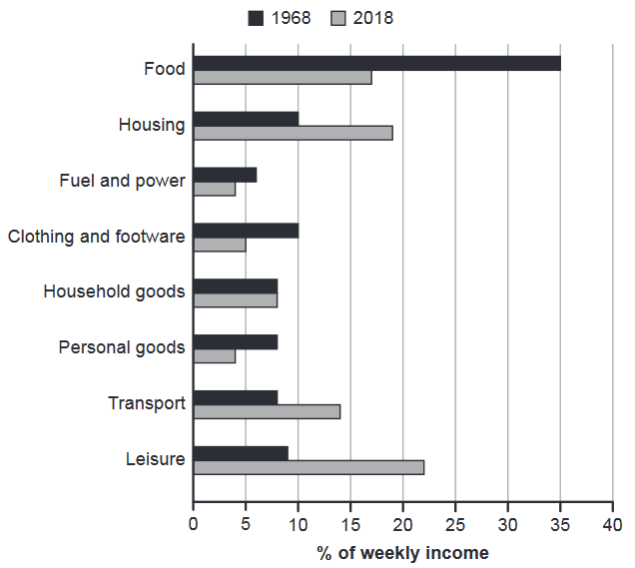
The chart below gives information about how families in one country spent their weekly income in 1968 and in 2018.
Summarise the information by selecting and reporting the main features, and make comparisons where relevant.
1968 and 2018: average weekly spending by families
Student answer (Band 5.0)
The chart illustrates how the family spend their family income in 1968 and 2018. Overall, the spending on food was highest in 1968, while the leisure spending increased in 2018.In 1968 family spent 35% on food .They spent around 10& on housing.They spent approximately 5% on fuel and power .On clothing and footware they spent 5% of their family income .They spent approximately on household goods about 7% of their family income and the transport and personal goods approximately 8%.Moreover in 2018 the most of their family income spent on leisure about 23% and lowest spent on personal goods, fuel and power approximately 4% oh their family income.Household goods remained same in 1968 and 2018 about 8%.Housing increased from 10% to 19% in the 2018 .They spent the 4% on fuel and power, personal goods.They spent on the food about 17% of their family income. In the last they spent clothing and footware about 5%
AI examiner evaluation
| Criterion | Band |
|---|---|
| Task Achievement / Task Response | 5.5 |
| Coherence and Cohesion | 5.0 |
| Lexical Resource | 5.0 |
| Grammatical Range and Accuracy | 5.0 |
| Overall | 5.0 |
Task Achievement / Task Response: Band 5.5
You identify the main contrast that food was the largest category in 1968 and leisure was largest in 2018, and you report several relevant figures, including food at 35% and 17% and housing rising from 10% to 19%. However, the overview is brief and does not summarise the broader shift in spending, while some details are inaccurate: clothing and footwear in 1968 was about 10%, not 5%, and transport in 2018 was about 14% but is not reported. The statement that household goods stayed at about 8% is accurate. To make the response more complete, select the most notable increases and decreases and compare them clearly, rather than listing categories unevenly.
Coherence and Cohesion: Band 5.0
The response has a basic overall order: it introduces the chart, gives a short overview, and then discusses the two years. Some comparisons, such as housing rising from 10% to 19% and household goods remaining stable, help connect the data. However, most information is presented as a long sequence of short statements, with little clear grouping or progression. The transition “Moreover in 2018” is awkward, and “In the last” does not clearly signal the final category. Punctuation and spacing also make the flow harder to follow. Organise the details into separate paragraphs for the overview and comparisons, and group related changes—for example, rising categories together and falling categories together.
Lexical Resource: Band 5.0
You use relevant chart vocabulary such as “spending,” “increased,” “remained same,” and “approximately,” so the reader can generally understand the categories and comparisons. However, the range is limited and several phrases are repetitive or imprecise, especially the repeated “They spent” and “their family income.” Some word choices and spelling reduce accuracy, including “footware” and “oh” in place of “of.” Use more precise expressions for proportions and change, and vary the reporting verbs. For example, describe a category as “accounted for” a share of income, or say that spending “fell” or “rose” between the years. Check category names against the chart before writing.
Grammatical Range and Accuracy: Band 5.0
Most sentences use simple structures, and the basic meaning is usually recoverable. There are frequent errors in sentence formation and punctuation, however, which make the response less fluent. For example, “the family spend their family income” has a subject–verb form problem, while “the most of their family income spent on leisure” is missing a clear verb construction. The sentence beginning “They spent approximately on household goods about 7%” is also awkwardly ordered. Several sentences run together without spaces after full stops, and the opening overview joins two clauses without appropriate spacing or punctuation. Practise accurate patterns such as “Families spent X% on…” and “X accounted for…,” then proofread each sentence for a complete verb phrase.
See this exact question answered at other band scores. The same prompt compared across bands.
Browse more IELTS Writing model answers or get your own writing scored by the same AI examiner.