Band 6.5 IELTS Writing Task 1 Model Answer
Overall Band Score: 6.5 · Cambridge IELTS 17 · 2026-11-19
IELTS Writing Task 1 question
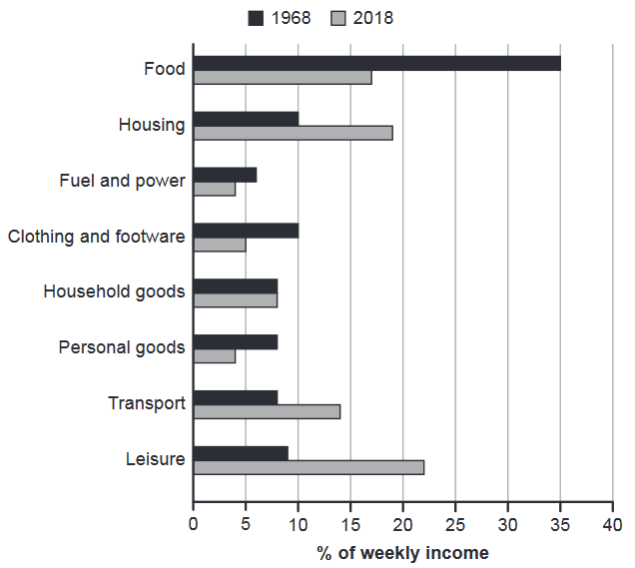
The chart below gives information about how families in one country spent their weekly income in 1968 and in 2018.
Summarise the information by selecting and reporting the main features, and make comparisons where relevant.
1968 and 2018: average weekly spending by families
Student answer (Band 6.5)
The bar chart illustrates a compareson of the average weekly spending by families in one country in 1968 and 2018.
Overall, in 1968 food was accounted the biggest proportion, while fuel and power had the smallest. However, the higgest percentage of spending was on leisure for 2018, and personal goods with fuel and power had the lowest percentage. Although housegoods spending is the same for both years.
In 1968, only around 6% of the income was dedicated for fuel and power, while household and personal goods and transport represented around 8% each. While housing, clothing and footware was accounted for 10% of the weekly income, whereas 35% was spend on food.
Leisure was taking about 22% in 2018, followed by housing with sightly under 20%. The spendings on food, clothing and footware dropped to half compared to 1968 to about 17% and 5% respectively. Moreover less than 5% was dedicated to each personal goods and fuel and power.
AI examiner evaluation
| Criterion | Band |
|---|---|
| Task Achievement / Task Response | 6.5 |
| Coherence and Cohesion | 7.0 |
| Lexical Resource | 6.0 |
| Grammatical Range and Accuracy | 5.5 |
| Overall | 6.5 |
Task Achievement / Task Response: Band 6.5
You identify the main contrast accurately: food was the largest category in 1968, while leisure led in 2018, and you note that household-goods spending was unchanged. Most figures you include are consistent with the chart, including food at about 35% and 17%, and leisure at about 22% in 2018. This gives the response a clear overview and relevant supporting detail. Some features are less fully reported: for example, transport rose from about 8% to 14%, a notable change that is omitted, and the 2018 household-goods figure is not stated. Also, “personal goods with fuel and power had the lowest percentage” is imprecise because they tie at about 4% in 2018. Including these comparisons would make coverage more complete and precise.
Coherence and Cohesion: Band 7.0
The response is organised into a clear introduction, an overview, and separate paragraphs for the two years, so the reader can follow the comparison. Linking expressions such as “Overall,” “while,” “followed by,” and “Moreover” help signal relationships between the figures. The progression is generally logical, although the final sentence of the overview, “Although housegoods spending is the same for both years,” is a fragment and feels detached from the preceding point. The 1968 paragraph also begins a sentence with “While” and then adds another contrast with “whereas,” making the relationship slightly awkward. Connect these ideas into complete, well-balanced sentences and use references such as “this category” only when their meaning is unmistakable.
Lexical Resource: Band 6.0
You use a reasonable range of task-related vocabulary, including “proportion,” “represented,” “dedicated,” and “followed by,” and the meaning is generally clear. However, several spelling and word-choice errors reduce precision: “compareson,” “higgest,” “housegoods,” and “sightly” should be corrected, while “spendings” is not the natural form in this context. Some collocations are also awkward, such as “food was accounted the biggest proportion” and “Leisure was taking about 22%.” Prefer standard chart language such as “accounted for,” “stood at,” and “spending on.” More accurate use of these expressions, alongside careful proofreading, would make the vocabulary more flexible and natural without changing the clear overall message.
Grammatical Range and Accuracy: Band 5.5
You attempt a mix of simple and more complex structures, including comparisons with “while” and “whereas,” and most of the intended meaning can be understood. Some grammatical errors remain. For example, “food was accounted the biggest proportion” has an incorrect verb pattern, and “Although housegoods spending is the same for both years” is a dependent clause without a main clause. In “While housing, clothing and footware was accounted for 10%,” the plural subject does not agree with “was”; the sentence also combines “while” and “whereas” awkwardly. The phrase “dropped to half compared to 1968” needs a clearer comparison structure. Practise complete clauses, subject–verb agreement, and accurate comparative forms, then check each sentence for a main verb and a clear grammatical relationship.
See this exact question answered at other band scores. The same prompt compared across bands.
Browse more IELTS Writing model answers or get your own writing scored by the same AI examiner.