Band 6.5 IELTS Writing Task 1 Model Answer
Overall Band Score: 6.5 · Cambridge IELTS 17 · 2026-11-20
IELTS Writing Task 1 question
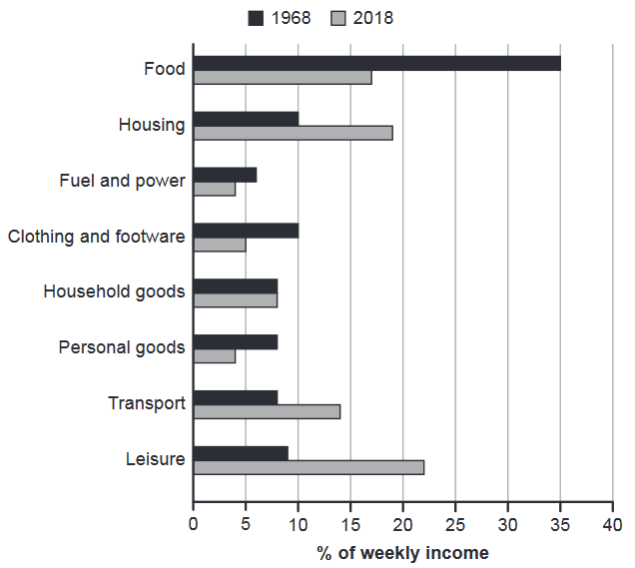
The chart below gives information about how families in one country spent their weekly income in 1968 and in 2018.
Summarise the information by selecting and reporting the main features, and make comparisons where relevant.
1968 and 2018: average weekly spending by families
Student answer (Band 6.5)
The bar graph compares weekly spending of families in a country in 1968 and 2018.
Overall, it is evident that families spent major proportion of their income on food in 1968 and smallest in fuel and power. In contrast, in 2018 leisure accounted for major spending and smallest proportion was fuel and power.
Spending was twice higher in food in 1968, stood at 35% compared to around 17% in 2018.Families spent least amount of their income in power and fuel approximately 7% and 4% in 1968 and 2018 respectively. Investment in houshold good stood at around 8% in both years and in housing it was twice lower in 1968, 10% and around 19% in 2018.
Spending in leisure rose more than twice in 2018, at around 23% which was less than 10% in 1968. Transport witnessed an increase in spending, and was around 7% in 1968, reached to almost 14% in 2018. On the contrary, investment in personal good decreased fromaround 8% in 1968 to less than 5% in 2018
AI examiner evaluation
| Criterion | Band |
|---|---|
| Task Achievement / Task Response | 7.0 |
| Coherence and Cohesion | 6.5 |
| Lexical Resource | 6.0 |
| Grammatical Range and Accuracy | 5.5 |
| Overall | 6.5 |
Task Achievement / Task Response: Band 7.0
You identify the main contrast accurately: food was the largest category in 1968, while leisure led in 2018, and fuel and power was the smallest in both years. The comparisons for food, housing, leisure and transport are generally supported by the chart, and you also note the stable household-goods figure and the fall in personal goods. This gives the response a clear overview and relevant supporting detail. To make the account more complete and precise, include clothing and footwear, which fell from about 10% to 5%, and avoid vague descriptions such as “twice lower”; state the figures and direction of change directly. The overview could also summarise the broader shift from food-related spending towards leisure, housing and transport.
Coherence and Cohesion: Band 6.5
The response has a clear overall shape: an introduction, an overview, and two paragraphs of comparisons. Information is mostly grouped sensibly, and transitions such as “In contrast” and “On the contrary” help signal changes between categories. This coherent arrangement meets the lower-band expectations, while the half-band strength is the emerging logical progression from the main overview to supporting figures. However, some links are awkward or unclear: “Investment in household good … and in housing…” combines two separate comparisons, and the final sentence feels appended rather than integrated into a clear grouping. Use one paragraph for categories that decreased or stayed stable and another for those that increased, with clearer sentence boundaries and references.
Lexical Resource: Band 6.0
You use an adequate range of task vocabulary, including “accounted for,” “proportion,” “rose,” “decreased,” and “witnessed an increase.” These choices allow you to describe the main movements without obscuring the data. There are, however, several inaccurate or unnatural expressions that limit precision: “major proportion” and “major spending” are not natural collocations here, while “Investment” is unsuitable for describing household expenditure. Spelling and word-form slips such as “houshold good” and “personal good” also reduce control. Aim for straightforward, accurate terms such as “share of weekly income,” “spending,” and “household goods.” More precise phrasing will be more effective than using elevated vocabulary that does not fit the context.
Grammatical Range and Accuracy: Band 5.5
You attempt both simple and more complex sentence forms, including contrast clauses and comparisons, and the overall meaning is usually clear. Some grammatical errors remain, particularly with articles, sentence construction, and punctuation. For example, “families spent major proportion” needs an article (“a major proportion”), and “smallest in fuel and power” would be clearer as “the smallest share was spent on fuel and power.” The sentence beginning “Spending was twice higher…” is also awkwardly formed, and there is no space after the full stop in “2018.Families.” Use complete, well-punctuated sentences and check article use and comparative structures. These corrections would make your range more controlled and consistently accurate.
See this exact question answered at other band scores. The same prompt compared across bands.
Browse more IELTS Writing model answers or get your own writing scored by the same AI examiner.