Band 6.5 IELTS Writing Task 1 Model Answer
Overall Band Score: 6.5 · Cambridge IELTS 17 · 2026-11-20
IELTS Writing Task 1 question
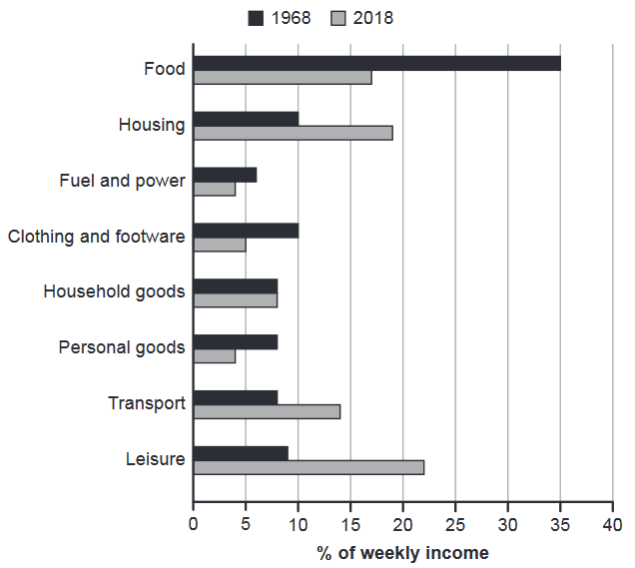
The chart below gives information about how families in one country spent their weekly income in 1968 and in 2018.
Summarise the information by selecting and reporting the main features, and make comparisons where relevant.
1968 and 2018: average weekly spending by families
Student answer (Band 6.5)
The bar graph illustrates comparison between average percentage of weekly income spent by families in 1968 and 2018 across different areas.
Overall, In 1968, people used to spent their most weekly income buying food whereas people in 2018, spent highest on leisure activities. The amount of money spent on food was halved by the year 2018 while housing was increased to twice of figures in 1968.
Earlier, the amount spent of food was 35% of their weekly income incontrast became little more than 15% by the year 2018. Money spent on housing and leisure had followed a similar trend. It was increased over the years incontrast, fuel and power and clothing and footware was seen following decreased trend on spending. In addition, figures for household goods remained same over the decades. The cost associated with transportation has increased signficantly while amount of money spent on purchasing personal goods have dropped significantly.
AI examiner evaluation
| Criterion | Band |
|---|---|
| Task Achievement / Task Response | 7.0 |
| Coherence and Cohesion | 6.5 |
| Lexical Resource | 6.0 |
| Grammatical Range and Accuracy | 5.5 |
| Overall | 6.5 |
Task Achievement / Task Response: Band 7.0
You identify the main contrast accurately: food was the largest category in 1968, while leisure became the largest in 2018. The overview also highlights the substantial fall in food spending and rise in housing, and the body covers all eight categories. Most reported figures and directions match the chart, including food at 35% and just over 15%, stable household-goods spending, and the increase in transport. To make the account more fully precise, avoid saying housing “increased to twice” its earlier figure: it rose from 10% to 19%, which is close to, but not exactly, double. Some comparisons, such as fuel and clothing, are described only generally; adding their approximate figures would make these details better supported.
Coherence and Cohesion: Band 6.5
The response has a clear overall structure: an introduction, an overview, and a paragraph describing category-level changes. The reader can follow the broad progression from the dominant spending category in 1968 to the leading one in 2018, and linking expressions such as “Overall,” “Earlier,” and “In addition” help signal relationships. However, the final paragraph groups many comparisons into a long sequence, so the organisation becomes less controlled. The repeated “in contrast” is also not always used to express a clear contrast, and “Money spent on housing and leisure had followed a similar trend” is vague before the trends are explained. Grouping rises and falls more deliberately, and using clearer references, would make cohesion more flexible and precise.
Lexical Resource: Band 6.0
You use an adequate range of task-related vocabulary, including “weekly income,” “remained same,” “increased,” “decreased trend,” and “dropped significantly.” These choices allow you to describe the main movements, and terms such as “transportation” and “personal goods” show some variety. However, several phrases are imprecise or unnatural, including “spent their most weekly income,” “amount spent of food,” and “housing was increased.” There are also spelling errors in “incontrast,” “footware,” and “signficantly,” which reduce accuracy. Aim for more natural collocations and consistent category labels, such as “the proportion spent on food” and “spending on housing rose.”
Grammatical Range and Accuracy: Band 5.5
You attempt both simple and more complex sentence forms, and the overall meaning is generally understandable. The overview and several comparisons communicate the key trends, but some grammatical errors recur. For example, “people used to spent” has an incorrect verb form, while “people in 2018, spent highest” has faulty sentence construction and an unnecessary comma. In “housing was increased,” the passive form is not appropriate for describing the chart’s change; use “housing spending increased.” Agreement and number are also inconsistent in “clothing and footware was seen” and “personal goods have dropped.” Punctuation around “in contrast” needs attention. More accurate verb forms and sentence boundaries would improve control.
See this exact question answered at other band scores. The same prompt compared across bands.
Browse more IELTS Writing model answers or get your own writing scored by the same AI examiner.