Band 5.5 IELTS Writing Task 1 Model Answer
Overall Band Score: 5.5 · Cambridge IELTS 17 · 2026-11-20
IELTS Writing Task 1 question
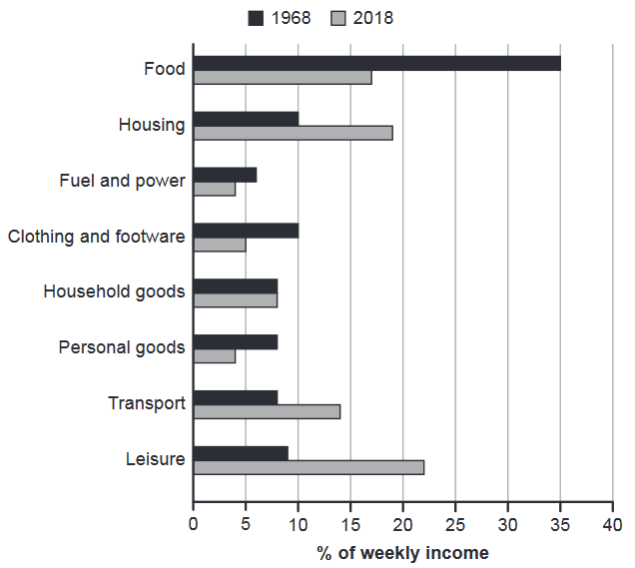
The chart below gives information about how families in one country spent their weekly income in 1968 and in 2018.
Summarise the information by selecting and reporting the main features, and make comparisons where relevant.
1968 and 2018: average weekly spending by families
Student answer (Band 5.5)
The bar chart below shows the given information about how families in one country spent their weekly income from 1968 to 2018. I will explain weekly spending by families between 1968 and 2018.
Overall, we see a huge declined in food spending by families over the decades and a huge risen in leisure acitvities over the decades .The housing and transport has some rose in spending by families over the years. The households spending by families is same as 1968.
The families spending on food in 1968 is higher than any other spending but we see a huge declined in spending on food by familes now only 16 percent. The spending on leisure activities is increasing over the years and in 2018 is 23 percent and spending on housing and transport has rose over the decades.The spending on feul and power is declined as compared to 1968. The spending on clothing and footware is around 10percent in 1968 but we see declined in 2018 and household spending is balanced and we see also declined in personal goods spending by families
AI examiner evaluation
| Criterion | Band |
|---|---|
| Task Achievement / Task Response | 6.0 |
| Coherence and Cohesion | 5.5 |
| Lexical Resource | 5.0 |
| Grammatical Range and Accuracy | 5.0 |
| Overall | 5.5 |
Task Achievement / Task Response: Band 6.0
You identify the main contrast accurately: food takes a much smaller share in 2018, while leisure rises substantially, and you also note increases in housing and transport. Your figures for food (about 16%) and leisure (23%) are close to the chart’s approximate values. However, the overview is not fully precise: household goods remain at roughly 8%, rather than household spending generally being “the same,” and the response does not clearly identify leisure as the largest category in 2018 or food as the largest in 1968. Several categories are mentioned without exact comparisons, so some features are less fully reported than others. A clearer overview and more systematic figures would strengthen the summary.
Coherence and Cohesion: Band 5.5
The response has a recognisable structure, with an introduction, an overview and a paragraph of supporting details. This helps the reader follow the broad comparison. However, progression within the body is limited: categories are listed one after another, with few clear groupings or contrasts. The repeated wording “over the decades” and “spending by families” makes the links feel mechanical, while the final sentence combines several categories without a clear sequence. Organise the details into meaningful groups—for example, categories that rose versus those that fell or stayed stable—and use concise linking phrases to show these relationships. This would make the comparison easier to follow.
Lexical Resource: Band 5.0
You use relevant topic vocabulary such as “weekly income,” “spending,” “declined” and “increasing,” so the main trends are generally understandable. However, the range is limited and several word-choice, collocation and spelling problems reduce precision. Phrases such as “a huge declined,” “a huge risen,” and “has some rose” are not natural ways to describe changes; “households spending” is also unclear. There are spelling errors in “acitvities,” “familes,” “feul” and “footware,” and “balanced” does not clearly express that household-goods spending was unchanged. Use accurate trend language consistently, such as “fell sharply,” “rose considerably” and “remained stable,” and check spelling.
Grammatical Range and Accuracy: Band 5.0
Your sentences communicate the main comparisons, and you attempt some longer structures, including “The spending on clothing and footware is around 10percent in 1968 but we see declined in 2018.” However, the response relies heavily on simple sentence patterns, and errors in verb forms, agreement and sentence construction are frequent enough to make parts awkward. For example, “The housing and transport has” should use a plural verb, while “has rose” needs the correct past participle, “has risen.” The opening overview also contains an incomplete construction: “we see a huge declined.” Punctuation is inconsistent, including the space before the full stop in the overview. Practise forming accurate past-tense comparisons and vary sentence structures while keeping each sentence controlled.
See this exact question answered at other band scores. The same prompt compared across bands.
Browse more IELTS Writing model answers or get your own writing scored by the same AI examiner.