Band 4.0 IELTS Writing Task 1 Model Answer
Overall Band Score: 4.0 · Cambridge IELTS 17 · 2026-11-22
IELTS Writing Task 1 question
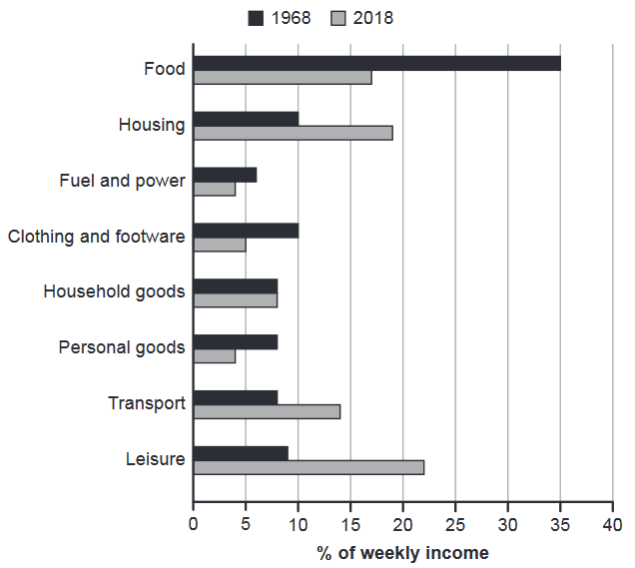
The chart below gives information about how families in one country spent their weekly income in 1968 and in 2018.
Summarise the information by selecting and reporting the main features, and make comparisons where relevant.
1968 and 2018: average weekly spending by families
Student answer (Band 4.0)
The graph chart illustrates data related how in a country people spent their weakly budget from 1968 to 2018.
Overall, the food spend high amount on food upword over the period. In addition second number the money spent on housing and leisure. While the minute quantity spent on fuels, power and personal goods. But the other thing clothing, household items and transport etc spent average costs.
In1968, food spent big cost in weekly basis while fuel and power used little amount respectively.
AI examiner evaluation
| Criterion | Band |
|---|---|
| Task Achievement / Task Response | 3.0 |
| Coherence and Cohesion | 4.5 |
| Lexical Resource | 4.5 |
| Grammatical Range and Accuracy | 4.5 |
| Overall | 4.0 |
Task Achievement / Task Response: Band 3.0
The response identifies the chart’s subject and attempts an overview, but it does not accurately report the main trends. In particular, “food spend high amount on food upword over the period” suggests food spending increased, whereas its share fell from about 35% to 17%. Housing and leisure did rise, and fuel/power and personal goods were among the smaller categories, but these points are not supported with figures or clear comparisons. The final sentence mentions only food and fuel in 1968, leaving most categories and the 2018 data unreported. The response is also substantially below the required 150 words. To improve, give a clear, accurate overview and compare the largest changes with selected figures from both years.
Coherence and Cohesion: Band 4.5
There is a basic attempt to organise the response into an opening, an overview, and a detail paragraph, so the reader can recognise a general structure. However, progression is limited: the final paragraph gives only one brief observation and does not develop the comparisons introduced earlier. Linking is also awkward in phrases such as “In addition second number” and “While the minute quantity,” and the opening overview combines several categories without a clear relationship. Use separate paragraphs for the overview and key comparisons, then connect ideas with straightforward, accurate links such as “By contrast” and “Meanwhile.” This would make the information easier to follow and reduce the impression of disconnected statements.
Lexical Resource: Band 4.5
The response uses some relevant chart vocabulary, including “weekly,” “spent,” “housing,” and “fuel and power,” and it attempts to describe amounts and categories. However, word choice and collocation are often inaccurate or unclear: “weekly budget” is not the same as the chart’s share of weekly income, “food spend high amount” is unnatural, and “second number” does not clearly identify a category. “Upword” is also misspelled, while “minute quantity” is not an appropriate way to describe a small proportion. Build a more precise set of terms for describing proportions and change, such as “accounted for,” “share,” “rose,” and “fell,” and check spelling and word forms before submitting.
Grammatical Range and Accuracy: Band 4.5
The response attempts several sentence forms, including an overview beginning “Overall” and a contrast introduced by “While,” but control is inconsistent. For example, “The food spend high amount on food upword over the period” lacks a clear grammatical subject–verb structure, and “In1968, food spent big cost” omits the construction needed to say what share was spent. The sentence beginning “While” is a fragment, and “In addition second number the money spent…” is difficult to parse. There is also little accurate use of comparative structures or complete sentences. Practise simple, reliable patterns such as “Families spent 35% of their income on food in 1968” and “This figure fell to 17% in 2018,” then combine them with accurate contrast clauses.
See this exact question answered at other band scores. The same prompt compared across bands.
Browse more IELTS Writing model answers or get your own writing scored by the same AI examiner.