Band 5.5 IELTS Writing Task 1 Model Answer
Overall Band Score: 5.5 · Cambridge IELTS 17 · 2026-11-22
IELTS Writing Task 1 question
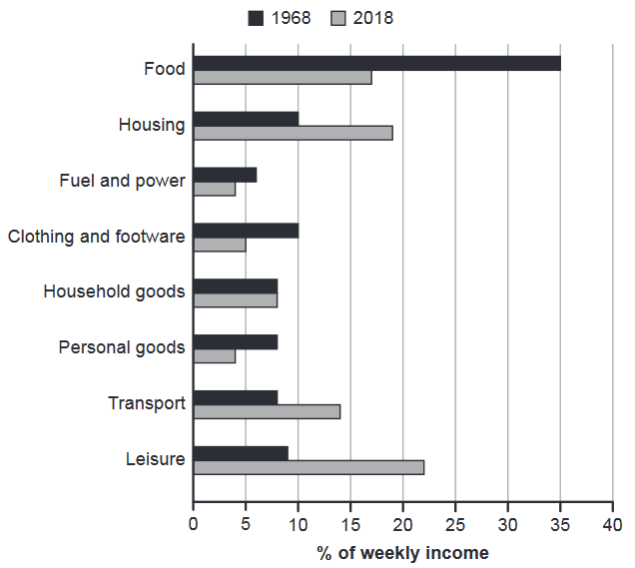
The chart below gives information about how families in one country spent their weekly income in 1968 and in 2018.
Summarise the information by selecting and reporting the main features, and make comparisons where relevant.
1968 and 2018: average weekly spending by families
Student answer (Band 5.5)
The bar graph provide the information about how families in one country expenditured their weekly income in 1968 and in 2018.
Overall, the families had spended significantly on the food in 1968. while, low portion of weekly income was spend on fuel and power. instead of, in 2018 the families had spended maximum on the leisure. at the same time, also minimum income had been spending on fuel and power.
Looking at the details, In 1968 the families had been spending mostly money on food at 35 percent of weekly. on housing and clothing and footware were same at 10 portion. the expenditure on household goods, personal goods, transport were almost same were little bit difference.
In 2018, the larger changes have appearing in weekly income spend. the most income was spending on leisure approximately at 23 percent. followed by housing around at 19 portion. fewest had been expending on fuel and power and personal goods these were same.
AI examiner evaluation
| Criterion | Band |
|---|---|
| Task Achievement / Task Response | 6.0 |
| Coherence and Cohesion | 6.0 |
| Lexical Resource | 5.5 |
| Grammatical Range and Accuracy | 5.0 |
| Overall | 5.5 |
Task Achievement / Task Response: Band 6.0
You identify the main contrasts: food was the largest category in 1968, while leisure was largest in 2018, and fuel and power was among the smallest in both years. You also include relevant figures such as 35% for food and about 23% for leisure, which is close to the chart’s approximate value. However, some comparisons are incomplete or unclear. For example, you say several 1968 categories were “almost same” without reporting their values, and you do not mention the notable rise in housing or transport, or the fall in clothing and personal goods. The overview is relevant, but “minimum” spending in 2018 overlooks that personal goods shares the lowest value with fuel and power. Select and compare the key changes more precisely.
Coherence and Cohesion: Band 6.0
The response has a recognisable structure: an introduction, an overview, and separate paragraphs for the two years. This gives the reader a coherent overall arrangement, and phrases such as “Overall” and “Looking at the details” help signal the sections. However, progression within the detail paragraphs is less controlled. The 1968 paragraph lists categories without clearly grouping or comparing them, while the 2018 paragraph gives only a few figures and does not connect them to the earlier year. Some linking is mechanical or unclear, particularly “while,” “instead of,” and “at the same time, also.” Use transitions to express specific relationships, and organise the details around the largest increases, decreases, and stable categories.
Lexical Resource: Band 5.5
You use relevant chart vocabulary, including “weekly income,” “expenditure,” “portion,” and “approximately,” and the reader can generally understand the categories being compared. However, several word choices and collocations are inaccurate or unnatural, such as “expenditured,” “spended,” “maximum on the leisure,” and “the larger changes have appearing.” “At 10 portion” is also not a natural way to report a percentage. These errors make the description less precise, even though the intended meaning is usually recoverable. Aim for a smaller set of accurate reporting expressions—such as “accounted for,” “spent on,” and “the highest proportion”—and check spelling, especially “footwear.”
Grammatical Range and Accuracy: Band 5.0
You attempt both simple statements and longer sentences, and the paragraph structure makes the intended meaning mostly accessible. However, verb forms and sentence construction are not yet controlled consistently. Examples include “families had spended,” “was spend,” and “the larger changes have appearing”; these require accurate past-tense forms and appropriate passive constructions. There are also sentence-boundary and punctuation problems: “1968. while” begins a fragment, and “In 1968 the families had been spending mostly money on food at 35 percent of weekly. on housing…” joins ideas unclearly. Use straightforward past-tense sentences, punctuate them carefully, and check subject–verb agreement and articles to make comparisons easier to follow.
See this exact question answered at other band scores. The same prompt compared across bands.
Browse more IELTS Writing model answers or get your own writing scored by the same AI examiner.