Band 5.5 IELTS Writing Task 1 Model Answer
Overall Band Score: 5.5 · Cambridge IELTS 17 · 2026-11-22
IELTS Writing Task 1 question
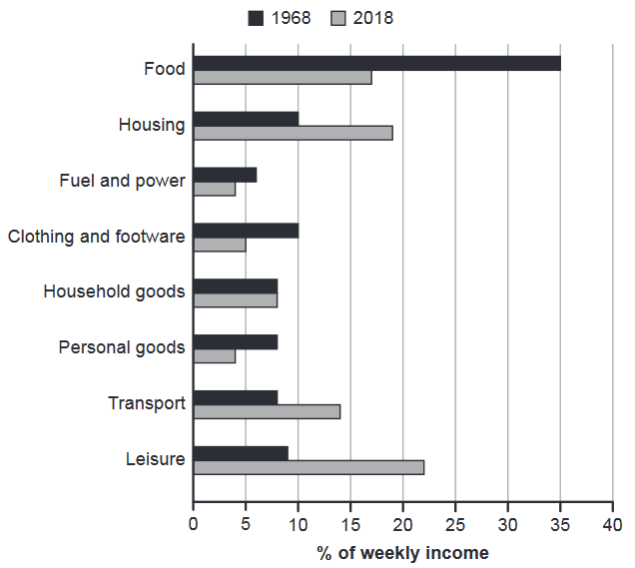
The chart below gives information about how families in one country spent their weekly income in 1968 and in 2018.
Summarise the information by selecting and reporting the main features, and make comparisons where relevant.
1968 and 2018: average weekly spending by families
Student answer (Band 5.5)
The given chart illustrates how families in one particular country allocating their weekly expenditures in 1968 and 2018.
Overall, in 1968 the highest weekly expense allocated for food. While fuel and power spending least among the options. Meanwhile, in 2018 leisure was the highest weekly expenditure with personal good was the lowest spending.
Looking at 1968 trend, people tend to spend their money for basic need such as food which accounted for 35%. Housing, clothing and footware 10%. In addition, household goods, personal goods, transport and leisure spent around 10% respectively. Where fuel and power charged approximately 5%.
However, in 2018 the trends are changed. Food was not longer the highest which accounted just about 15% after all. Leisure and housing dominated with more than 20% and almost 20% shared. Fuel and power and personal goods were less than 5%. Clothing and footware 5%. In addition, leisure growth over 50 years accounted for more than 20% in 2018.
AI examiner evaluation
| Criterion | Band |
|---|---|
| Task Achievement / Task Response | 6.0 |
| Coherence and Cohesion | 6.0 |
| Lexical Resource | 5.5 |
| Grammatical Range and Accuracy | 5.0 |
| Overall | 5.5 |
Task Achievement / Task Response: Band 6.0
You identify the main shift clearly: food is the largest category in 1968, while leisure leads in 2018, and you note that fuel and power is among the smallest categories. Several comparisons are relevant, including food at 35% and the rise in leisure. However, some figures are inaccurate or imprecise: in 2018 food is about 17%, not 15%; leisure is 22%, rather than merely “more than 20%”; and in 1968 household goods, personal goods and transport are each 8%, not around 10%. The overview also says personal goods is the lowest in 2018, but fuel and power shares that low point at 4%. Report the key comparisons more accurately and include the notable rise in transport from 8% to 14% to make the account more complete.
Coherence and Cohesion: Band 6.0
The response has a clear overall structure: an introduction, an overview, and separate paragraphs for the two years. This makes the main comparison easy to follow, and transitions such as “Meanwhile” and “However” help signal changes. Cohesion is not always smooth, though. The sentence beginning “Overall, in 1968…” is a fragment, and “Where fuel and power…” is also disconnected from the preceding sentence. The final sentence repeats the point that leisure was high in 2018 rather than adding a new comparison. Improve the links between figures by grouping categories that rose, fell or remained stable, and use complete sentences instead of isolated data statements.
Lexical Resource: Band 5.5
You use relevant topic vocabulary, including “weekly expenditures,” “accounted for,” “dominated,” and “allocated,” and the reader can generally understand the categories being compared. However, several word choices and collocations are inaccurate or awkward: “families…allocating their weekly expenditures,” “spend their money for basic need,” and “leisure growth” do not sound natural in this context. “Personal good” should be plural, and “footware” is misspelled; the chart label is “footwear.” There is also repetition of “highest” and “spending.” Aim for precise reporting verbs and natural collocations, such as “accounted for,” “made up,” or “the proportion spent on,” while checking category names and spelling.
Grammatical Range and Accuracy: Band 5.0
You attempt both simple and more complex forms, including the contrast introduced by “While” and the time comparison in “after 50 years.” However, some sentence structures are incomplete or inaccurate. “The given chart illustrates how families…allocating” needs a finite verb, while “in 1968 the highest weekly expense allocated for food” lacks a complete verb phrase. “Housing, clothing and footware 10%” is also a sentence fragment, and “leisure and housing…almost 20% shared” has an unclear structure. There are errors in articles and agreement as well, such as “the trends are changed” and “personal good was.” Use complete clauses with a clear subject and verb, and check tense and agreement when describing the two years.
See this exact question answered at other band scores. The same prompt compared across bands.
Browse more IELTS Writing model answers or get your own writing scored by the same AI examiner.