Band 5.0 IELTS Writing Task 1 Model Answer
Overall Band Score: 5.0 · Cambridge IELTS 17 · 2026-11-22
IELTS Writing Task 1 question
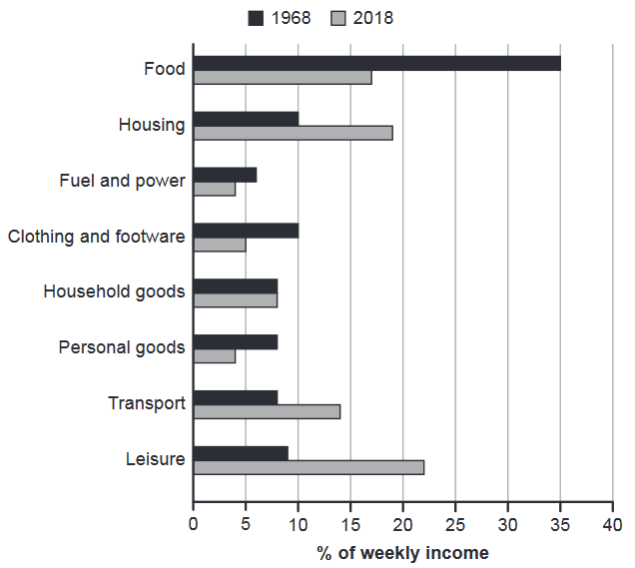
The chart below gives information about how families in one country spent their weekly income in 1968 and in 2018.
Summarise the information by selecting and reporting the main features, and make comparisons where relevant.
1968 and 2018: average weekly spending by families
Student answer (Band 5.0)
The bar chart compares how families in one country spends on their weekly income between 1968 and 2018.
Overall, in 1968 food is the highest in percentage spending on weekly but it decline dramatically, while leisure and housing rose end of the year. Moreover, spendings in other propotions has experienced some fluctuations.
in 1968, food was highest in percentage throughout the year, but it declined after years dramatically 17% in 2018. while house, clothing and footwear gradually increased 10% in 1968, moreover, fuel and forest was lowest in entire period. Household good stood at the same percentage 8% in 1968 and 2018.
personal goods and transport rose 8% in 1968 but transport increased in 14% in 2018 in contrast in 2018 leisure was the highest in percentage 23%
AI examiner evaluation
| Criterion | Band |
|---|---|
| Task Achievement / Task Response | 5.5 |
| Coherence and Cohesion | 5.0 |
| Lexical Resource | 5.0 |
| Grammatical Range and Accuracy | 5.0 |
| Overall | 5.0 |
Task Achievement / Task Response: Band 5.5
You identify the chart’s main contrast: food takes the largest share in 1968 and falls to 17% in 2018, while leisure becomes the largest category in 2018. You also note that household goods remain at 8%, and mention transport’s rise. However, several comparisons are incomplete or unclear: housing rises from 10% to 19%, not merely that it “rose,” and clothing falls from 10% to 5%, rather than increasing. “Fuel and forest” is not a chart category; fuel and power falls from 6% to 4%. The overview also says other proportions fluctuated, which does not clearly describe the overall pattern. The response is 22 words below the required minimum, limiting the detail and coverage of the key figures. Include accurate comparisons for the main categories and develop the overview more fully.
Coherence and Cohesion: Band 5.0
The response has a basic structure, beginning with an introduction and an overview before moving to details. It also groups some categories together, such as household goods, personal goods and transport. However, progression is difficult to follow because the details are not consistently organised by year or by direction of change. The sentence beginning “while house, clothing and footwear…” is especially unclear, and the final sentence combines several comparisons without clear punctuation. Linking words such as “moreover,” “but” and “in contrast” are used, but sometimes do not show the relationship accurately. Use separate, clearly punctuated sentences and organise the body around categories that rose, fell or stayed unchanged; this would make the comparisons easier to follow.
Lexical Resource: Band 5.0
You use some relevant chart vocabulary, including “percentage,” “declined,” “increased” and “stood at the same percentage,” so the reader can recognise the intended comparisons. However, the range is limited and several word choices or forms are inaccurate, sometimes making the meaning unclear. “Spendings” and “proportions” are not natural choices in this context, while “fuel and forest” misnames the category “fuel and power.” The phrase “highest in percentage spending on weekly” is also awkward, and “rose end of the year” does not fit a comparison between two years. Aim for precise expressions such as “share of weekly income,” “accounted for,” and “fell from…to…”. Check category names against the chart and avoid repeating “percentage” when a more natural phrase is available.
Grammatical Range and Accuracy: Band 5.0
The response attempts both simple and more connected sentences, including a contrast with “while” and a comparison introduced by “in contrast.” However, grammatical errors occur frequently and sometimes make relationships difficult to understand. For example, “families…spends” has subject–verb disagreement, and “it decline” needs a past-tense verb. The sentence “while house, clothing and footwear gradually increased 10% in 1968” has unclear structure and does not express the intended comparison accurately. Capitalisation is inconsistent at sentence beginnings, and punctuation is often missing, particularly in the final sentence. Practise forming complete sentences with a clear subject and verb, use past tense consistently for the two dates, and separate comparisons with full stops or semicolons.
See this exact question answered at other band scores. The same prompt compared across bands.
Browse more IELTS Writing model answers or get your own writing scored by the same AI examiner.