Band 5.5 IELTS Writing Task 1 Model Answer
Overall Band Score: 5.5 · Cambridge IELTS 17 · 2026-11-23
IELTS Writing Task 1 question
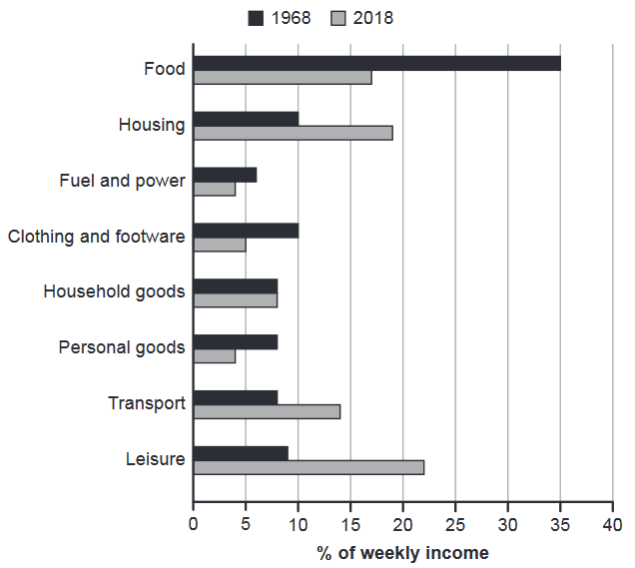
The chart below gives information about how families in one country spent their weekly income in 1968 and in 2018.
Summarise the information by selecting and reporting the main features, and make comparisons where relevant.
1968 and 2018: average weekly spending by families
Student answer (Band 5.5)
The bar chart compares average weekly spending by families in 1968 and 2018, as a percentage of weekly income. Overall, in 1968, food was the highest expense, while in 2018, food and leisure were more important.
First of all, in 1968, families spent about 35% on food, but this fells to 15% to 20% in 2018. Clothing and footware also fell to 10% to 5%. Fuel and power and personal goods fell slightly now. In contrast , housing rose from 10% to 15% to 20% becoming the largest expense in 2018. Leisure also more than doubled from almost 10% to 23%, and transport rise from almost 8% to 18%. Spending on the household goods remains the same in both years that are almost 5% to 10%.
In conclusion, families in 2018 spent less in food and clothing, and more on housing, transport and leisure than in 1968.
AI examiner evaluation
| Criterion | Band |
|---|---|
| Task Achievement / Task Response | 5.5 |
| Coherence and Cohesion | 6.0 |
| Lexical Resource | 5.5 |
| Grammatical Range and Accuracy | 5.5 |
| Overall | 5.5 |
Task Achievement / Task Response: Band 5.5
You identify the chart’s subject and report several important changes, including the fall in food spending and rises in housing and leisure. However, the overview is not fully accurate: saying “food and leisure were more important” in 2018 is vague, and housing—not food or leisure—was the largest category. Several figures are also imprecise or misleading: transport rose from about 8% to 14%, not 18%, and household goods stayed near 8%, rather than ranging from 5% to 10%. Fuel and power and personal goods are mentioned without their approximate values. The response is also three words below the required minimum. A clearer overview and more accurate selection of key figures would make the summary more complete.
Coherence and Cohesion: Band 6.0
The response has a recognisable structure: an introduction and overview, a paragraph describing comparisons, and a concluding summary. The comparisons are generally grouped sensibly, and phrases such as “In contrast” help signal a change in direction. However, the conclusion largely repeats the overview, so it adds little, while the main paragraph moves quickly between categories without a clear grouping or consistent comparison pattern. Some linking is also awkward, as in “Fuel and power and personal goods fell slightly now.” Organise the details into clearer groups—for example, categories that declined and those that increased—and use transitions that accurately express the relationship between the figures.
Lexical Resource: Band 5.5
You use relevant chart vocabulary, including “average weekly spending,” “percentage,” “rose,” “fell,” and “more than doubled,” which allows the reader to understand the main comparisons. The range is adequate but somewhat repetitive, with “spent,” “fell,” and “rose” carrying much of the description. Some word choices and collocations are inaccurate or unclear: “more important” does not precisely describe a spending share, and “fell slightly now” is not a natural way to compare two past years. There are also spelling errors in “footware” and “fells.” Use precise terms such as “accounted for,” “share,” and “declined,” and check spelling and collocation when editing.
Grammatical Range and Accuracy: Band 5.5
You attempt a mixture of simple and more complex sentences, including a contrast with “but” and a comparison using “from … to ….” Most of the message remains understandable, but errors in verb forms and sentence construction reduce accuracy. For example, “this fells to 15% to 20%” has an incorrect verb form and an unclear comparison pattern; “transport rise” should use a past-tense verb, and “the household goods remains” has a subject–verb agreement problem. The sentence about fuel and personal goods also lacks a clear grammatical structure. Practise consistent past-tense reporting and use patterns such as “fell from X to Y” or “rose from X to Y.”
See this exact question answered at other band scores. The same prompt compared across bands.
Browse more IELTS Writing model answers or get your own writing scored by the same AI examiner.