Band 5.5 IELTS Writing Task 1 Model Answer
Overall Band Score: 5.5 · Cambridge IELTS 17 · 2026-11-23
IELTS Writing Task 1 question
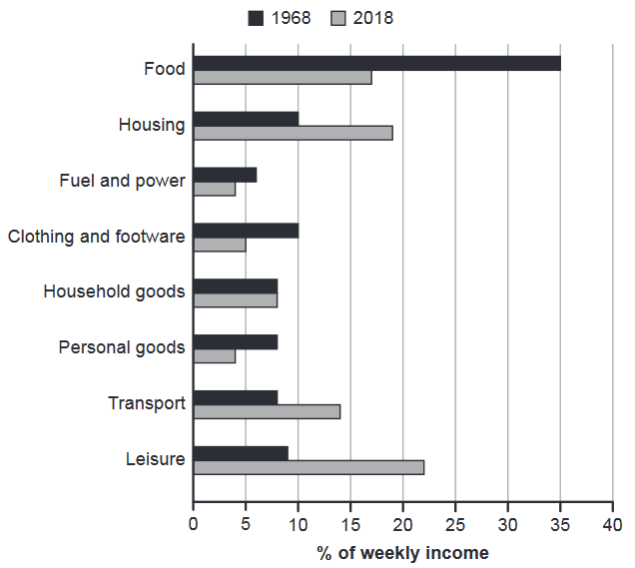
The chart below gives information about how families in one country spent their weekly income in 1968 and in 2018.
Summarise the information by selecting and reporting the main features, and make comparisons where relevant.
1968 and 2018: average weekly spending by families
Student answer (Band 5.5)
The bar chart shows data about the way witch families spend their weekly income in just one country, in 1968 and 2018.
Overall, it's evident that in 1968, food experienced the highest weekly spending by families, while fuel and power saw the lowest spend from peoples. Meanwhile, in 2018, families spent their weekly income most in leisure, and less in fuel and power as well as similar as 1968.
In 1968, food saw a high spend from families by 35%, followed by housing, clothing and footware with approximately a same value, around 10%. Furthermore, most of families income had spent in houshold and personal goods and transport by about 7%. Finally, fuel and power recorded the lowest income spend by just 6% of weekly income.
In 2018, leisure, considered as the highest weekly income spend, around 23% , followed by housing,
food and transport by about 19% , 16% and 14% respectively. and after that, it comes to the lowest proportion of weekly income in personal goods and fuel and power by just 3%
AI examiner evaluation
| Criterion | Band |
|---|---|
| Task Achievement / Task Response | 5.5 |
| Coherence and Cohesion | 5.5 |
| Lexical Resource | 5.5 |
| Grammatical Range and Accuracy | 5.0 |
| Overall | 5.5 |
Task Achievement / Task Response: Band 5.5
You identify the chart’s main contrast: food is the largest category in 1968, while leisure leads in 2018, and fuel and power is among the smallest in both years. Several figures are also reported accurately or approximately, including food at 35% in 1968 and transport at 14% in 2018. However, some comparisons are unclear or inaccurate: in 2018, housing is about 19% and food about 17%, rather than 19% and 16%; household goods remains around 8%, but is not included in the 2018 account. The overview also says fuel and power was the lowest in 1968, although clothing and footwear, household goods, personal goods and transport were all higher, and it does not clearly summarise the broad shift in spending. Select the most important changes and report them precisely.
Coherence and Cohesion: Band 5.5
The response has a recognisable structure, moving from an introduction and overview to separate paragraphs for 1968 and 2018. This makes the two years easy to distinguish, and sequencing expressions such as “followed by” and “Finally” help organise the figures. However, progression within sentences is sometimes difficult to follow: the 2018 sentence beginning “leisure… followed by housing, food and transport” has awkward punctuation and an incomplete continuation beginning “and after that”. The overview also combines several points without clearly ranking or contrasting them. Use complete sentences, group categories by their relative importance, and make links between the overview and detail paragraphs more explicit. These changes would make the organisation more consistently clear rather than relying on a list-like sequence.
Lexical Resource: Band 5.5
You use relevant chart vocabulary, including “weekly income”, “highest”, “lowest”, “followed by” and “proportion”, so the reader can generally understand the comparisons. There is also some attempt to vary phrasing with expressions such as “recorded” and “considered as”. However, the range is limited and several word choices or collocations are noticeably inaccurate, including “food experienced the highest weekly spending”, “a high spend from families” and “most of families income had spent”. Spelling errors such as “witch”, “footware” and “houshold” also reduce accuracy. Prefer direct, natural reporting language—for example, “families spent the largest share on food” or “accounted for”—and check category names carefully. More precise vocabulary would make the comparisons clearer and less repetitive.
Grammatical Range and Accuracy: Band 5.0
You attempt a mixture of simple statements and longer sentences, and the basic meaning is usually recoverable. However, control is inconsistent, particularly in longer constructions. Examples include “most of families income had spent”, where the possessive and verb construction are faulty, and “followed by housing, food and transport… and after that, it comes”, which joins ideas without a complete, well-formed sentence. There are also problems with articles and sentence boundaries, such as “around a same value” and the lowercase “and” after a full stop. These errors sometimes make the reader pause to interpret the intended relationship. Build accuracy first with clear subject–verb sentences, then combine them using correctly formed clauses; proofread articles, verb forms and punctuation.
See this exact question answered at other band scores. The same prompt compared across bands.
Browse more IELTS Writing model answers or get your own writing scored by the same AI examiner.