Band 6.5 IELTS Writing Task 1 Model Answer
Overall Band Score: 6.5 · Cambridge IELTS 17 · 2026-11-23
IELTS Writing Task 1 question
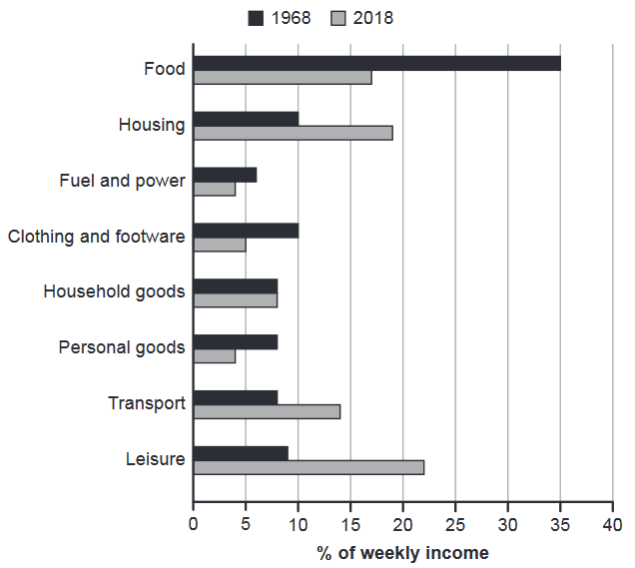
The chart below gives information about how families in one country spent their weekly income in 1968 and in 2018.
Summarise the information by selecting and reporting the main features, and make comparisons where relevant.
1968 and 2018: average weekly spending by families
Student answer (Band 6.5)
Data about how families in a country decided to spend their weekly income in 1968 and in 2018 is illustrated by the provided bar graph. Overall, we can clearly see that in 1968 the vast majority of families spent their weekly income on food. On the other hand, most families in 2018 spent their weekly income on leisure.
In 1968, we can see that there is very minor differences in the categories with no category exceeding the 10% mark and one reaching it (clothing and footware), besides food, which reached a massive 35%.
As for 2018, leisure topped the list with families spending about 22% of their weekly income on it. Closely, about 19% was spent on housing, making it the second most spent on category. We can see a clear difference on how much families spent their weekly income on food, with 2018 families spending only about 17%. Furthermore, families spent approximately 14% on transportation and about 7% on household goods as it was the same as 1968. Personal goods and fuel and power saw similar results with both getting about 4%.
AI examiner evaluation
| Criterion | Band |
|---|---|
| Task Achievement / Task Response | 6.5 |
| Coherence and Cohesion | 7.0 |
| Lexical Resource | 6.5 |
| Grammatical Range and Accuracy | 6.0 |
| Overall | 6.5 |
Task Achievement / Task Response: Band 6.5
You identify the main contrast clearly: food was the largest category in 1968, while leisure led in 2018, and you support this with relevant figures. You also report several 2018 categories accurately. However, the description of 1968 is internally inconsistent: saying there were “no category exceeding the 10% mark” overlooks food at 35%, and clothing and footwear was 10%, not a category above that threshold. The overview also says “most families” spent their income on these categories, which confuses the share of income with the number of families. To make the account more complete and precise, compare the main rises and falls across both years, including housing, transport, and the categories that changed little.
Coherence and Cohesion: Band 7.0
The response is organised into a clear introduction, overview, and year-focused detail paragraphs, so the reader can follow the broad progression from 1968 to 2018. Linking phrases such as “Overall,” “On the other hand,” and “Furthermore” help signal relationships between points. The sequence within the 2018 paragraph is also generally logical, moving from the largest categories to smaller ones. Some connections could be more exact: “Closely” does not clearly express that housing ranked second, and “As for 2018” repeats the year-based transition rather than linking the comparison to the preceding paragraph. A more systematic comparison of corresponding categories would make the progression smoother and reduce the sense of listing.
Lexical Resource: Band 6.5
You use an adequate range of task-related vocabulary, including “topped the list,” “approximately,” “category,” and “weekly income,” and the meaning is generally clear. There are also attempts at more descriptive phrasing, such as “a clear difference.” However, some choices are imprecise or awkward for describing a chart: “families decided to spend” suggests a decision-making process not shown by the data, while “most families” incorrectly refers to people rather than proportions of income. “Closely” is also an unsuitable way to introduce the second-highest figure. Check spelling and standard forms, including “footwear” and “transportation” (the chart label is “transport”). More precise reporting language would improve flexibility and accuracy.
Grammatical Range and Accuracy: Band 6.0
You use a mix of simple and more complex sentence forms, including the contrastive sentence beginning “On the other hand” and the clause “with families spending about 22%.” Most sentences remain understandable, but some grammatical errors and awkward constructions are present. In “there is very minor differences,” the verb does not agree with the plural noun; use “there are very minor differences.” The phrase “making it the second most spent on category” has an unclear grammatical structure, and “as it was the same as 1968” does not clearly attach the comparison to household goods. Aim for more controlled comparative clauses, for example, “Housing ranked second, at 19%, compared with 10% in 1968.” This would strengthen accuracy while retaining sentence variety.
See this exact question answered at other band scores. The same prompt compared across bands.
Browse more IELTS Writing model answers or get your own writing scored by the same AI examiner.