Band 6.0 IELTS Writing Task 1 Model Answer
Overall Band Score: 6.0 · Cambridge IELTS 17 · 2026-11-23
IELTS Writing Task 1 question
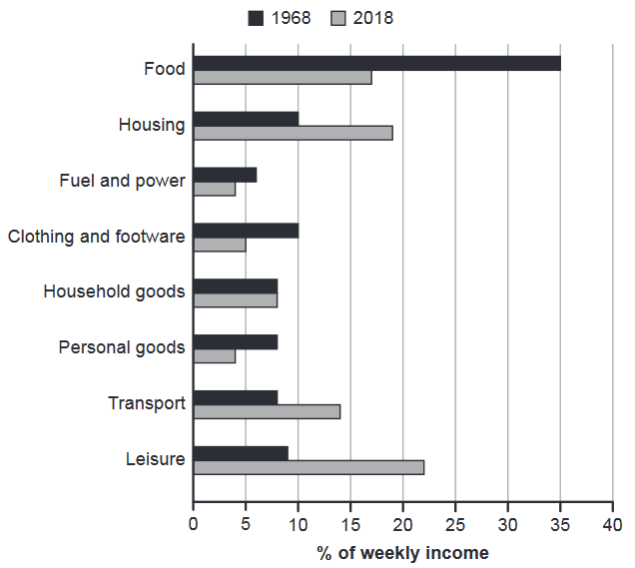
The chart below gives information about how families in one country spent their weekly income in 1968 and in 2018.
Summarise the information by selecting and reporting the main features, and make comparisons where relevant.
1968 and 2018: average weekly spending by families
Student answer (Band 6.0)
The bar chart illustrates the proporton of weekly money spent on various products between 1968 and 2018.
Overall, the highest proportion of weekly money spent on food in both years, while the proportion of money spent on Fuel and power was the lowest in the given years.
In terms of spending, food dominated the largest proportion of money spent in both years at about 35 for 1968 and 17 for 2018. In addition, the second largest percentage of money spent on housing in the given years. Additionally, in 2018, the percentage of weekly income expended on leisure at roughly 23%, it is largest than 1968 year on the likewise categories. Moreover, Clothing and footwear spent their money at 10% for 1968 and 5% for 2018.
For the remaining information, fuel and power and personal good represented their income expended in 1968 6% and 8%, in 2018, 4% and 3% respectively. Furthermore, the proportion of weekly money spent on Household goods were same proportion at 8% each in the years 1968 and 2018.
AI examiner evaluation
| Criterion | Band |
|---|---|
| Task Achievement / Task Response | 5.5 |
| Coherence and Cohesion | 6.0 |
| Lexical Resource | 6.0 |
| Grammatical Range and Accuracy | 5.5 |
| Overall | 6.0 |
Task Achievement / Task Response: Band 5.5
You identify several important features, including the sharp fall in food spending (about 35% to 17%), the rise in leisure, and the unchanged 8% for household goods. However, the overview is not fully accurate: food was the largest category in 1968, but leisure—not food—was highest in 2018, at about 22%. Fuel and power was the lowest in both years, so that comparison is sound. Some details are missing or unclear: housing rose from 10% to 19%, and transport increased from 8% to 14%, while the response calls housing the second-largest category without specifying the year. Personal goods in 2018 is also reported as 3% rather than approximately 4%. Select and compare the main changes more precisely.
Coherence and Cohesion: Band 6.0
The response has a clear overall arrangement: an introduction, an overview, and two paragraphs of details. This makes the information reasonably easy to follow, and linking expressions such as “In addition,” “Moreover,” and “Furthermore” help signal additions. However, some connections are mechanical or unclear. For example, “Additionally, in 2018…” does not form a complete sentence, and “For the remaining information” is an awkward transition into the final comparisons. The paragraphing also groups figures without a consistent comparison pattern, making it harder to see changes between years. Organise the details by major rises and falls, and use clearer links such as “By contrast” or “Meanwhile” only where the relationship warrants them.
Lexical Resource: Band 6.0
You use a reasonable range of task-related vocabulary, including “proportion,” “dominated,” “expended,” and “represented,” and the meaning is generally understandable. There are, however, several inaccurate or unnatural choices that limit precision. “Weekly money” is less suitable than “weekly income,” while “largest than” is not the correct comparative expression. “Personal good” should be plural, and “products” is too narrow for categories such as housing and leisure. There is also a spelling error in “proporton.” Aim for natural collocations and consistent category labels; for example, describe a category as accounting for a share of income rather than saying it “spent their money.”
Grammatical Range and Accuracy: Band 5.5
You attempt both simple and more developed sentence forms, and the main message can usually be understood. Some grammatical errors remain, particularly in sentence completeness and agreement. The overview sentence “Overall, the highest proportion … in both years” lacks a main verb, and “the second largest percentage … on housing” is also incomplete. In “the percentage … on leisure …, it is largest,” the clauses are joined incorrectly and the comparison structure is faulty. The phrase “Household goods were same proportion” also needs an article and a more suitable verb construction. Practise complete clauses and accurate comparative forms, while retaining your attempts to vary sentence structure.
See this exact question answered at other band scores. The same prompt compared across bands.
Browse more IELTS Writing model answers or get your own writing scored by the same AI examiner.