Band 6.0 IELTS Writing Task 1 Model Answer
Overall Band Score: 6.0 · Cambridge IELTS 17 · 2026-11-23
IELTS Writing Task 1 question
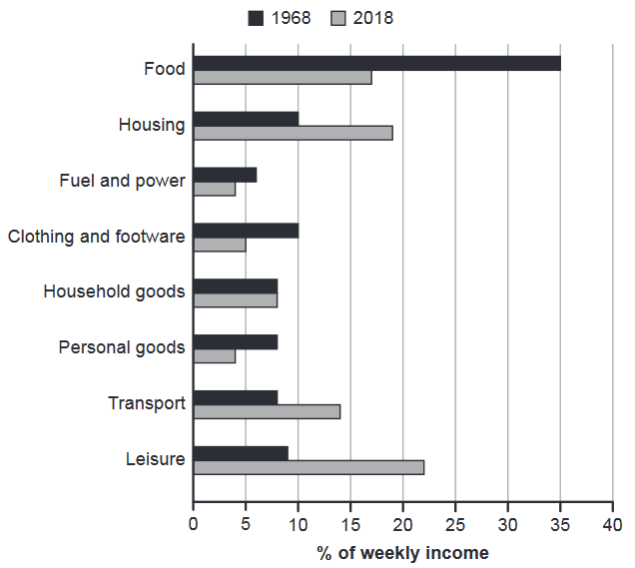
The chart below gives information about how families in one country spent their weekly income in 1968 and in 2018.
Summarise the information by selecting and reporting the main features, and make comparisons where relevant.
1968 and 2018: average weekly spending by families
Student answer (Band 6.0)
The bar chart illustrates how families in one country spent their weekly income on 8 categories in 1968 and in 2018. While there were increase in a few categoires, others saw increase in weekly spending.
Leisure is observed with highest percentage of increase for household spendings. On the other hand, there had been a significant decrease in food category. In 1968, people tend to spent about 9 percentage of their income in leisure, but in 2018 the number rose to around 22 percentage. However, exactly 35 percentage of income was spent on food which decreased by about 18 percentage in 2018. People spent less and less on categories like fuel and power, clothings and footware and personal goods. The spending on household goods neither decreased nor increased overtime. In contrast, people spent more on housing and transport in 2018.
In conclusion, while some of the categories had seen slight or significant decrease or increase in household spendings, some category remained very small in terms on spending.
AI examiner evaluation
| Criterion | Band |
|---|---|
| Task Achievement / Task Response | 6.0 |
| Coherence and Cohesion | 6.0 |
| Lexical Resource | 5.5 |
| Grammatical Range and Accuracy | 5.5 |
| Overall | 6.0 |
Task Achievement / Task Response: Band 6.0
You identify the chart’s subject and report several important comparisons accurately: leisure rises from about 9% to 22%, food falls from 35% to around 17%, household goods stays at 8%, and housing and transport increase. This gives the response a relevant overview of the main shifts. However, the opening overview is unclear and internally contradictory: “there were increase in a few categories, others saw increase” does not distinguish the directions of change. The final sentence is also too general to add a useful summary, and the increases in housing and transport are not quantified. A clearer overview naming the largest rise and fall, followed by a few precise supporting figures, would make the key features more fully developed.
Coherence and Cohesion: Band 6.0
The response has a recognisable structure: an introduction, a paragraph describing changes, and a concluding sentence. Comparisons are also signposted with phrases such as “On the other hand” and “In contrast,” helping the reader follow the broad direction of the discussion. However, the opening sentence after the introduction is confusing, and the conclusion largely repeats the idea that categories changed without synthesising the main pattern. The body also moves through categories without a particularly clear grouping or hierarchy. Organise the details around the largest decreases and increases, then mention the stable category, and use linking phrases only where they express a genuine contrast. This would make progression clearer and cohesion less mechanical.
Lexical Resource: Band 5.5
You use relevant chart vocabulary, including “percentage,” “decrease,” “rose,” and “spent,” and the reader can generally understand the comparisons. There is some variety in how changes are described, such as “rose to” and “decreased by.” However, several word choices and collocations are inaccurate or awkward: “highest percentage of increase for household spendings” is unclear, while “people tend to spent” and “some category” show problems with word form or number. Spelling errors such as “categoires,” “clothings,” and “footware” also reduce accuracy. Aim for precise expressions such as “the largest increase in the share of weekly income” and use the chart’s category labels consistently.
Grammatical Range and Accuracy: Band 5.5
You attempt a mix of simple and more complex sentences, including contrast clauses beginning “While” and “Although”-like structures such as “On the other hand.” Most of the intended meaning remains understandable. Some grammatical errors, however, recur in verb forms, agreement, and sentence construction. For example, “there were increase” needs a plural noun or a different verb pattern, and “people tend to spent” should use the base form after “tend to.” In “some category remained,” the subject and verb do not agree, while “there had been a significant decrease” uses an unnecessarily awkward tense for describing chart data. Practise accurate past-tense reporting and check agreement and verb patterns when editing.
See this exact question answered at other band scores. The same prompt compared across bands.
Browse more IELTS Writing model answers or get your own writing scored by the same AI examiner.