Band 4.5 IELTS Writing Task 1 Model Answer
Overall Band Score: 4.5 · Cambridge IELTS 17 · 2026-11-24
IELTS Writing Task 1 question
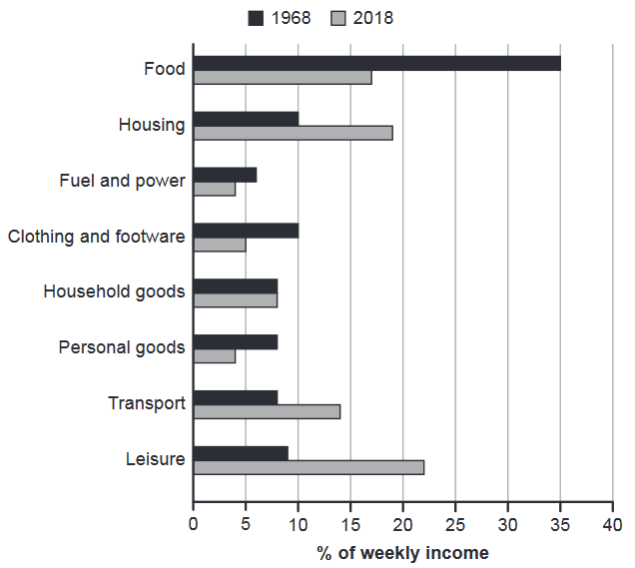
The chart below gives information about how families in one country spent their weekly income in 1968 and in 2018.
Summarise the information by selecting and reporting the main features, and make comparisons where relevant.
1968 and 2018: average weekly spending by families
Student answer (Band 4.5)
The chart illustrate the weakely money spending ratio in earlier 1968 and 2018.In 1968 Bar line demonstrate the weakely spending money percentage of Food is around about 35 percent it's higher than 18 percent from 2018 and also the ratio of spending money on personal goods are more decrese than 2018.The ratio of household goods are both same in 1968 and 2018 but the percentage of leisure are much greater than 1968.The fuel and power are little bit difference and also the the ratio of
AI examiner evaluation
| Criterion | Band |
|---|---|
| Task Achievement / Task Response | 4.0 |
| Coherence and Cohesion | 3.5 |
| Lexical Resource | 5.0 |
| Grammatical Range and Accuracy | 4.5 |
| Overall | 4.5 |
Task Achievement / Task Response: Band 4.0
You identify several relevant comparisons, including food spending being higher in 1968, household-goods spending being the same, and leisure taking a larger share in 2018. However, the response addresses the task only minimally: it gives no clear overview of the main changes and omits most categories, including housing and transport. The comparison that personal-goods spending decreased is also unclear because it does not state which year had the higher figure. The final sentence stops mid-thought, leaving the fuel-and-power comparison incomplete. The response is 85 words, below the required 150, so there is not enough coverage or supporting detail. Include a concise overview, then report the most important increases and decreases with accurate figures.
Coherence and Cohesion: Band 3.5
There is a basic attempt to connect comparisons using phrases such as “and also” and “but,” and the response generally stays focused on the chart. However, the ideas are crowded into one paragraph and do not follow a clear overall progression. The opening does not establish a useful overview, and the comparisons move from food to personal goods, household goods, leisure, and fuel without a consistent grouping. The last clause, “and also the the ratio of,” is unfinished, which disrupts the flow and leaves the reader unsure what point was intended. Organise the response into an overview and a detail paragraph, grouping categories that rose and fell, and use complete sentences with clear links.
Lexical Resource: Band 5.0
The response uses some relevant chart vocabulary, including “percentage,” “ratio,” “higher,” and “greater,” so the reader can recognise that it is comparing spending shares. However, the range is limited and several choices are inaccurate or awkward, which sometimes makes the meaning difficult to follow. For example, “weakely money spending ratio” is not a natural way to describe the data, and “Bar line demonstrate” does not clearly identify the chart. There are also spelling errors such as “weakely” and “decrese.” Use precise terms consistently, such as “share of weekly income,” “proportion,” and “accounted for,” and check spelling before finishing.
Grammatical Range and Accuracy: Band 4.5
You attempt to combine ideas in longer sentences, for example by linking comparisons with “and also” and “but.” However, sentence control is weak: the opening has no clear subject–verb agreement (“The chart illustrate”), and the sentence beginning “In 1968 Bar line demonstrate” has an unclear structure. Articles and plurals are also inconsistent, as in “the ratio of household goods are,” while punctuation is missing after the opening sentence and around several clauses. The final sentence is incomplete, so its grammatical relationship cannot be understood. Use shorter, complete sentences first, checking subject–verb agreement and sentence boundaries; then add a few controlled comparisons using “whereas” or “while.”
See this exact question answered at other band scores. The same prompt compared across bands.
Browse more IELTS Writing model answers or get your own writing scored by the same AI examiner.