Band 5.5 IELTS Writing Task 1 Model Answer
Overall Band Score: 5.5 · Cambridge IELTS 17 · 2026-11-24
IELTS Writing Task 1 question
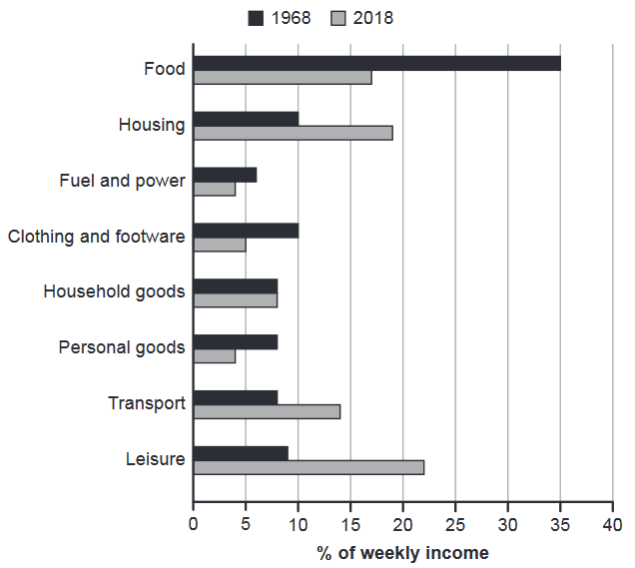
The chart below gives information about how families in one country spent their weekly income in 1968 and in 2018.
Summarise the information by selecting and reporting the main features, and make comparisons where relevant.
1968 and 2018: average weekly spending by families
Student answer (Band 5.5)
The bar chart provides indormation about the average weekly spending by families in 1968 and 2018.
Overall, the chart reveals the change of spending patterns over the period. Some spendings increased and others has decreased.
In 1968, the most thing families used to spend their money on was food, represented 35% of the weekly income. Followed by housing and clothing and footware at 10% both. Furthermore, the same percentage was recorded for personal goods and transport, at less than a tenth. Leisure acoounted for around 10% of spendings. While the least proportion goes to fuel and power at approximately 5%.
In 2018, a lot of patterns has changed, leisure occupated the largest share accounted around 20% of the weekly income of households. Followed by housing at approximately 20% and transport who was less than 15%. In addition, personal goods was below 5%. Clothing and footwar and fuel and power accounted a smal proportion of spendings at 5%.
The only category remained unchanged in both years was household goods accounted less than a tenth of weekly income.
AI examiner evaluation
| Criterion | Band |
|---|---|
| Task Achievement / Task Response | 5.5 |
| Coherence and Cohesion | 6.0 |
| Lexical Resource | 5.0 |
| Grammatical Range and Accuracy | 5.0 |
| Overall | 5.5 |
Task Achievement / Task Response: Band 5.5
You identify the broad shift in spending and report several important figures, including food at 35% in 1968, leisure at about 20% in 2018, and household goods as unchanged. However, the overview is too general: “Some spendings increased and others has decreased” does not specify the main contrasts. Some details are also inaccurate or imprecise: in 2018, leisure was 22% and housing 19%, while clothing and footwear was 5% and fuel and power 4%; these are not both 5%. The 1968 figures for personal goods and transport were 8% each, rather than simply “less than a tenth.” To strengthen the response, state the key changes explicitly, especially the sharp fall in food and the rises in leisure, housing and transport, and report comparisons more precisely.
Coherence and Cohesion: Band 6.0
The response has a clear overall arrangement: an introduction, a brief overview, separate paragraphs for each year, and a final comparison of household goods. This makes the information easy to follow. You also use linking expressions such as “Overall,” “Furthermore,” and “In addition.” However, some connections feel mechanical or incomplete. For example, “Followed by housing…” and “While the least proportion…” are fragments rather than fully integrated sentences, and the repeated “Followed by” pattern makes the reporting less fluid. The final sentence about household goods is relevant but could be incorporated into a more developed comparison between years. Use complete sentences and organise the body around the largest changes or related categories to create clearer progression.
Lexical Resource: Band 5.0
You use relevant chart vocabulary, including “weekly income,” “largest share,” “proportion,” and “accounted for,” so the topic is generally clear. However, the range and control are limited by repeated or unnatural expressions. “Spendings” is not the natural noun here; use “spending” or “expenditure.” Phrases such as “the most thing families used to spend their money on” and “a lot of patterns has changed” are awkward, while “occupated” and “acoounted” show spelling or word-form problems. “Footware” is also misspelled, and “small proportion of spendings” is imprecise. Aim for accurate collocations such as “the largest share was allocated to food” and “the proportion spent on leisure rose.” Proofreading spelling and choosing standard chart-reporting phrases would improve clarity.
Grammatical Range and Accuracy: Band 5.0
You attempt some complex structures, including “While the least proportion goes to fuel and power…” and “The only category remained unchanged…,” but control is inconsistent. There are errors in agreement and verb forms, such as “others has decreased,” “a lot of patterns has changed,” and “personal goods was.” The phrase “food, represented 35%” lacks a suitable grammatical link, and “Followed by housing…” is a sentence fragment. Tense also shifts unnecessarily from past reporting to “goes” in the 1968 description. These errors sometimes make relationships between figures less clear. Practise complete sentence patterns for comparisons, maintain past tense when describing the two years, and check subject–verb agreement and clause structure.
See this exact question answered at other band scores. The same prompt compared across bands.
Browse more IELTS Writing model answers or get your own writing scored by the same AI examiner.