Band 5.0 IELTS Writing Task 1 Model Answer
Overall Band Score: 5.0 · Cambridge IELTS 17 · 2026-11-24
IELTS Writing Task 1 question
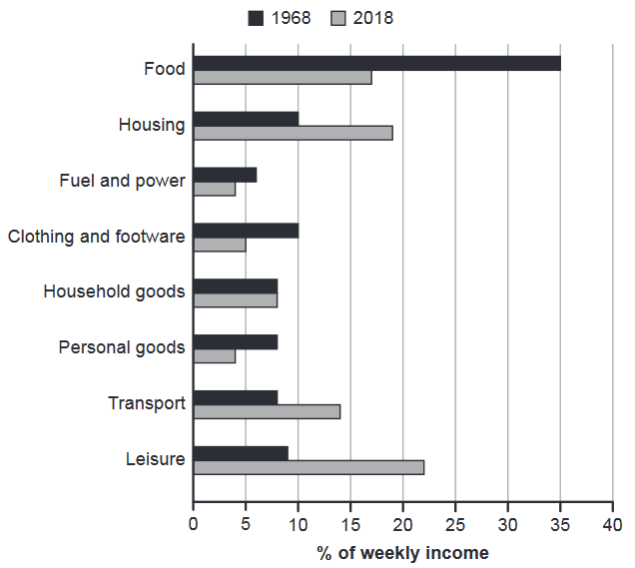
The chart below gives information about how families in one country spent their weekly income in 1968 and in 2018.
Summarise the information by selecting and reporting the main features, and make comparisons where relevant.
1968 and 2018: average weekly spending by families
Student answer (Band 5.0)
The bar chat illustrates different categories of expenses of households used to spend their proprtion of weekly income in 1968 and 2018.
Overall, families used to spend the most on buying food and housing in earlier days while after over two decades, they spent more in leisure rather than the fundamental things for living. However, Expenses regarding household goods are almost similar in both eras.
Families in 1968, spent over one thrid of their weeekly income to provide food for them. Their second priority was providing housing and clothings and footwares for the family members which
AI examiner evaluation
| Criterion | Band |
|---|---|
| Task Achievement / Task Response | 4.5 |
| Coherence and Cohesion | 5.0 |
| Lexical Resource | 5.5 |
| Grammatical Range and Accuracy | 5.0 |
| Overall | 5.0 |
Task Achievement / Task Response: Band 4.5
You identify the chart’s subject and give a relevant overview, noting that food and housing were major expenses and that leisure became more important, while household-goods spending stayed similar. However, the response is incomplete: it stops mid-sentence after “which,” and reports only one approximate figure—food at over one third in 1968. It does not describe the 2018 figures or make the key comparisons across the other categories, so the task is addressed only partially. The response also contains 96 words, below the required 150. To improve, complete the report and select several major changes, such as food falling from about 35% to 17%, leisure rising from 9% to 22%, and housing and transport increasing by 2018.
Coherence and Cohesion: Band 5.0
The response has a recognisable structure: an introduction, an overview, and the beginning of a detail paragraph. The overview also groups the information into broad comparisons, which helps the reader understand the intended focus. However, the report does not progress to a complete account, and the final sentence is left unfinished at “which,” disrupting the flow. Connections between the overview and supporting details are limited because very few figures or category comparisons follow. The linking word “However” introduces a contrast, but the relationship could be expressed more precisely. Use separate, complete paragraphs for the overview and the main data comparisons, and organise the details by categories that rose, fell, or remained stable.
Lexical Resource: Band 5.5
You use some relevant vocabulary for describing a chart, including “categories of expenses,” “weekly income,” “priority,” and “similar.” These choices make the general topic understandable. However, several spelling and word-choice problems reduce precision: “bar chat” should be “bar chart,” “proprtion” should be “proportion,” and “one thrid” should be “one third.” Phrases such as “used to spend their proportion” and “after over two decades” are awkward or unclear, while “fundamental things for living” is less precise than naming the spending categories. Aim for accurate chart language and concise collocations, such as “accounted for,” “share of weekly income,” and “expenditure on essentials.”
Grammatical Range and Accuracy: Band 5.0
The response attempts both simple and more extended sentence forms, including a contrast in the overview: “while … they spent more in leisure.” The main ideas can generally be followed, but grammatical control is uneven. In the opening, “categories of expenses of households used to spend” has an unclear subject and faulty sentence construction. “Families in 1968, spent” includes an unnecessary comma, and “to provide food for them” is an awkwardly formed purpose phrase. The final detail sentence is incomplete, so its grammatical relationship cannot be understood. Practise building clear subject–verb sentences, checking tense and prepositions, and finishing each sentence before adding further clauses.
See this exact question answered at other band scores. The same prompt compared across bands.
Browse more IELTS Writing model answers or get your own writing scored by the same AI examiner.